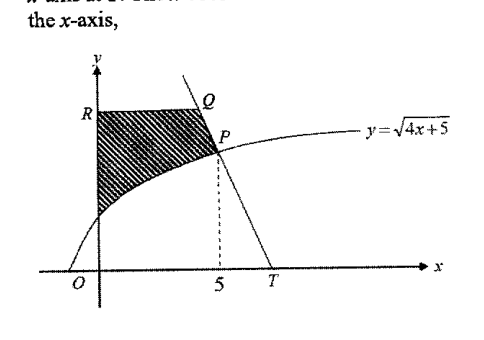
图中显示了曲线 y=4x+5y = \sqrt{4x + 5} 的一部分。曲线在 PP 点处的法线与 xx 轴交于 TT。PP 的 xx 坐标为 5。已知 PTPT 是 PQPQ 的两倍,且 RQRQ 平行于 xx 轴,

  1. (i)

    求 PP 点处的法线方程,

  2. (ii)

    解释为什么该曲线没有驻点,

  3. (iii)

    求 QQ 的坐标,

  4. (iv)

    求阴影区域的面积。

  5. (9)
    1. (b)

      证明 1+cos⁡x1−cos⁡x=(csc⁡x+cot⁡x)2\frac{1 + \cos x}{1 - \cos x} = (\csc x + \cot x)^2。

    2. (c)

      在不使用计算器的情况下,求满足 cos⁡2x=sin⁡230∘\cos 2x = \sin 230^\circ 的 xx,其中 0∘<x<180∘0^\circ < x < 180^\circ。

先不看答案,让 AI 诊断你卡在哪里?

它不会直接告诉你答案,而是问你卡在哪一步看看 AI 是怎么陪你一步步弄懂这道题的

完整解法

8(i)

1. Find the $y$-coordinate of $P$.

When x=5x = 5,
y=4(5)+5=25=5y = \sqrt{4(5) + 5} = \sqrt{25} = 5
So, PP is (5,5)(5, 5).

2. Find the gradient of the tangent at $P$.

y=(4x+5)12y = (4x + 5)^{\frac{1}{2}}
dydx=12(4x+5)−12⋅4=24x+5\frac{dy}{dx} = \frac{1}{2}(4x + 5)^{-\frac{1}{2}} \cdot 4 = \frac{2}{\sqrt{4x + 5}}
At x=5x = 5, gradient of tangent mt=24(5)+5=25m_t = \frac{2}{\sqrt{4(5) + 5}} = \frac{2}{5}.

3. Find the equation of the normal at $P$.

Gradient of normal mn=−1mt=−52m_n = -\frac{1}{m_t} = -\frac{5}{2}.
Equation of the normal:
y−5=−52(x−5)y - 5 = -\frac{5}{2}(x - 5)
y=−52x+252+5y = -\frac{5}{2}x + \frac{25}{2} + 5
y=−52x+352y = -\frac{5}{2}x + \frac{35}{2}

答案

y=−52x+352y = -\frac{5}{2}x + \frac{35}{2}

8(ii)

1. Find the derivative of the curve equation

y=(4x+5)12y = (4x + 5)^{\frac{1}{2}}
dydx=12(4x+5)−12(4)\frac{dy}{dx} = \frac{1}{2}(4x + 5)^{-\frac{1}{2}}(4)
dydx=24x+5\frac{dy}{dx} = \frac{2}{\sqrt{4x + 5}}

2. Explain why the derivative cannot be zero

For a stationary point, dydx=0\frac{dy}{dx} = 0.
However, the numerator of 24x+5\frac{2}{\sqrt{4x + 5}} is a non-zero constant (2), so dydx≠0\frac{dy}{dx} \neq 0 for any real value of xx.
Therefore, the curve has no stationary points.

答案

Since dydx=24x+5≠0\frac{dy}{dx} = \frac{2}{\sqrt{4x + 5}} \neq 0 for all valid xx, the curve has no stationary points.

8(iv)

1. Find the coordinates of $P$, $T$, and $Q$ from earlier parts to establish the boundaries

From the curve equation y=4x+5y = \sqrt{4x + 5}, at x=5x = 5, y=25=5y = \sqrt{25} = 5. So PP is (5,5)(5, 5).
dydx=12(4x+5)−1/2(4)=24x+5\frac{dy}{dx} = \frac{1}{2}(4x+5)^{-1/2}(4) = \frac{2}{\sqrt{4x+5}}.
At x=5x = 5, gradient of tangent =25= \frac{2}{5}, so gradient of normal =−52= -\frac{5}{2}.
Equation of normal: y−5=−52(x−5)  ⟹  y=−2.5x+17.5y - 5 = -\frac{5}{2}(x - 5) \implies y = -2.5x + 17.5.
At TT, y=0  ⟹  2.5x=17.5  ⟹  x=7y = 0 \implies 2.5x = 17.5 \implies x = 7. So T(7,0)T(7, 0).
Since PT=2PQPT = 2PQ and QQ is above PP, the horizontal distance from QQ to PP is half of that from PP to TT.
xP−xQ=12(xT−xP)  ⟹  5−xQ=12(7−5)=1  ⟹  xQ=4x_P - x_Q = \frac{1}{2}(x_T - x_P) \implies 5 - x_Q = \frac{1}{2}(7 - 5) = 1 \implies x_Q = 4.
yQ=−2.5(4)+17.5=7.5y_Q = -2.5(4) + 17.5 = 7.5. So Q(4,7.5)Q(4, 7.5).

2. Calculate the total area under the upper boundaries ($RQ$ and $QP$)

The upper boundary consists of the horizontal line RQRQ from x=0x=0 to x=4x=4, and the line segment QPQP from x=4x=4 to x=5x=5.
Area under RQRQ (rectangle) =4×7.5=30= 4 \times 7.5 = 30.
Area under QPQP (trapezium) =12(7.5+5)×(5−4)=6.25= \frac{1}{2}(7.5 + 5) \times (5 - 4) = 6.25.
Total area under upper boundary =30+6.25=36.25=1454= 30 + 6.25 = 36.25 = \frac{145}{4}.

3. Calculate the area under the curve and subtract it from the upper area to find the shaded region

Area under the curve from x=0x=0 to x=5x=5:
∫05(4x+5)12 dx=[(4x+5)3232×4]05\int_0^5 (4x + 5)^{\frac{1}{2}} \, dx = \left[ \frac{(4x+5)^{\frac{3}{2}}}{\frac{3}{2} \times 4} \right]_0^5
=[16(4x+5)32]05= \left[ \frac{1}{6}(4x+5)^{\frac{3}{2}} \right]_0^5
=16(2532−532)= \frac{1}{6}(25^{\frac{3}{2}} - 5^{\frac{3}{2}})
=16(125−55)=1256−556= \frac{1}{6}(125 - 5\sqrt{5}) = \frac{125}{6} - \frac{5\sqrt{5}}{6}

Shaded Area =Area under lines−Area under curve= \text{Area under lines} - \text{Area under curve}
=1454−(1256−556)= \frac{145}{4} - \left( \frac{125}{6} - \frac{5\sqrt{5}}{6} \right)
=43512−25012+556= \frac{435}{12} - \frac{250}{12} + \frac{5\sqrt{5}}{6}
=18512+556≈17.3 units2= \frac{185}{12} + \frac{5\sqrt{5}}{6} \approx 17.3 \text{ units}^2

答案

18512+556\frac{185}{12} + \frac{5\sqrt{5}}{6} or 17.317.3 units2^2

8(9)(b)

1. Express the terms on the right-hand side using sine and cosine.

RHS=(csc⁡x+cot⁡x)2\text{RHS} = (\csc x + \cot x)^2
=(1sin⁡x+cos⁡xsin⁡x)2= \left(\frac{1}{\sin x} + \frac{\cos x}{\sin x}\right)^2

2. Combine the terms into a single fraction and expand the square.

=(1+cos⁡xsin⁡x)2= \left(\frac{1 + \cos x}{\sin x}\right)^2
=(1+cos⁡x)2sin⁡2x= \frac{(1 + \cos x)^2}{\sin^2 x}

3. Use the Pythagorean identity to express the denominator in terms of cosine.

=(1+cos⁡x)21−cos⁡2x= \frac{(1 + \cos x)^2}{1 - \cos^2 x}

4. Factorise the denominator as a difference of squares and simplify to obtain the left-hand side.

=(1+cos⁡x)2(1−cos⁡x)(1+cos⁡x)= \frac{(1 + \cos x)^2}{(1 - \cos x)(1 + \cos x)}
=1+cos⁡x1−cos⁡x= \frac{1 + \cos x}{1 - \cos x}
=LHS (shown)= \text{LHS (shown)}

答案

Proof completed.

8(9)(c)

1. Express $\sin 230^\circ$ in terms of cosine using complementary angles or reference angles

sin⁡230∘=sin⁡(180∘+50∘)=−sin⁡50∘\sin 230^\circ = \sin(180^\circ + 50^\circ) = -\sin 50^\circ
Since sin⁡θ=cos⁡(90∘−θ)\sin \theta = \cos(90^\circ - \theta), we have sin⁡50∘=cos⁡40∘\sin 50^\circ = \cos 40^\circ.
Therefore, sin⁡230∘=−cos⁡40∘\sin 230^\circ = -\cos 40^\circ.

2. Set up the equation for $\cos 2x$ and find the basic angle

cos⁡2x=−cos⁡40∘\cos 2x = -\cos 40^\circ
The basic angle for 2x2x is 40∘40^\circ. Since cos⁡2x\cos 2x is negative, 2x2x must lie in the second or third quadrant.

3. Solve for $x$ within the given domain

Given 0∘<x<180∘0^\circ < x < 180^\circ, the domain for 2x2x is 0∘<2x<360∘0^\circ < 2x < 360^\circ.
2x=180∘−40∘=140∘2x = 180^\circ - 40^\circ = 140^\circ or 2x=180∘+40∘=220∘2x = 180^\circ + 40^\circ = 220^\circ
x=70∘ or 110∘x = 70^\circ \text{ or } 110^\circ

答案

x=70∘ or 110∘x = 70^\circ \text{ or } 110^\circ

AI 分析,可能出错

用 AI 批改,圈出写错的那一步,并自动将你的薄弱点存入错题本,形成你的错因库。

同一知识点的其他题

  1. 1如图所示,一个建在矩形底面上的温室。建造拱形屋顶和两个完全相同的半圆形侧面共使用了 140 m2140\text{ m}^2 的聚乙烯薄膜。每个半圆的半径为 r mr\text{ m},温室的长度为 y my\text{ m}。 证明温室的体积 V m3V\text{ m}^3…
  2. 2在三角形 ABCABC 中,AB=x cmAB = x\ \text{cm},AC=3x cmAC = 3x\ \text{cm},且角 BAC=2π3BAC = \dfrac{2\pi}{3}。如果 xx 以 0.5 cm/s0.5\ \text{cm/s} 的速率增加,求当 x=4x = 4…
  3. 3已知一条曲线的方程为 y=2x−33x+4y = \frac{2x - 3}{3x + 4},其中 x≠−43x \ne -\frac{4}{3}。 曲线在点 PP(其中 x>0x > 0)处的法线平行于直线 y=−2517x+2y = -\frac{25}{17}x + 2。…
  4. 4求曲线 y=2x2−ln⁡x+cy = 2x^2 - \ln x + c 的导函数。 曲线在点 TT 处与正 xx 轴相切。求 TT 的坐标。 证明 c=−ln⁡2ec = -\ln 2\sqrt{e}。 求在点 TT 处 d2ydx2\frac{\text{d}^2y}{\text{d}x^2}…
  5. 5曲线 y=2tan⁡3x−1y = 2\tan 3x - 1 在点 P(π3,−1)P\left(\frac{\pi}{3}, -1\right) 处的法线交 yy 轴于点 AA,交 xx 轴于点 BB。求三角形 AOBAOB 的精确面积。