The diagram shows part of the curve . The normal of the curve at meets the -axis at . The -coordinate of is 5. Given that is twice of and is parallel to the -axis,
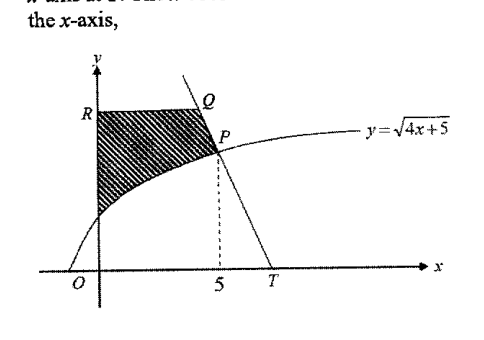
- (i)
find the equation of the normal at ,
- (ii)
explain why the curve has no stationary points,
- (iii)
find the coordinates of ,
- (iv)
find the area of the shaded region.
- (9)
- (b)
Prove that .
- (c)
Without the use of a calculator, find such that where .
- (b)
It won't just hand you the answer — it asks where you're stuck.How the checker works
Worked solution
8(i)
1. Find the $y$-coordinate of $P$.
When ,
So, is .
2. Find the gradient of the tangent at $P$.
At , gradient of tangent .
3. Find the equation of the normal at $P$.
Gradient of normal .
Equation of the normal:
8(ii)
1. Find the derivative of the curve equation
2. Explain why the derivative cannot be zero
For a stationary point, .
However, the numerator of is a non-zero constant (2), so for any real value of .
Therefore, the curve has no stationary points.
Since for all valid , the curve has no stationary points.
8(iv)
1. Find the coordinates of $P$, $T$, and $Q$ from earlier parts to establish the boundaries
From the curve equation , at , . So is .
.
At , gradient of tangent , so gradient of normal .
Equation of normal: .
At , . So .
Since and is above , the horizontal distance from to is half of that from to .
.
. So .
2. Calculate the total area under the upper boundaries ($RQ$ and $QP$)
The upper boundary consists of the horizontal line from to , and the line segment from to .
Area under (rectangle) .
Area under (trapezium) .
Total area under upper boundary .
3. Calculate the area under the curve and subtract it from the upper area to find the shaded region
Area under the curve from to :
Shaded Area
or units
8(9)(b)
1. Express the terms on the right-hand side using sine and cosine.
2. Combine the terms into a single fraction and expand the square.
3. Use the Pythagorean identity to express the denominator in terms of cosine.
4. Factorise the denominator as a difference of squares and simplify to obtain the left-hand side.
Proof completed.
8(9)(c)
1. Express $\sin 230^\circ$ in terms of cosine using complementary angles or reference angles
Since , we have .
Therefore, .
2. Set up the equation for $\cos 2x$ and find the basic angle
The basic angle for is . Since is negative, must lie in the second or third quadrant.
3. Solve for $x$ within the given domain
Given , the domain for is .
or
AI analysis — may contain mistakes.
Worked this one out on paper? Snap your steps and Gigle's AI math checker will circle the step where it went wrong.
More questions on this topic
- 1The diagram shows a greenhouse built on a rectangular base. of polyethene is used to build the curved r…
- 2In the triangle , , and angle . If is increasing…
- 3A curve has the equation , where . The normal to the point on the cur…
- 4Find the gradient function of the curve . The curve touches the positive -axis at point . Fi…
- 5The normal to the curve at point crosses the -axis at point …