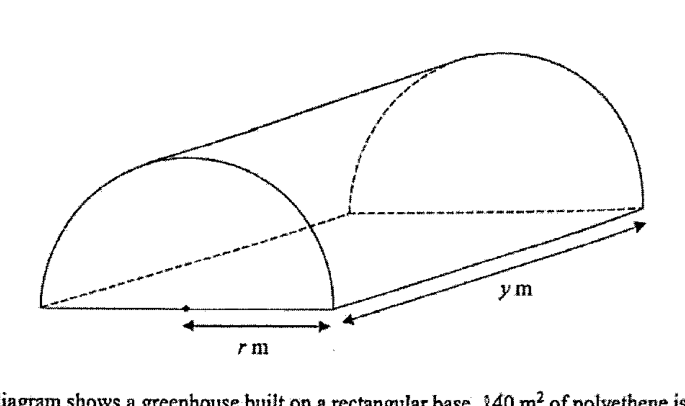
The diagram shows a greenhouse built on a rectangular base. of polyethene is used to build the curved roof and the two identical semicircular sides. The radius of each semicircle is and the length of the greenhouse is .
- (i)
Show that the volume, , of the greenhouse is given by .
- (ii)
Given that can vary, find the value of for which has a stationary value.
- (iii)
Explain why this value of gives the largest possible volume of the greenhouse.
It won't just hand you the answer — it asks where you're stuck.How the checker works
Worked solution
11(i)
1. Formulate an equation for the total area of polyethene used.
Area of two semicircular sides =
Area of curved roof =
Total area =
2. Express the length $y$ in terms of $r$.
3. Formulate the expression for the volume of the greenhouse.
Volume = Cross-sectional area length
4. Substitute $y$ into the volume expression and simplify to obtain the given result.
(shown)
(shown)
11(ii)
1. Differentiate the volume function with respect to $r$
Given
2. Set the derivative to zero to find the stationary value
For a stationary value,
3. Solve for $r$
(since )
(to 3 s.f.)
11(iii)
1. Find the second derivative of V with respect to r
2. Evaluate the sign of the second derivative to justify the maximum
Since (as it is a physical length), .
Therefore, the stationary value is a maximum, giving the largest possible volume.
Since for , the volume is a maximum.
AI analysis — may contain mistakes.
Worked this one out on paper? Snap your steps and Gigle's AI math checker will circle the step where it went wrong.
More questions on this topic
- 1In the triangle , , and angle . If is increasing…
- 2A curve has the equation , where . The normal to the point on the cur…
- 3Find the gradient function of the curve . The curve touches the positive -axis at point . Fi…
- 4The normal to the curve at point crosses the -axis at point …
- 5The point lies on the curve for . The normal to the curve at is par…