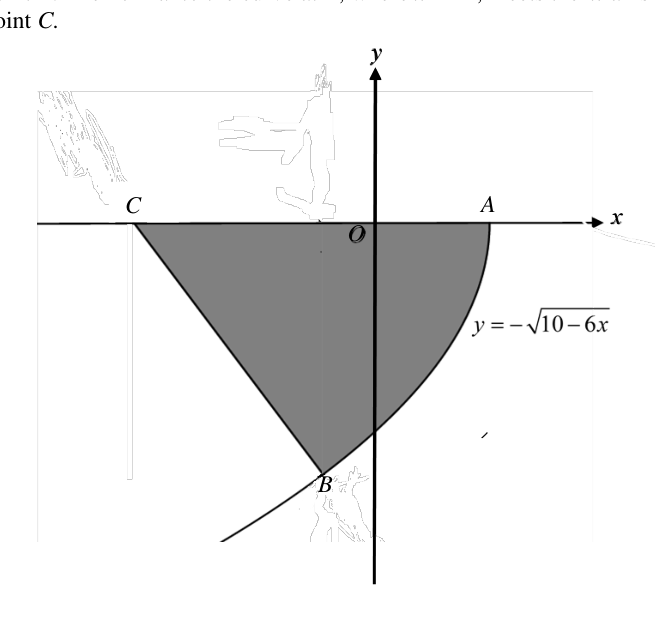
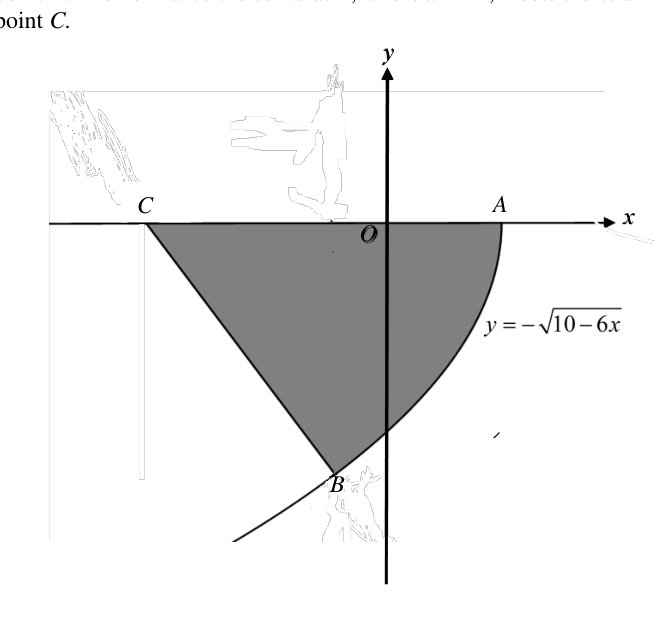
Using y−y1=m(x−x1) with (−1,−4) and m=−34: y−(−4)=−34(x−(−1)) y+4=−34(x+1) y=−34x−34−4 y=−34x−316
答案
y=−34x−316
9(b)
1. Find the equation of the normal at B and the coordinates of C
From part (a), y=−(10−6x)1/2. dxdy=−21(10−6x)−1/2(−6)=10−6x3.
At x=−1, dxdy=163=43.
Gradient of normal =−34.
Equation of normal at B(−1,−4): y−(−4)=−34(x−(−1))⇒y=−34x−316.
At C, y=0⇒−34x−316=0⇒x=−4.
So C is (−4,0).
2. Find the area of the triangle bounded by the normal, x-axis, and the vertical line $x=-1$
The region from x=−4 to x=−1 is a triangle with vertices (−4,0), (−1,0), and (−1,−4).
Base =−1−(−4)=3.
Height =4.
Area of triangle =21×3×4=6.
3. Set up the definite integral for the area under the curve from $x=-1$ to $x=5/3$
The curve meets the x-axis at A where 10−6x=0⇒x=35.
The area between the curve and the x-axis from x=−1 to x=35 is: ∫−15/3∣−10−6x∣dx=∫−15/3(10−6x)1/2dx