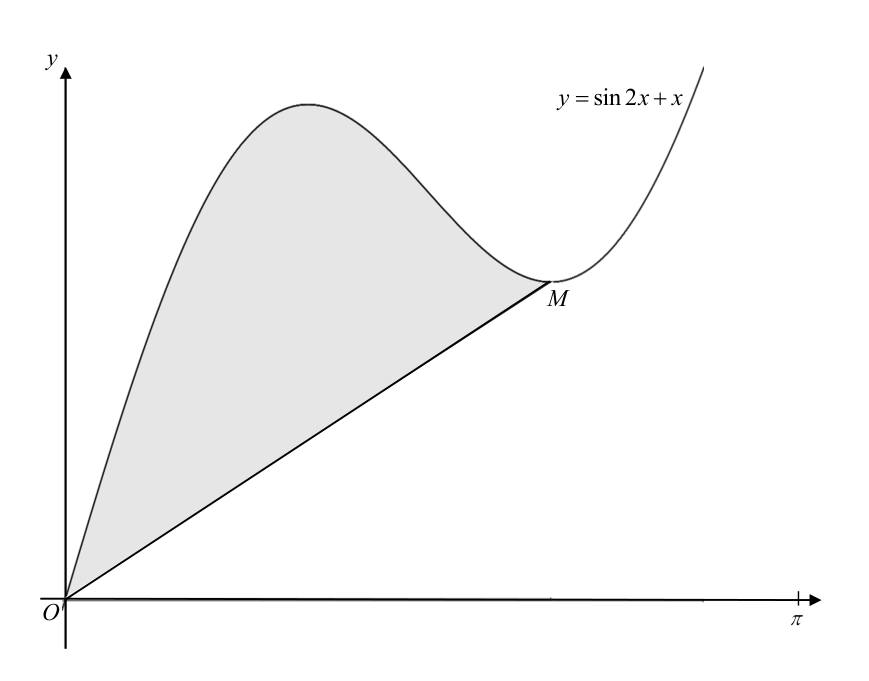
1. Find the derivative of the curve to locate stationary points.
y=sin2x+x dxdy=2cos2x+1
2. Set the derivative to zero and solve for $x$ to find the minimum point $M$.
For stationary points, dxdy=0: 2cos2x+1=0 cos2x=−21
Since 0≤x≤π, 0≤2x≤2π. 2x=32π or 2x=34π x=3π or x=32π
Using the second derivative test: dx2d2y=−4sin2x
At x=3π, dx2d2y=−4sin(32π)<0 (Maximum)
At x=32π, dx2d2y=−4sin(34π)>0 (Minimum)
So, the x-coordinate of M is 32π.
3. Find the $y$-coordinate of $M$.
Substitute x=32π into the equation of the curve: y=sin(2(32π))+32π y=sin(34π)+32π y=−23+32π
4. Calculate the area under the curve from $x = 0$ to $x = \frac{2\pi}{3}$.
Area under curve =∫032π(sin2x+x)dx =[−21cos2x+2x2]032π =(−21cos(34π)+21(32π)2)−(−21cos(0)+0) =(−21(−21)+184π2)−(−21(1)) =41+92π2+21 =43+92π2
5. Calculate the area of the triangle under the line $OM$.
The region under the line OM from x=0 to x=32π is a right-angled triangle with base 32π and height (−23+32π).
Area of triangle =21×base×height =21(32π)(−23+32π) =3π(−23+32π) =−63π+92π2
6. Subtract the area of the triangle from the area under the curve to find the shaded area.
Shaded Area =Area under curve−Area of triangle =(43+92π2)−(−63π+92π2) =43+92π2+63π−92π2 =63π+43 (Shown)