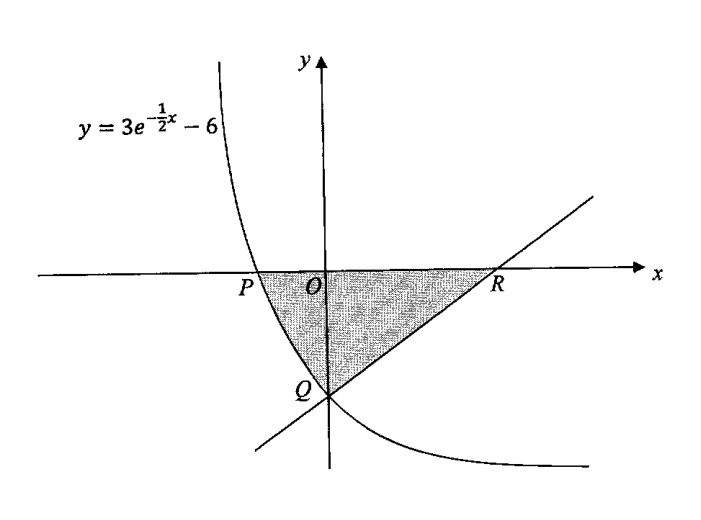
1. Find the coordinates of P (x-intercept of the curve)
At P, y=0:
3e−21x−6=0
e−21x=2
−21x=ln2
x=−2ln2
So P is (−2ln2,0).
2. Find the coordinates of Q (y-intercept of the curve)
At Q, x=0:
y=3e0−6=3−6=−3
So Q is (0,−3).
3. Find the gradient of the curve at Q and the equation of the normal
dxdy=3(−21)e−21x=−23e−21x
At x=0, dxdy=−23.
Gradient of normal at Q is 32.
Equation of normal: y−(−3)=32(x−0)⟹y=32x−3.
4. Find the coordinates of R (x-intercept of the normal)
At R, y=0:
32x−3=0⟹x=29.
So R is (29,0).
5. Calculate the area bounded by the curve, x-axis and y-axis (from P to O)
Area 1 = ∫−2ln20(0−y)dx=−∫−2ln20(3e−21x−6)dx
=−[−1/23e−21x−6x]−2ln20
=−[−6e−21x−6x]−2ln20
=−((−6−0)−(−6eln2−6(−2ln2)))
=−(−6−(−12+12ln2))
=−(6−12ln2)=12ln2−6
6. Calculate the area of the triangle OQR and the total shaded area
Area of triangle OQR=21×OR×OQ=21×29×3=427.
Total shaded area = Area 1 + Area of triangle OQR
=(12ln2−6)+427
=12ln2+43
答案6ln2−43