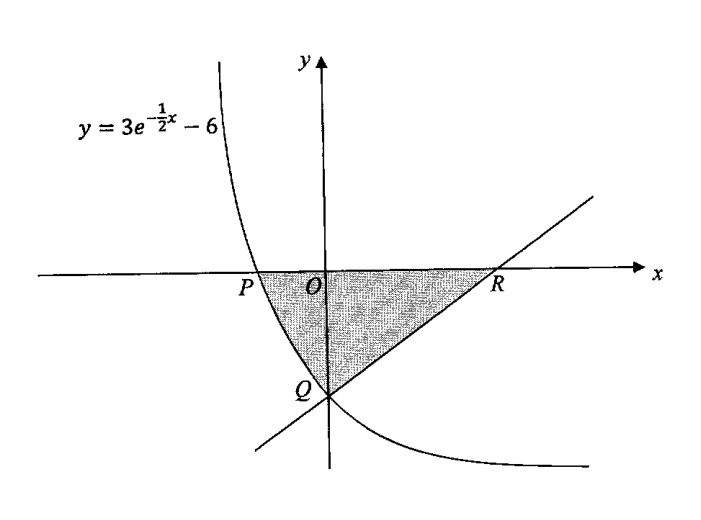
The diagram shows part of the curve y=3e−12x−6y = 3e^{-\frac{1}{2}x} - 6 which crosses the xx-axis at PP and the yy-axis at QQ. The normal to the curve at QQ meets the xx-axis at RR. Find

  1. (a)

    the equation of the normal,

  2. (b)

    the area of the shaded region.

Work through it with AI →

It won't just hand you the answer — it asks where you're stuck.How the checker works

Worked solution

10(a)

1. Find the coordinates of $Q$ (y-intercept)

At QQ, x=0x = 0.
y=3e−12(0)−6=3(1)−6=−3y = 3e^{-\frac{1}{2}(0)} - 6 = 3(1) - 6 = -3.
So QQ is (0,−3)(0, -3).

2. Differentiate the equation of the curve to find the gradient function

dydx=3(−12)e−12x=−32e−12x\frac{dy}{dx} = 3 \left(-\frac{1}{2}\right) e^{-\frac{1}{2}x} = -\frac{3}{2}e^{-\frac{1}{2}x}

3. Find the gradient of the tangent and normal at $Q$

At QQ (x=0x = 0),
Gradient of tangent, mt=−32e0=−32m_t = -\frac{3}{2}e^0 = -\frac{3}{2}.
Gradient of normal, mn=−1mt=23m_n = -\frac{1}{m_t} = \frac{2}{3}.

4. Find the equation of the normal

Equation of normal at (0,−3)(0, -3) with gradient 23\frac{2}{3}:
y−(−3)=23(x−0)y - (-3) = \frac{2}{3}(x - 0)
y=23x−3y = \frac{2}{3}x - 3

Answer

y=2x−3y = 2x - 3

10(b)

1. Find the coordinates of P (x-intercept of the curve)

At PP, y=0y = 0:
3e−12x−6=03e^{-\frac{1}{2}x} - 6 = 0
e−12x=2e^{-\frac{1}{2}x} = 2
−12x=ln⁡2-\frac{1}{2}x = \ln 2
x=−2ln⁡2x = -2\ln 2
So PP is (−2ln⁡2,0)(-2\ln 2, 0).

2. Find the coordinates of Q (y-intercept of the curve)

At QQ, x=0x = 0:
y=3e0−6=3−6=−3y = 3e^{0} - 6 = 3 - 6 = -3
So QQ is (0,−3)(0, -3).

3. Find the gradient of the curve at Q and the equation of the normal

dydx=3(−12)e−12x=−32e−12x\frac{dy}{dx} = 3(-\frac{1}{2})e^{-\frac{1}{2}x} = -\frac{3}{2}e^{-\frac{1}{2}x}
At x=0x = 0, dydx=−32\frac{dy}{dx} = -\frac{3}{2}.
Gradient of normal at QQ is 23\frac{2}{3}.
Equation of normal: y−(−3)=23(x−0)  ⟹  y=23x−3y - (-3) = \frac{2}{3}(x - 0) \implies y = \frac{2}{3}x - 3.

4. Find the coordinates of R (x-intercept of the normal)

At RR, y=0y = 0:
23x−3=0  ⟹  x=92\frac{2}{3}x - 3 = 0 \implies x = \frac{9}{2}.
So RR is (92,0)(\frac{9}{2}, 0).

5. Calculate the area bounded by the curve, x-axis and y-axis (from P to O)

Area 1 = ∫−2ln⁡20(0−y) dx=−∫−2ln⁡20(3e−12x−6) dx\int_{-2\ln 2}^{0} (0 - y) \, dx = -\int_{-2\ln 2}^{0} (3e^{-\frac{1}{2}x} - 6) \, dx
=−[3e−12x−1/2−6x]−2ln⁡20= -\left[ \frac{3e^{-\frac{1}{2}x}}{-1/2} - 6x \right]_{-2\ln 2}^{0}
=−[−6e−12x−6x]−2ln⁡20= -\left[ -6e^{-\frac{1}{2}x} - 6x \right]_{-2\ln 2}^{0}
=−((−6−0)−(−6eln⁡2−6(−2ln⁡2)))= -\left( (-6 - 0) - (-6e^{\ln 2} - 6(-2\ln 2)) \right)
=−(−6−(−12+12ln⁡2))= -\left( -6 - (-12 + 12\ln 2) \right)
=−(6−12ln⁡2)=12ln⁡2−6= - (6 - 12\ln 2) = 12\ln 2 - 6

6. Calculate the area of the triangle OQR and the total shaded area

Area of triangle OQR=12×OR×OQ=12×92×3=274OQR = \frac{1}{2} \times OR \times OQ = \frac{1}{2} \times \frac{9}{2} \times 3 = \frac{27}{4}.
Total shaded area = Area 1 + Area of triangle OQROQR
=(12ln⁡2−6)+274= (12\ln 2 - 6) + \frac{27}{4}
=12ln⁡2+34= 12\ln 2 + \frac{3}{4}

Answer

6ln⁡2−346\ln 2 - \frac{3}{4}

AI analysis — may contain mistakes.

Worked this one out on paper? Snap your steps and Gigle's AI math checker will circle the step where it went wrong.

More questions on this topic

  1. 1The diagram shows a greenhouse built on a rectangular base. 140 m2140\text{ m}^2 of polyethene is used to build the curved r…
  2. 2In the triangle ABCABC, AB=x cmAB = x\ \text{cm}, AC=3x cmAC = 3x\ \text{cm} and angle BAC=2π3BAC = \dfrac{2\pi}{3}. If xx is increasing…
  3. 3A curve has the equation y=2x−33x+4y = \frac{2x - 3}{3x + 4}, where x≠−43x \ne -\frac{4}{3}. The normal to the point PP on the cur…
  4. 4Find the gradient function of the curve y=2x2−ln⁡x+cy = 2x^2 - \ln x + c. The curve touches the positive xx-axis at point TT. Fi…
  5. 5The normal to the curve y=2tan⁡3x−1y = 2\tan 3x - 1 at point P(π3,−1)P\left(\frac{\pi}{3}, -1\right) crosses the yy-axis at point AA…