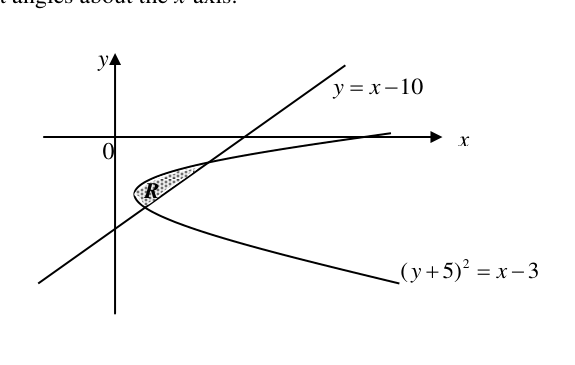
下图显示了一个由曲线 (y+5)2=x−3(y+5)^{2}=x-3 和直线 y=x−10y=x-10 所围成的区域 RR。求 RR 绕 x 轴旋转一周所形成的旋转体的体积。

  1. ((a))

    下图显示了由曲线 (y+5)2=x−3(y+5)^{2}=x-3 和直线 y=x−10y=x-10 所围成的区域 RR。求当 RR 绕 x 轴旋转一周时所形成的旋转体的体积。

  2. ((b))
    1. ((i))

      证明 ∫e−2xcos⁡x dx=−25e−2xcos⁡x+15e−2xsin⁡x+C ,\int e^{-2x}\cos x\,\mathrm{d}x = -\dfrac{2}{5}e^{-2x}\cos x + \dfrac{1}{5}e^{-2x}\sin x + C\,, 其中 CC 是任意常数。

    2. ((ii))

      曲线 Γ\Gamma 由参数方程定义:

      x=sin⁡t,y=e−2t,where −π2≤t≤π2.x=\sin t,\quad y=e^{-2t},\quad\text{where } -\dfrac{\pi}{2}\le t\le \dfrac{\pi}{2}.

      求由曲线 Γ\Gamma、曲线 Γ\Gamma 在 y 轴处的切线以及直线 x=1x=1 所围成区域的面积的准确值。

先不看答案,让 AI 诊断你卡在哪里?

它不会直接告诉你答案,而是问你卡在哪一步看看 AI 是怎么陪你一步步弄懂这道题的

完整解法

8((a))

1. Find the points of intersection between the curve and the line.

Substitute the line equation y=x−10  ⟹  x=y+10y = x - 10 \implies x = y + 10 into the curve's equation:
(y+5)2=(y+10)−3(y+5)^2 = (y+10) - 3
y2+10y+25=y+7y^2 + 10y + 25 = y + 7
y2+9y+18=0y^2 + 9y + 18 = 0
(y+3)(y+6)=0(y+3)(y+6) = 0
y=−3ory=−6y = -3 \quad \text{or} \quad y = -6
When y=−3y = -3, x=7x = 7. When y=−6y = -6, x=4x = 4.
Thus, the intersections are (4,−6)(4, -6) and (7,−3)(7, -3).

2. Express the curve with $y$ as the subject and identify the upper and lower branches to determine the boundaries of the region.

Making yy the subject of the curve's equation:
(y+5)2=x−3  ⟹  y=−5±x−3(y+5)^2 = x - 3 \implies y = -5 \pm \sqrt{x-3}
The parabola opens to the right with its vertex at (3,−5)(3, -5).

The inner boundary of the region RR (closer to the xx-axis, hence smaller radius of revolution) is the upper branch:
y1=−5+x−3for x∈[3,7]y_{1} = -5 + \sqrt{x-3} \quad \text{for } x \in [3, 7]

The outer boundary (further from the xx-axis, hence larger radius) is split into two sections:

  1. The lower branch of the curve: y2=−5−x−3y_{2} = -5 - \sqrt{x-3} for x∈[3,4]x \in [3, 4]
  2. The line: y3=x−10y_{3} = x - 10 for x∈[4,7]x \in [4, 7]

3. Set up the definite integrals for the volume of the solid generated when the region $R$ is rotated $360^\circ$ about the $x$-axis.

The volume VV is found using the washer/disc method, requiring us to split the region at x=4x=4 based on the outer boundaries:
V=π∫34(y22−y12)dx+π∫47(y32−y12)dxV = \pi \int_{3}^{4} \left( y_{2}^2 - y_{1}^2 \right) \mathrm{d}x + \pi \int_{4}^{7} \left( y_{3}^2 - y_{1}^2 \right) \mathrm{d}x

Substituting the functions:
V1=π∫34[(−5−x−3)2−(−5+x−3)2]dxV_1 = \pi \int_{3}^{4} \left[ (-5 - \sqrt{x-3})^2 - (-5 + \sqrt{x-3})^2 \right] \mathrm{d}x
V2=π∫47[(x−10)2−(−5+x−3)2]dxV_2 = \pi \int_{4}^{7} \left[ (x-10)^2 - (-5 + \sqrt{x-3})^2 \right] \mathrm{d}x

4. Evaluate the integrals (analytically or via a graphing calculator) to find the exact volume.

Simplifying the integrands:
V1=π∫3420x−3 dxV_1 = \pi \int_{3}^{4} 20\sqrt{x-3} \, \mathrm{d}x
V2=π∫47(x2−21x+78+10x−3)dxV_2 = \pi \int_{4}^{7} \left( x^2 - 21x + 78 + 10\sqrt{x-3} \right) \mathrm{d}x

Evaluating the definite integrals:
V1=π[403(x−3)32]34=403πV_1 = \pi \left[ \frac{40}{3}(x-3)^{\frac{3}{2}} \right]_3^4 = \frac{40}{3}\pi
V2=π[x33−21x22+78x+203(x−3)32]47=1636πV_2 = \pi \left[ \frac{x^3}{3} - \frac{21x^2}{2} + 78x + \frac{20}{3}(x-3)^{\frac{3}{2}} \right]_4^7 = \frac{163}{6}\pi

Total volume:
V=V1+V2=403π+1636π=2436π=81π2V = V_1 + V_2 = \frac{40}{3}\pi + \frac{163}{6}\pi = \frac{243}{6}\pi = \frac{81\pi}{2}

答案

81π2\frac{81\pi}{2}

8((b))((i))

1. Set up the first application of integration by parts.

Let I=∫e−2xcos⁡x dxI = \int e^{-2x}\cos x\,\mathrm{d}x.
Using the integration by parts formula ∫u dv=uv−∫v du\int u\,\mathrm{d}v = uv - \int v\,\mathrm{d}u:
Let u=e−2xu = e^{-2x} and dv=cos⁡x dx\mathrm{d}v = \cos x\,\mathrm{d}x.
Then du=−2e−2x dx\mathrm{d}u = -2e^{-2x}\,\mathrm{d}x and v=sin⁡xv = \sin x.

2. Apply the integration by parts formula to obtain a new integral.

I=e−2xsin⁡x−∫(sin⁡x)(−2e−2x) dxI = e^{-2x}\sin x - \int (\sin x)(-2e^{-2x})\,\mathrm{d}x
I=e−2xsin⁡x+2∫e−2xsin⁡x dxI = e^{-2x}\sin x + 2\int e^{-2x}\sin x\,\mathrm{d}x

3. Apply integration by parts a second time to the new integral.

For ∫e−2xsin⁡x dx\int e^{-2x}\sin x\,\mathrm{d}x, let u=e−2xu = e^{-2x} and dv=sin⁡x dx\mathrm{d}v = \sin x\,\mathrm{d}x.
Then du=−2e−2x dx\mathrm{d}u = -2e^{-2x}\,\mathrm{d}x and v=−cos⁡xv = -\cos x.

∫e−2xsin⁡x dx=−e−2xcos⁡x−∫(−cos⁡x)(−2e−2x) dx\int e^{-2x}\sin x\,\mathrm{d}x = -e^{-2x}\cos x - \int (-\cos x)(-2e^{-2x})\,\mathrm{d}x
∫e−2xsin⁡x dx=−e−2xcos⁡x−2∫e−2xcos⁡x dx\int e^{-2x}\sin x\,\mathrm{d}x = -e^{-2x}\cos x - 2\int e^{-2x}\cos x\,\mathrm{d}x

4. Substitute back to form an equation in terms of $I$ and solve.

Substitute this result back into the earlier equation for II:
I=e−2xsin⁡x+2(−e−2xcos⁡x−2I)I = e^{-2x}\sin x + 2(-e^{-2x}\cos x - 2I)
I=e−2xsin⁡x−2e−2xcos⁡x−4II = e^{-2x}\sin x - 2e^{-2x}\cos x - 4I
5I=−2e−2xcos⁡x+e−2xsin⁡x5I = -2e^{-2x}\cos x + e^{-2x}\sin x
I=−25e−2xcos⁡x+15e−2xsin⁡x+CI = -\dfrac{2}{5}e^{-2x}\cos x + \dfrac{1}{5}e^{-2x}\sin x + C
(where CC is an arbitrary constant of integration.)

答案

∫e−2xcos⁡x dx=−25e−2xcos⁡x+15e−2xsin⁡x+C\int e^{-2x}\cos x\,\mathrm{d}x = -\dfrac{2}{5}e^{-2x}\cos x + \dfrac{1}{5}e^{-2x}\sin x + C

8((b))((ii))

1. Find the value of parameter $t$ and coordinates at the $y$-axis.

At the yy-axis, x=0x = 0.
sin⁡t=0  ⟹  t=0\sin t = 0 \implies t = 0
When t=0t = 0, y=e−2(0)=1y = e^{-2(0)} = 1.
The point of intersection with the yy-axis is (0,1)(0, 1).

2. Find the gradient of the curve at $t=0$.

Using parametric differentiation:
dxdt=cos⁡t\frac{\mathrm{d}x}{\mathrm{d}t} = \cos t
dydt=−2e−2t\frac{\mathrm{d}y}{\mathrm{d}t} = -2e^{-2t}
dydx=dydtdxdt=−2e−2tcos⁡t\frac{\mathrm{d}y}{\mathrm{d}x} = \frac{\frac{\mathrm{d}y}{\mathrm{d}t}}{\frac{\mathrm{d}x}{\mathrm{d}t}} = \frac{-2e^{-2t}}{\cos t}
At t=0t = 0:
dydx=−2e0cos⁡0=−2\frac{\mathrm{d}y}{\mathrm{d}x} = \frac{-2e^0}{\cos 0} = -2

3. Determine the equation of the tangent at the $y$-axis.

Using the point (0,1)(0, 1) and gradient m=−2m = -2:
y−1=−2(x−0)y - 1 = -2(x - 0)
y=−2x+1y = -2x + 1

4. Set up the area integral for the region.

The region is bounded by the curve, the tangent, and the line x=1x = 1. The integration bounds for xx are from 00 to 11.
Area=∫01(ycurve−ytangent) dx\text{Area} = \int_{0}^{1} (y_{\text{curve}} - y_{\text{tangent}}) \,\mathrm{d}x
Area=∫01ycurve dx−∫01(−2x+1) dx\text{Area} = \int_{0}^{1} y_{\text{curve}} \,\mathrm{d}x - \int_{0}^{1} (-2x + 1) \,\mathrm{d}x

5. Evaluate the area using parametric substitution and the result from (b)(i).

For the curve integral, substitute x=sin⁡t  ⟹  dx=cos⁡t dtx = \sin t \implies \mathrm{d}x = \cos t \,\mathrm{d}t. As xx goes from 00 to 11, tt goes from 00 to π2\frac{\pi}{2}.
∫01ycurve dx=∫0π2e−2tcos⁡t dt\int_{0}^{1} y_{\text{curve}} \,\mathrm{d}x = \int_{0}^{\frac{\pi}{2}} e^{-2t} \cos t \,\mathrm{d}t
Using the integration result from (b)(i):
∫0π2e−2tcos⁡t dt=[−25e−2tcos⁡t+15e−2tsin⁡t]0π2\int_{0}^{\frac{\pi}{2}} e^{-2t} \cos t \,\mathrm{d}t = \left[ -\frac{2}{5}e^{-2t}\cos t + \frac{1}{5}e^{-2t}\sin t \right]_0^{\frac{\pi}{2}}
=(0+15e−π)−(−25+0)=15e−π+25= \left( 0 + \frac{1}{5}e^{-\pi} \right) - \left( -\frac{2}{5} + 0 \right) = \frac{1}{5}e^{-\pi} + \frac{2}{5}
Now evaluate the tangent line's definite integral:
∫01(−2x+1) dx=[−x2+x]01=(−1+1)−0=0\int_{0}^{1} (-2x + 1) \,\mathrm{d}x = \left[ -x^2 + x \right]_0^1 = (-1 + 1) - 0 = 0
Therefore, the exact area is:
(15e−π+25)−0=15e−π+25\left( \frac{1}{5}e^{-\pi} + \frac{2}{5} \right) - 0 = \frac{1}{5}e^{-\pi} + \frac{2}{5}

答案

\frac{1}{5}e^{-\pi} + \frac{2}{5}

AI 分析,可能出错

用 AI 批改,圈出写错的那一步,并自动将你的薄弱点存入错题本,形成你的错因库。

同一知识点的其他题

  1. 1曲线 CC 由参数方程定义 x=t−sin⁡tx = t - \sin t,y=sin⁡2ty = \sin^{2} t,  0≤t≤π\;0 \le t \le \pi。 曲线 CC 上的点 AA 对应的参数为 π2\dfrac{\pi}{2},且是一个极大值点。直线…
  2. 2下图显示了 y=f(x)y = f(x) 的图像。该曲线在 (0,a)(0,a) 处有一个极值点,且直线 y=±kxy = \pm kx 是该曲线的渐近线,其中 aa 和 kk 是正实常数。 [续] 现在已知 f(x)=a1+x2\mathrm{f}(x) = a\sqrt{1+x^2}…
  3. 3已知 C=∫0πe−2xcos⁡x  dxC = \int_{0}^{\pi} \mathrm{e}^{-2x} \cos x \; \mathrm{d}x 且 S=∫0πe−2xsin⁡x  dxS = \int_{0}^{\pi} \mathrm{e}^{-2x} \sin x \; \mathrm{d}x…
  4. 4函数 f 定义为 f(x)=ln⁡(5−x),  x<5f(x)=\ln(5-x),\; x<5。 求由曲线 y=f(x)y=f(x) 以及 x 轴和 y 轴所围成的区域绕 y 轴完全旋转一周所得旋转体的体积。答案精确到两位小数。 写出使得 f(∣x∣)=∣f(x)∣f(|x|)=|f(x)| 成立的…
  5. 5通过换元法 u=x+1u = \sqrt{x+1},求 ∫x+1x−1 dx\displaystyle \int \frac{\sqrt{x+1}}{x-1}\,dx。 区域 RR 由曲线 y=x+1x−1y = \dfrac{\sqrt{x+1}}{x-1} 以及直线…