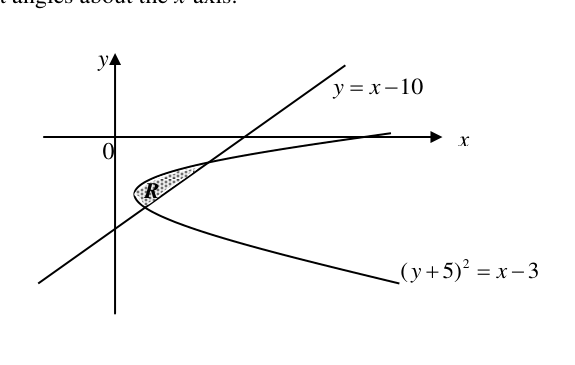
The diagram below shows a region RR bounded by the curve (y+5)2=x−3(y+5)^{2}=x-3 and the line y=x−10y=x-10. Find the volume of solid formed when RR is rotated through four right angles about the x-axis.
  1. ((a))

    The diagram below shows a region RR bounded by the curve (y+5)2=x−3(y+5)^{2}=x-3 and the line y=x−10y=x-10. Find the volume of solid formed when RR is rotated through four right angles about the x-axis.

  2. ((b))
    1. ((i))

      Show that ∫e−2xcos⁡x dx=−25e−2xcos⁡x+15e−2xsin⁡x+C ,\int e^{-2x}\cos x\,\mathrm{d}x = -\dfrac{2}{5}e^{-2x}\cos x + \dfrac{1}{5}e^{-2x}\sin x + C\,, where CC is an arbitrary constant.

    2. ((ii))

      A curve Γ\Gamma is defined by the parametric equations

      x=sin⁡t,y=e−2t,where −π2≤t≤π2.\n\nFindtheexactareaoftheregionboundedbythecurvex=\sin t,\quad y=e^{-2t},\quad\text{where } -\dfrac{\pi}{2}\le t\le \dfrac{\pi}{2}.\n\nFind the exact area of the region bounded by the curve \Gamma,thetangenttothecurve, the tangent to the curve \Gammaatthey−axisandthelineat the y-axis and the linex=1$.

Work through it with AI →

It won't just hand you the answer — it asks where you're stuck.How the checker works

Worked solution

8((a))

1. Find the points of intersection between the curve and the line.

Substitute the line equation y=x−10  ⟹  x=y+10y = x - 10 \implies x = y + 10 into the curve's equation:
(y+5)2=(y+10)−3(y+5)^2 = (y+10) - 3
y2+10y+25=y+7y^2 + 10y + 25 = y + 7
y2+9y+18=0y^2 + 9y + 18 = 0
(y+3)(y+6)=0(y+3)(y+6) = 0
y=−3ory=−6y = -3 \quad \text{or} \quad y = -6
When y=−3y = -3, x=7x = 7. When y=−6y = -6, x=4x = 4.
Thus, the intersections are (4,−6)(4, -6) and (7,−3)(7, -3).

2. Express the curve with $y$ as the subject and identify the upper and lower branches to determine the boundaries of the region.

Making yy the subject of the curve's equation:
(y+5)2=x−3  ⟹  y=−5±x−3(y+5)^2 = x - 3 \implies y = -5 \pm \sqrt{x-3}
The parabola opens to the right with its vertex at (3,−5)(3, -5).

The inner boundary of the region RR (closer to the xx-axis, hence smaller radius of revolution) is the upper branch:
y1=−5+x−3for x∈[3,7]y_{1} = -5 + \sqrt{x-3} \quad \text{for } x \in [3, 7]

The outer boundary (further from the xx-axis, hence larger radius) is split into two sections:

  1. The lower branch of the curve: y2=−5−x−3y_{2} = -5 - \sqrt{x-3} for x∈[3,4]x \in [3, 4]
  2. The line: y3=x−10y_{3} = x - 10 for x∈[4,7]x \in [4, 7]

3. Set up the definite integrals for the volume of the solid generated when the region $R$ is rotated $360^\circ$ about the $x$-axis.

The volume VV is found using the washer/disc method, requiring us to split the region at x=4x=4 based on the outer boundaries:
V=π∫34(y22−y12)dx+π∫47(y32−y12)dxV = \pi \int_{3}^{4} \left( y_{2}^2 - y_{1}^2 \right) \mathrm{d}x + \pi \int_{4}^{7} \left( y_{3}^2 - y_{1}^2 \right) \mathrm{d}x

Substituting the functions:
V1=π∫34[(−5−x−3)2−(−5+x−3)2]dxV_1 = \pi \int_{3}^{4} \left[ (-5 - \sqrt{x-3})^2 - (-5 + \sqrt{x-3})^2 \right] \mathrm{d}x
V2=π∫47[(x−10)2−(−5+x−3)2]dxV_2 = \pi \int_{4}^{7} \left[ (x-10)^2 - (-5 + \sqrt{x-3})^2 \right] \mathrm{d}x

4. Evaluate the integrals (analytically or via a graphing calculator) to find the exact volume.

Simplifying the integrands:
V1=π∫3420x−3 dxV_1 = \pi \int_{3}^{4} 20\sqrt{x-3} \, \mathrm{d}x
V2=π∫47(x2−21x+78+10x−3)dxV_2 = \pi \int_{4}^{7} \left( x^2 - 21x + 78 + 10\sqrt{x-3} \right) \mathrm{d}x

Evaluating the definite integrals:
V1=π[403(x−3)32]34=403πV_1 = \pi \left[ \frac{40}{3}(x-3)^{\frac{3}{2}} \right]_3^4 = \frac{40}{3}\pi
V2=π[x33−21x22+78x+203(x−3)32]47=1636πV_2 = \pi \left[ \frac{x^3}{3} - \frac{21x^2}{2} + 78x + \frac{20}{3}(x-3)^{\frac{3}{2}} \right]_4^7 = \frac{163}{6}\pi

Total volume:
V=V1+V2=403π+1636π=2436π=81π2V = V_1 + V_2 = \frac{40}{3}\pi + \frac{163}{6}\pi = \frac{243}{6}\pi = \frac{81\pi}{2}

Answer

81π2\frac{81\pi}{2}

8((b))((i))

1. Set up the first application of integration by parts.

Let I=∫e−2xcos⁡x dxI = \int e^{-2x}\cos x\,\mathrm{d}x.
Using the integration by parts formula ∫u dv=uv−∫v du\int u\,\mathrm{d}v = uv - \int v\,\mathrm{d}u:
Let u=e−2xu = e^{-2x} and dv=cos⁡x dx\mathrm{d}v = \cos x\,\mathrm{d}x.
Then du=−2e−2x dx\mathrm{d}u = -2e^{-2x}\,\mathrm{d}x and v=sin⁡xv = \sin x.

2. Apply the integration by parts formula to obtain a new integral.

I=e−2xsin⁡x−∫(sin⁡x)(−2e−2x) dxI = e^{-2x}\sin x - \int (\sin x)(-2e^{-2x})\,\mathrm{d}x
I=e−2xsin⁡x+2∫e−2xsin⁡x dxI = e^{-2x}\sin x + 2\int e^{-2x}\sin x\,\mathrm{d}x

3. Apply integration by parts a second time to the new integral.

For ∫e−2xsin⁡x dx\int e^{-2x}\sin x\,\mathrm{d}x, let u=e−2xu = e^{-2x} and dv=sin⁡x dx\mathrm{d}v = \sin x\,\mathrm{d}x.
Then du=−2e−2x dx\mathrm{d}u = -2e^{-2x}\,\mathrm{d}x and v=−cos⁡xv = -\cos x.

∫e−2xsin⁡x dx=−e−2xcos⁡x−∫(−cos⁡x)(−2e−2x) dx\int e^{-2x}\sin x\,\mathrm{d}x = -e^{-2x}\cos x - \int (-\cos x)(-2e^{-2x})\,\mathrm{d}x
∫e−2xsin⁡x dx=−e−2xcos⁡x−2∫e−2xcos⁡x dx\int e^{-2x}\sin x\,\mathrm{d}x = -e^{-2x}\cos x - 2\int e^{-2x}\cos x\,\mathrm{d}x

4. Substitute back to form an equation in terms of $I$ and solve.

Substitute this result back into the earlier equation for II:
I=e−2xsin⁡x+2(−e−2xcos⁡x−2I)I = e^{-2x}\sin x + 2(-e^{-2x}\cos x - 2I)
I=e−2xsin⁡x−2e−2xcos⁡x−4II = e^{-2x}\sin x - 2e^{-2x}\cos x - 4I
5I=−2e−2xcos⁡x+e−2xsin⁡x5I = -2e^{-2x}\cos x + e^{-2x}\sin x
I=−25e−2xcos⁡x+15e−2xsin⁡x+CI = -\dfrac{2}{5}e^{-2x}\cos x + \dfrac{1}{5}e^{-2x}\sin x + C
(where CC is an arbitrary constant of integration.)

Answer

∫e−2xcos⁡x dx=−25e−2xcos⁡x+15e−2xsin⁡x+C\int e^{-2x}\cos x\,\mathrm{d}x = -\dfrac{2}{5}e^{-2x}\cos x + \dfrac{1}{5}e^{-2x}\sin x + C

8((b))((ii))

1. Find the value of parameter $t$ and coordinates at the $y$-axis.

At the yy-axis, x=0x = 0.
sin⁡t=0  ⟹  t=0\sin t = 0 \implies t = 0
When t=0t = 0, y=e−2(0)=1y = e^{-2(0)} = 1.
The point of intersection with the yy-axis is (0,1)(0, 1).

2. Find the gradient of the curve at $t=0$.

Using parametric differentiation:
dxdt=cos⁡t\frac{\mathrm{d}x}{\mathrm{d}t} = \cos t
dydt=−2e−2t\frac{\mathrm{d}y}{\mathrm{d}t} = -2e^{-2t}
dydx=dydtdxdt=−2e−2tcos⁡t\frac{\mathrm{d}y}{\mathrm{d}x} = \frac{\frac{\mathrm{d}y}{\mathrm{d}t}}{\frac{\mathrm{d}x}{\mathrm{d}t}} = \frac{-2e^{-2t}}{\cos t}
At t=0t = 0:
dydx=−2e0cos⁡0=−2\frac{\mathrm{d}y}{\mathrm{d}x} = \frac{-2e^0}{\cos 0} = -2

3. Determine the equation of the tangent at the $y$-axis.

Using the point (0,1)(0, 1) and gradient m=−2m = -2:
y−1=−2(x−0)y - 1 = -2(x - 0)
y=−2x+1y = -2x + 1

4. Set up the area integral for the region.

The region is bounded by the curve, the tangent, and the line x=1x = 1. The integration bounds for xx are from 00 to 11.
Area=∫01(ycurve−ytangent) dx\text{Area} = \int_{0}^{1} (y_{\text{curve}} - y_{\text{tangent}}) \,\mathrm{d}x
Area=∫01ycurve dx−∫01(−2x+1) dx\text{Area} = \int_{0}^{1} y_{\text{curve}} \,\mathrm{d}x - \int_{0}^{1} (-2x + 1) \,\mathrm{d}x

5. Evaluate the area using parametric substitution and the result from (b)(i).

For the curve integral, substitute x=sin⁡t  ⟹  dx=cos⁡t dtx = \sin t \implies \mathrm{d}x = \cos t \,\mathrm{d}t. As xx goes from 00 to 11, tt goes from 00 to π2\frac{\pi}{2}.
∫01ycurve dx=∫0π2e−2tcos⁡t dt\int_{0}^{1} y_{\text{curve}} \,\mathrm{d}x = \int_{0}^{\frac{\pi}{2}} e^{-2t} \cos t \,\mathrm{d}t
Using the integration result from (b)(i):
∫0π2e−2tcos⁡t dt=[−25e−2tcos⁡t+15e−2tsin⁡t]0π2\int_{0}^{\frac{\pi}{2}} e^{-2t} \cos t \,\mathrm{d}t = \left[ -\frac{2}{5}e^{-2t}\cos t + \frac{1}{5}e^{-2t}\sin t \right]_0^{\frac{\pi}{2}}
=(0+15e−π)−(−25+0)=15e−π+25= \left( 0 + \frac{1}{5}e^{-\pi} \right) - \left( -\frac{2}{5} + 0 \right) = \frac{1}{5}e^{-\pi} + \frac{2}{5}
Now evaluate the tangent line's definite integral:
∫01(−2x+1) dx=[−x2+x]01=(−1+1)−0=0\int_{0}^{1} (-2x + 1) \,\mathrm{d}x = \left[ -x^2 + x \right]_0^1 = (-1 + 1) - 0 = 0
Therefore, the exact area is:
(15e−π+25)−0=15e−π+25\left( \frac{1}{5}e^{-\pi} + \frac{2}{5} \right) - 0 = \frac{1}{5}e^{-\pi} + \frac{2}{5}

Answer

\frac{1}{5}e^{-\pi} + \frac{2}{5}

AI analysis — may contain mistakes.

Worked this one out on paper? Snap your steps and Gigle's AI math checker will circle the step where it went wrong.

More questions on this topic

  1. 1The curve CC is defined by the parametric equations x=t−sin⁡tx = t - \sin t, y=sin⁡2ty = \sin^{2} t,   0≤t≤π\;0 \le t \le \pi. The point…
  2. 2The diagram shows the graph of y=f(x)y = f(x). The curve has a turning point at (0,a)(0,a) and the lines y=±kxy = \pm kx are asymp…
  3. 3You are given that C=∫0πe−2xcos⁡x  dxC = \int_{0}^{\pi} \mathrm{e}^{-2x} \cos x \; \mathrm{d}x and S=∫0πe−2xsin⁡x  dxS = \int_{0}^{\pi} \mathrm{e}^{-2x} \sin x \; \mathrm{d}x…
  4. 4A function f is defined as f(x)=ln⁡(5−x),  x<5.f(x)=\ln(5-x),\; x<5. Find the volume of revolution when the region bounded by the curve of…
  5. 5By using the substitution u=x+1u = \sqrt{x+1}, find ∫x+1x−1 dx\displaystyle \int \frac{\sqrt{x+1}}{x-1}\,dx. The region RR is boun…