The diagram shows the graph of . The curve has a turning point at and the lines are asymptotes to the curve, where and are positive real constants. [Continued] It is now given that and this holds for the rest of the question.
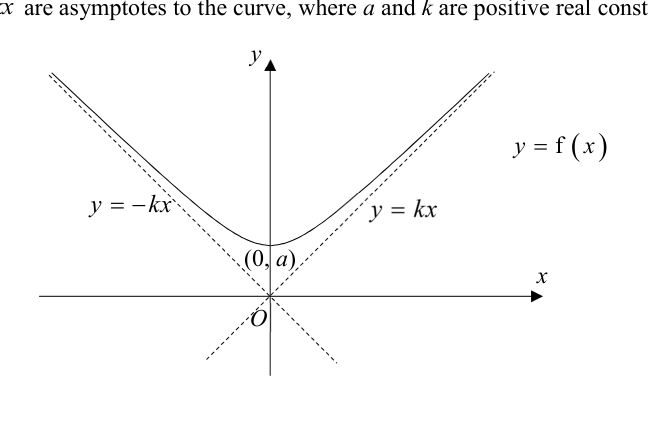
- (i)
On separate diagrams, sketch the graphs of and , giving the equations of any asymptotes and the coordinates of any turning points and of any points of intersection with the axes. You should label the graphs clearly.
- (ii)
The region is bounded by the curve , the line and the axes. A sculpture is made in the shape of the solid of revolution formed by rotating through radians about the -axis. Find the volume of the sculpture in terms of and .
It won't just hand you the answer — it asks where you're stuck.How the checker works
Worked solution
9(i)
1. Deduce the relationship between the constants $a$ and $k$.
Given , for large values of , .
Thus, the asymptotes of are and .
The question states the asymptotes are , where and are positive real constants. By comparing the equations, we deduce that .
2. Determine the key features of the graph of $y = \frac{1}{k}\mathrm{f}(x+2a)$.
Substitute : .
This corresponds to translating the graph of by units in the negative -direction, followed by a vertical scaling by .
- Turning point: The original turning point becomes , then scales to .
- Asymptotes: The original asymptotes translate to and scale by to become and .
- -intercept: Substitute , .
3. Differentiate $\mathrm{f}(x)$ to find the expression for the second graph.
Using the chain rule:
4. Determine the key features of the graph of $y = \mathrm{f}'(x)$.
- Intersection with axes: When , , so the curve passes through .
- Asymptotes:
As , .
As , .
Hence, horizontal asymptotes are and . - Turning points: Since the curve strictly transitions from asymptotic to up to , and for all , there are no turning points.
Graph of :
- Shape: U-shaped curve (upper branch of a hyperbola) opening upwards.
- Turning point (minimum):
- -intercept:
- Asymptotes: and
Graph of :
- Shape: Strictly increasing S-shaped curve passing through the origin.
- Intersection with axes:
- Asymptotes: and
- Turning points: None
9(ii)
1. Determine the boundary $y$-values for the region by evaluating the function at the $x$-limits.
The region is bounded by (the -axis) and . Find the corresponding -values on the curve :
When , .
When , .
2. Express $x^2$ in terms of $y$ to prepare for volume integration with respect to $y$.
3. Set up the integrals for the volume of revolution using the disk and washer methods.
The region rotated about the -axis can be split into two sections vertically:
- For , the cross-sections are solid disks of radius .
- For , the cross-sections are washers with an outer radius and an inner radius .
4. Evaluate the definite integral to find the exact final volume.
Therefore, the total volume of the sculpture is:
AI analysis — may contain mistakes.
Worked this one out on paper? Snap your steps and Gigle's AI math checker will circle the step where it went wrong.
More questions on this topic
- 1将函数的图象保持纵坐标不变,先将横坐标缩短为原来的,再向右平移个单位长度后得到,则的解析式为…
- 2By expressing the equation of the curve in the form , where …
- 3A curve has the equation where . Sketch , stating the coordinates of any points o…
- 4The diagram shows the graphs of and . The graph of has t…
- 5The curve with equation is transformed to curve by a translation of …