一个袋子里有 12 个球。
其中 2 个是红球,n 个是绿球,其余是蓝球。
尤妮丝随机从袋中取出两个球,且不放回。
- ((a))
补全树状图。
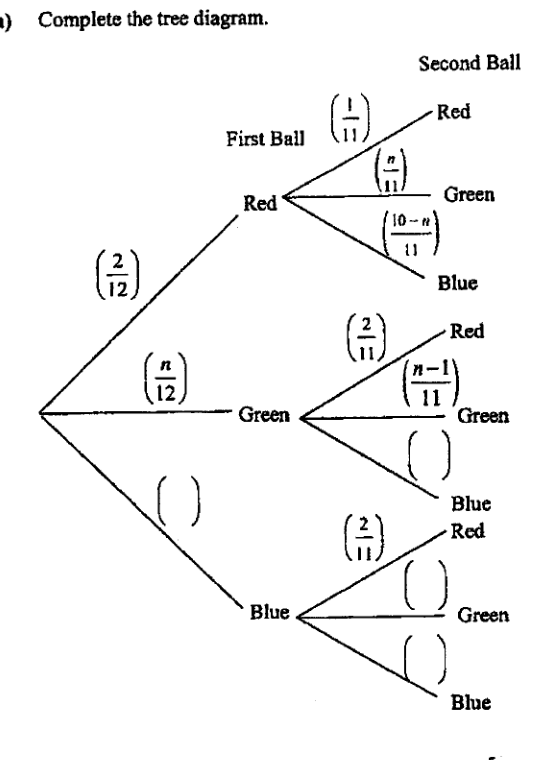
- ((b))
尤妮丝取出两个蓝球的概率是 。
写出一个代表这一信息的方程,并证明它可以化简为:。
答
- ((c))
解方程 。
答
n = ... 或 ...
- ((d))
解释为什么必须舍去第 (c) 部分中的一个解。
...
- ((e))
求尤妮丝取出不同颜色球的概率,用最简分数表示。
答:...
- ((f))
在这一轮中,尤妮丝随机从袋中取出两个球,且有放回。求她取出相同颜色球的概率,用最简分数表示。
答:...
它不会直接告诉你答案,而是问你卡在哪一步看看 AI 是怎么陪你一步步弄懂这道题的
完整解法
5((a))
1. Write the first-draw probabilities for each colour.
There are 12 balls in total.
Red balls:
Green balls:
Blue balls:
So the first-draw probabilities are
2. Fill in the second-draw conditional probabilities after each possible first draw.
Since the balls are taken without replacement, there are balls left for the second draw.
If the first ball is Red:
If the first ball is Green:
If the first ball is Blue:
First draw: .
Second draw:
- after Red:
- after Green:
- after Blue:
5((b))
1. Write the probability of taking two blue balls without replacement.
From the tree diagram,
Given that this probability is ,
2. Clear denominators to remove fractions.
Multiply both sides by :
3. Expand and rearrange into the required quadratic form.
5((c))
1. Factorise the quadratic expression.
Find two numbers with product and sum : and .
2. Use the zero product property to find the two values of $n$.
So,
or
5((d))
1. Identify the impossible solution using the total number of balls.
From part (c), or .
But the bag contains only 12 balls, so cannot be greater than 12.
Therefore, reject .
Reject , because there are only 12 balls in the bag, so the number of green balls cannot be 15.
5((e))
1. Use the valid value of $n$ to state the number of balls of each colour.
From parts (c) and (d), .
So the bag contains:
- red balls:
- green balls:
- blue balls:
2. Find the probability of taking two balls of the same colour without replacement.
3. Use the complement to find the probability of different colours.
5((f))
1. State the numbers of balls of each colour using the accepted value of $n$.
From earlier parts, .
So the bag contains:
- red balls:
- green balls:
- blue balls:
2. Find the probability of taking two balls of the same colour with replacement.
With replacement, the probabilities remain the same for both draws.
AI 分析,可能出错
用 AI 批改,圈出写错的那一步,并自动将你的薄弱点存入错题本,形成你的错因库。
同一知识点的其他题
- 1对 A、B 两家工厂生产的两批各 400 根钢条的质量进行了测量和记录。下方的累积频数图像显示了这些质量。 对于工厂 A 生产的钢条,求 中位数。 答案 ... kg 四分位距。 答案 ... kg 工厂 B 生产的钢条比工厂 A 生产的钢…
- 2一个袋子里装有 4 枚黑色硬币、7 枚红色硬币和 11 枚白色硬币。从袋子里随机连续抽取两枚硬币(不放回)。 求第二次抽到白色硬币的概率。 答案 ... 向袋子中加入 枚黄色硬币。两次抽取都抽到黑色硬币的概率为 …
- 3进行了一项调查,以统计一组学生中每人一周内收到的电子邮件数量。 下表表示调查的结果。 | 电子邮件数量 (n) | 频数 | |---|---| | | 8 | | | 13 |…
- 4累积频数曲线显示了 120 名学生在最近一次数学测试中获得的分数。满分是 100 分。 完成所得分数的分组频数表。 | 学生所得分数, x | 频数 | |---|---| | 0 ≤ x < 20 | 10 | | 20 ≤ x < 40…
- 5下面的茎叶图显示了20名学生在一次满分为50分的班级测试中所获得的分数。 写出中位数分数。 答案 ... 求标准差。 答案 ... 如果获得优秀的标准是分数至少达到80%,求班级中获得优秀的学生百分比。 答案 ... % 贝尔有六枚10美分…