A bag contains 12 balls.
2 of the balls are red, n are green balls and the rest are blue balls.
Eunice takes two balls from the bag, at random, without replacement.
- ((a))
Complete the tree diagram.
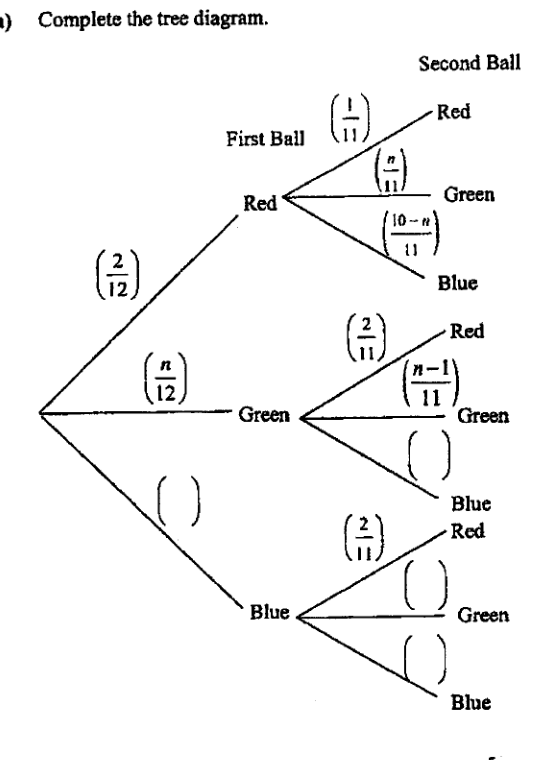
- ((b))
The probability that Eunice takes two blue balls is .
Write down an equation to represent this information and show that it simplifies to.
Answer
- ((c))
Solve the equation .
Answer
n = ... or ...
- ((d))
Explain why one of the solutions in part (c) must be rejected.
...
- ((e))
Find, as a fraction, in its simplest form, the probability that Eunice takes balls of different colours.
Answer ...
- ((f))
In this round, Eunice takes two balls from the bag, at random, with replacement. Find, as a fraction, in its simplest form, the probability that she will take balls of the same colour.
Answer ...
It won't just hand you the answer — it asks where you're stuck.How the checker works
Worked solution
5((a))
1. Write the first-draw probabilities for each colour.
There are 12 balls in total.
Red balls:
Green balls:
Blue balls:
So the first-draw probabilities are
2. Fill in the second-draw conditional probabilities after each possible first draw.
Since the balls are taken without replacement, there are balls left for the second draw.
If the first ball is Red:
If the first ball is Green:
If the first ball is Blue:
First draw: .
Second draw:
- after Red:
- after Green:
- after Blue:
5((b))
1. Write the probability of taking two blue balls without replacement.
From the tree diagram,
Given that this probability is ,
2. Clear denominators to remove fractions.
Multiply both sides by :
3. Expand and rearrange into the required quadratic form.
5((c))
1. Factorise the quadratic expression.
Find two numbers with product and sum : and .
2. Use the zero product property to find the two values of $n$.
So,
or
5((d))
1. Identify the impossible solution using the total number of balls.
From part (c), or .
But the bag contains only 12 balls, so cannot be greater than 12.
Therefore, reject .
Reject , because there are only 12 balls in the bag, so the number of green balls cannot be 15.
5((e))
1. Use the valid value of $n$ to state the number of balls of each colour.
From parts (c) and (d), .
So the bag contains:
- red balls:
- green balls:
- blue balls:
2. Find the probability of taking two balls of the same colour without replacement.
3. Use the complement to find the probability of different colours.
5((f))
1. State the numbers of balls of each colour using the accepted value of $n$.
From earlier parts, .
So the bag contains:
- red balls:
- green balls:
- blue balls:
2. Find the probability of taking two balls of the same colour with replacement.
With replacement, the probabilities remain the same for both draws.
AI analysis — may contain mistakes.
Worked this one out on paper? Snap your steps and Gigle's AI math checker will circle the step where it went wrong.
More questions on this topic
- 1The masses of two batches of 400 steel bars produced by factory A and B were measured and recorded. The cumulative frequ…
- 2A bag contains 4 black coins, 7 red coins and 11 white coins. Two coins are drawn from the bag at random, one after anot…
- 3A survey was carried out to find out the number of emails received in a week by each of a group of students. The table b…
- 4The cumulative frequency curve shows the marks obtained by the 120 students in a recent Mathematics Test. The maximum ma…
- 5The following stem-and-leaf diagram shows the marks obtained by 20 pupils in a class test that has a total mark of 50. S…