曲线 的方程为 ,其中 。
- ((i))
画出 的草图,用 表示出其与坐标轴的所有交点坐标、所有驻点坐标以及所有渐近线方程。
- ((ii))
经过单一变换得到 。已知 有一条对称轴 ,且点 在 上,求 的值。
- ((iii))
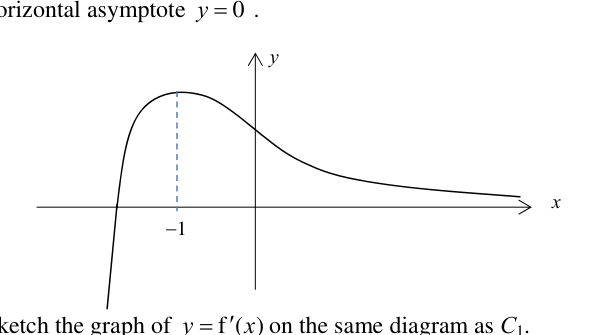
下面给出了 的图像。它在 处有一个极大值点,且有一条水平渐近线 。
在包含 的同一坐标系中,画出 的图像草图。
由此,说明方程 的根的个数。
它不会直接告诉你答案,而是问你卡在哪一步看看 AI 是怎么陪你一步步弄懂这道题的
完整解法
7((i))
1. Rewrite the equation into the standard form of a hyperbola.
Dividing through by :
This represents a standard hyperbola with a horizontal transverse axis.
2. Find the coordinates of the points of intersection with the axes.
For -intercepts, set :
The intersections with the -axis are and .
For -intercepts, set :
Since , , giving which has no real solutions. There are no intersections with the -axis.
3. Determine the coordinates of any stationary points using differentiation.
Differentiating implicitly with respect to :
For stationary points, .
However, as shown in the previous step, when , there are no real values for . Thus, there are no stationary points on .
4. Find the equations of the asymptotes.
The asymptotes for the hyperbola are given by replacing the constant with :
5. Synthesize the findings to describe the sketch of C1.
Draw the coordinate axes and the two diagonal asymptotes and . Since , these lines have a steeper gradient than .
Draw the two branches of the curve opening outwards to the left and right:
- The left branch has a vertex at .
- The right branch has a vertex at .
The curves must smoothly approach the asymptotes as .
Intersection with axes: and
Stationary points: None
Asymptotes: and
(Sketch: A hyperbola centred at the origin with a left branch passing through and a right branch passing through . Both branches approach the asymptotes and , which are steeper than since .)
7((ii))
1. Determine the equation of $C_2$ based on the change in the line of symmetry.
The curve , given by , is centered at the origin and has a vertical line of symmetry at .
For to have a line of symmetry at through a single transformation (based on standard transformations ), must be translated 2 units in the positive -direction.
Replacing with yields the equation of :
2. Substitute the given point $(4,3)$ to solve for $p$.
Substitute and into the equation of :
Since it is given that , we reject the negative root () to get:
7((iii))
1. Identify the key features to sketch the graph of $y = f'(x)$.
Based on the given graph of :
- has a maximum at , meaning its gradient is zero. The graph of must pass through the -axis at .
- For , is increasing, so (the graph is above the -axis).
- For , is decreasing, so (the graph is below the -axis).
- As , approaches a horizontal asymptote . The gradient approaches , so from below the -axis.
2. Relate the given equation to the graphs of $y = f'(x)$ and $C_1$.
We are given the equation:
Substituting , this can be rewritten as:
This is exactly the equation of the hyperbola . Thus, the roots of the given equation are exactly the -coordinates of the points of intersection between the graph of and the curve .
3. Determine the number of intersections between the two graphs.
By visualizing both graphs on the same diagram:
- At : The left branch of has a vertex at . The graph of also passes through . This gives 1 point of intersection.
- For : . The upper left branch of increases from towards with an initially infinite gradient, remaining above . There is no intersection here.
- For : is undefined (no real points), so there are no intersections.
- For : The lower right branch of starts at and decreases to . At , (meaning is below ). As , approaches and stays bounded, while goes to . Because starts below and ends up above it, the two curves must cross. This gives 1 point of intersection.
Total number of intersection points .
AI 分析,可能出错
用 AI 批改,圈出写错的那一步,并自动将你的薄弱点存入错题本,形成你的错因库。