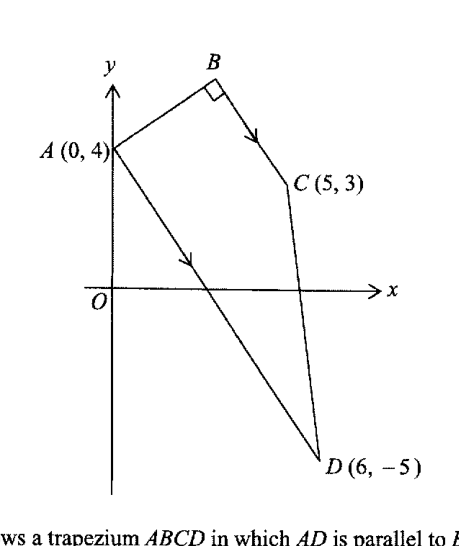
如图所示,梯形 ABCDABCD 中,ADAD 平行于 BCBC,且角 ABC=90∘ABC = 90^\circ。
AA、CC 和 DD 的坐标分别为 (0,4)(0, 4)、(5,3)(5, 3) 和 (6,−5)(6, -5)。

  1. (i)

    证明 BB 的坐标为 (3,6)(3, 6)。

  2. (ii)

    点 EE 在线段 DADA 的延长线上,使得 ΔBED 的面积ΔBAD 的面积=43\frac{\Delta BED \text{ 的面积}}{\Delta BAD \text{ 的面积}} = \frac{4}{3}。

    求点 EE 的坐标。

  3. (iii)

    已知 ECDFECDF 构成一个筝形(其中 FCFC 垂直于 EDED),求 FF 的坐标。由此,求 ECDFECDF 的面积。

先不看答案,让 AI 诊断你卡在哪里?

它不会直接告诉你答案,而是问你卡在哪一步看看 AI 是怎么陪你一步步弄懂这道题的

完整解法

9(i)

1. Find the gradient of the line $AD$ and hence the gradient of $BC$.

Gradient of AD=−5−46−0=−96=−32AD = \frac{-5 - 4}{6 - 0} = \frac{-9}{6} = -\frac{3}{2}
Since ADAD is parallel to BCBC, gradient of BC=−32BC = -\frac{3}{2}.

2. Find the equation of the line $BC$.

Using point C(5,3)C(5, 3) and gradient −32-\frac{3}{2}:
y−3=−32(x−5)y - 3 = -\frac{3}{2}(x - 5)
2y−6=−3x+152y - 6 = -3x + 15
3x+2y=213x + 2y = 21 --- (1)

3. Find the equation of the line $AB$.

Since ∠ABC=90∘\angle ABC = 90^\circ, ABAB is perpendicular to BCBC.
Gradient of AB=−1−3/2=23AB = \frac{-1}{-3/2} = \frac{2}{3}
Using point A(0,4)A(0, 4) and gradient 23\frac{2}{3}:
y−4=23(x−0)y - 4 = \frac{2}{3}(x - 0)
y=23x+4y = \frac{2}{3}x + 4
2x−3y=−122x - 3y = -12 --- (2)

4. Solve the equations simultaneously to find the coordinates of $B$.

From (2), x=3y−122x = \frac{3y - 12}{2}. Substitute into (1):
3(3y−122)+2y=213\left(\frac{3y - 12}{2}\right) + 2y = 21
9y−36+4y=429y - 36 + 4y = 42
13y=78  ⟹  y=613y = 78 \implies y = 6
Substitute y=6y = 6 into x=3(6)−122=62=3x = \frac{3(6) - 12}{2} = \frac{6}{2} = 3.
Therefore, the coordinates of BB are (3,6)(3, 6) (shown).

答案

Shown that BB is (3,6)(3, 6).

9(ii)

1. Relate the ratio of areas to the ratio of base lengths.

Triangles BEDBED and BADBAD share the same perpendicular height from BB to the line EDED.
Therefore, the ratio of their areas is equal to the ratio of their bases:
EDAD=43\frac{ED}{AD} = \frac{4}{3}

2. Find the coordinates of $E$ using vector translation or ratio.

Since EE lies on DADA produced, the points are in the order D,A,ED, A, E.
This means ED=EA+ADED = EA + AD, so EA+ADAD=43  ⟹  EAAD=13\frac{EA + AD}{AD} = \frac{4}{3} \implies \frac{EA}{AD} = \frac{1}{3}.
Using vectors, AE→=13DA→\overrightarrow{AE} = \frac{1}{3}\overrightarrow{DA}.
DA→=A−D=(0−6,4−(−5))=(−6,9)\overrightarrow{DA} = A - D = (0 - 6, 4 - (-5)) = (-6, 9)
AE→=13(−6,9)=(−2,3)\overrightarrow{AE} = \frac{1}{3}(-6, 9) = (-2, 3)
Coordinates of E=A+AE→=(0,4)+(−2,3)=(−2,7)E = A + \overrightarrow{AE} = (0, 4) + (-2, 3) = (-2, 7).

答案

(−2,7)(-2, 7)

9(iii)

1. Find the coordinates of $E$ using the ratio of areas from part (ii).

Since ΔBED\Delta BED and ΔBAD\Delta BAD share the same height from BB to the line EDED, the ratio of their areas is the ratio of their bases:
EDAD=43\frac{ED}{AD} = \frac{4}{3}
Since EE lies on DADA produced, AA is between EE and DD, so EA=13ADEA = \frac{1}{3}AD.
DA⃗=A−D=(0−6,4−(−5))=(−6,9)\vec{DA} = A - D = (0 - 6, 4 - (-5)) = (-6, 9)
AE⃗=13DA⃗=(−2,3)\vec{AE} = \frac{1}{3}\vec{DA} = (-2, 3)
E=A+AE⃗=(0,4)+(−2,3)=(−2,7)E = A + \vec{AE} = (0, 4) + (-2, 3) = (-2, 7)

2. Determine the relationship between the diagonals of the kite $ECDF$.

In kite ECDFECDF, the diagonals are EDED and CFCF. The diagonals of a kite are perpendicular, and one bisects the other.
Let's check the lengths of ECEC and CDCD:
EC2=(5−(−2))2+(3−7)2=49+16=65EC^2 = (5 - (-2))^2 + (3 - 7)^2 = 49 + 16 = 65
CD2=(6−5)2+(−5−3)2=1+64=65CD^2 = (6 - 5)^2 + (-5 - 3)^2 = 1 + 64 = 65
Since EC=CDEC = CD, for FF to be uniquely determined as a kite (specifically a rhombus in this orientation), the diagonal EDED must bisect CFCF. Thus, the intersection of the diagonals is the midpoint of both EDED and CFCF.

3. Find the coordinates of $F$.

Midpoint of EDED, M=(−2+62,7+(−5)2)=(2,1)M = \left(\frac{-2 + 6}{2}, \frac{7 + (-5)}{2}\right) = (2, 1).
Since MM is also the midpoint of CFCF:
xF+52=2  ⟹  xF=−1\frac{x_F + 5}{2} = 2 \implies x_F = -1
yF+32=1  ⟹  yF=−1\frac{y_F + 3}{2} = 1 \implies y_F = -1
So, F=(−1,−1)F = (-1, -1).

4. Calculate the area of the kite $ECDF$.

Area of kite =12×ED×CF= \frac{1}{2} \times ED \times CF
ED=(6−(−2))2+(−5−7)2=82+(−12)2=208ED = \sqrt{(6 - (-2))^2 + (-5 - 7)^2} = \sqrt{8^2 + (-12)^2} = \sqrt{208}
CF=(5−(−1))2+(3−(−1))2=62+42=52CF = \sqrt{(5 - (-1))^2 + (3 - (-1))^2} = \sqrt{6^2 + 4^2} = \sqrt{52}
Area =12×208×52=12×10816=12×104=52= \frac{1}{2} \times \sqrt{208} \times \sqrt{52} = \frac{1}{2} \times \sqrt{10816} = \frac{1}{2} \times 104 = 52

答案

Coordinates of FF are (−1,−1)(-1, -1), Area =52= 52

AI 分析,可能出错

用 AI 批改,圈出写错的那一步,并自动将你的薄弱点存入错题本,形成你的错因库。

同一知识点的其他题

  1. 1已知一条曲线的方程为 y=2x−33x+4y = \frac{2x - 3}{3x + 4},其中 x≠−43x \ne -\frac{4}{3}。 曲线在点 PP(其中 x>0x > 0)处的法线平行于直线 y=−2517x+2y = -\frac{25}{17}x + 2。…
  2. 2曲线 y=2tan⁡3x−1y = 2\tan 3x - 1 在点 P(π3,−1)P\left(\frac{\pi}{3}, -1\right) 处的法线交 yy 轴于点 AA,交 xx 轴于点 BB。求三角形 AOBAOB 的精确面积。
  3. 3点 PP 在曲线 y=ln⁡(x+1x−1)y = \ln\left(\frac{x+1}{x-1}\right)(x>1x > 1)上。该曲线在点 PP 处的法线平行于直线 2y=3x+22y = 3x + 2。曲线在点 PP 处的切线交 yy 轴于点 QQ。求…
  4. 4图中显示了曲线 y=g(x)y = g(x) 的一部分。(2,8)(2, 8) 和 (6,1)(6, 1) 是曲线上的两个点。 已知 ∫26y dx=32\int_{2}^{6} y \text{ } dx = 32,求 ∫18x dy\int_{1}^{8} x \text{ } dy…
  5. 5图示为曲线 y=3e−12x−6y = 3e^{-\frac{1}{2}x} - 6 的一部分,该曲线与 xx 轴相交于点 PP,与 yy 轴相交于点 QQ。曲线在点 QQ 处的法线与 xx 轴交于点 RR。求 法线的方程, 阴影区域的面积。