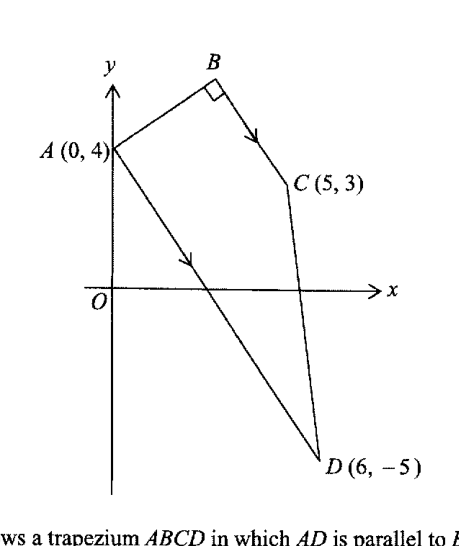
The diagram shows a trapezium ABCDABCD in which ADAD is parallel to BCBC and angle ABC=90∘ABC = 90^\circ.
The coordinates of AA, CC and DD are (0,4)(0, 4), (5,3)(5, 3) and (6,−5)(6, -5) respectively.

  1. (i)

    Show that the coordinates of BB are (3,6)(3, 6).

  2. (ii)

    The point EE lies on the line DADA produced such that area of ΔBEDarea of ΔBAD=43\frac{\text{area of } \Delta BED}{\text{area of } \Delta BAD} = \frac{4}{3}.

    Find the coordinates of point EE.

  3. (iii)

    Given that ECDFECDF form a kite in which FCFC is perpendicular to EDED, find the coordinates of FF. Hence, find the area of ECDFECDF.

Work through it with AI →

It won't just hand you the answer — it asks where you're stuck.How the checker works

Worked solution

9(i)

1. Find the gradient of the line $AD$ and hence the gradient of $BC$.

Gradient of AD=−5−46−0=−96=−32AD = \frac{-5 - 4}{6 - 0} = \frac{-9}{6} = -\frac{3}{2}
Since ADAD is parallel to BCBC, gradient of BC=−32BC = -\frac{3}{2}.

2. Find the equation of the line $BC$.

Using point C(5,3)C(5, 3) and gradient −32-\frac{3}{2}:
y−3=−32(x−5)y - 3 = -\frac{3}{2}(x - 5)
2y−6=−3x+152y - 6 = -3x + 15
3x+2y=213x + 2y = 21 --- (1)

3. Find the equation of the line $AB$.

Since ∠ABC=90∘\angle ABC = 90^\circ, ABAB is perpendicular to BCBC.
Gradient of AB=−1−3/2=23AB = \frac{-1}{-3/2} = \frac{2}{3}
Using point A(0,4)A(0, 4) and gradient 23\frac{2}{3}:
y−4=23(x−0)y - 4 = \frac{2}{3}(x - 0)
y=23x+4y = \frac{2}{3}x + 4
2x−3y=−122x - 3y = -12 --- (2)

4. Solve the equations simultaneously to find the coordinates of $B$.

From (2), x=3y−122x = \frac{3y - 12}{2}. Substitute into (1):
3(3y−122)+2y=213\left(\frac{3y - 12}{2}\right) + 2y = 21
9y−36+4y=429y - 36 + 4y = 42
13y=78  ⟹  y=613y = 78 \implies y = 6
Substitute y=6y = 6 into x=3(6)−122=62=3x = \frac{3(6) - 12}{2} = \frac{6}{2} = 3.
Therefore, the coordinates of BB are (3,6)(3, 6) (shown).

Answer

Shown that BB is (3,6)(3, 6).

9(ii)

1. Relate the ratio of areas to the ratio of base lengths.

Triangles BEDBED and BADBAD share the same perpendicular height from BB to the line EDED.
Therefore, the ratio of their areas is equal to the ratio of their bases:
EDAD=43\frac{ED}{AD} = \frac{4}{3}

2. Find the coordinates of $E$ using vector translation or ratio.

Since EE lies on DADA produced, the points are in the order D,A,ED, A, E.
This means ED=EA+ADED = EA + AD, so EA+ADAD=43  ⟹  EAAD=13\frac{EA + AD}{AD} = \frac{4}{3} \implies \frac{EA}{AD} = \frac{1}{3}.
Using vectors, AE→=13DA→\overrightarrow{AE} = \frac{1}{3}\overrightarrow{DA}.
DA→=A−D=(0−6,4−(−5))=(−6,9)\overrightarrow{DA} = A - D = (0 - 6, 4 - (-5)) = (-6, 9)
AE→=13(−6,9)=(−2,3)\overrightarrow{AE} = \frac{1}{3}(-6, 9) = (-2, 3)
Coordinates of E=A+AE→=(0,4)+(−2,3)=(−2,7)E = A + \overrightarrow{AE} = (0, 4) + (-2, 3) = (-2, 7).

Answer

(−2,7)(-2, 7)

9(iii)

1. Find the coordinates of $E$ using the ratio of areas from part (ii).

Since ΔBED\Delta BED and ΔBAD\Delta BAD share the same height from BB to the line EDED, the ratio of their areas is the ratio of their bases:
EDAD=43\frac{ED}{AD} = \frac{4}{3}
Since EE lies on DADA produced, AA is between EE and DD, so EA=13ADEA = \frac{1}{3}AD.
DA⃗=A−D=(0−6,4−(−5))=(−6,9)\vec{DA} = A - D = (0 - 6, 4 - (-5)) = (-6, 9)
AE⃗=13DA⃗=(−2,3)\vec{AE} = \frac{1}{3}\vec{DA} = (-2, 3)
E=A+AE⃗=(0,4)+(−2,3)=(−2,7)E = A + \vec{AE} = (0, 4) + (-2, 3) = (-2, 7)

2. Determine the relationship between the diagonals of the kite $ECDF$.

In kite ECDFECDF, the diagonals are EDED and CFCF. The diagonals of a kite are perpendicular, and one bisects the other.
Let's check the lengths of ECEC and CDCD:
EC2=(5−(−2))2+(3−7)2=49+16=65EC^2 = (5 - (-2))^2 + (3 - 7)^2 = 49 + 16 = 65
CD2=(6−5)2+(−5−3)2=1+64=65CD^2 = (6 - 5)^2 + (-5 - 3)^2 = 1 + 64 = 65
Since EC=CDEC = CD, for FF to be uniquely determined as a kite (specifically a rhombus in this orientation), the diagonal EDED must bisect CFCF. Thus, the intersection of the diagonals is the midpoint of both EDED and CFCF.

3. Find the coordinates of $F$.

Midpoint of EDED, M=(−2+62,7+(−5)2)=(2,1)M = \left(\frac{-2 + 6}{2}, \frac{7 + (-5)}{2}\right) = (2, 1).
Since MM is also the midpoint of CFCF:
xF+52=2  ⟹  xF=−1\frac{x_F + 5}{2} = 2 \implies x_F = -1
yF+32=1  ⟹  yF=−1\frac{y_F + 3}{2} = 1 \implies y_F = -1
So, F=(−1,−1)F = (-1, -1).

4. Calculate the area of the kite $ECDF$.

Area of kite =12×ED×CF= \frac{1}{2} \times ED \times CF
ED=(6−(−2))2+(−5−7)2=82+(−12)2=208ED = \sqrt{(6 - (-2))^2 + (-5 - 7)^2} = \sqrt{8^2 + (-12)^2} = \sqrt{208}
CF=(5−(−1))2+(3−(−1))2=62+42=52CF = \sqrt{(5 - (-1))^2 + (3 - (-1))^2} = \sqrt{6^2 + 4^2} = \sqrt{52}
Area =12×208×52=12×10816=12×104=52= \frac{1}{2} \times \sqrt{208} \times \sqrt{52} = \frac{1}{2} \times \sqrt{10816} = \frac{1}{2} \times 104 = 52

Answer

Coordinates of FF are (−1,−1)(-1, -1), Area =52= 52

AI analysis — may contain mistakes.

Worked this one out on paper? Snap your steps and Gigle's AI math checker will circle the step where it went wrong.

More questions on this topic

  1. 1A curve has the equation y=2x−33x+4y = \frac{2x - 3}{3x + 4}, where x≠−43x \ne -\frac{4}{3}. The normal to the point PP on the cur…
  2. 2The normal to the curve y=2tan⁡3x−1y = 2\tan 3x - 1 at point P(π3,−1)P\left(\frac{\pi}{3}, -1\right) crosses the yy-axis at point AA…
  3. 3The point PP lies on the curve y=ln⁡(x+1x−1)y = \ln\left(\frac{x+1}{x-1}\right) for x>1x > 1. The normal to the curve at PP is par…
  4. 4The figure shows part of the curve y=g(x)y = g(x). (2,8)(2, 8) and (6,1)(6, 1) are two points on the curve. Given that ∫26y dx=32\int_{2}^{6} y \text{ } dx = 32…
  5. 5The diagram shows part of the curve y=3e−12x−6y = 3e^{-\frac{1}{2}x} - 6 which crosses the xx-axis at PP and the yy-axis at QQ…