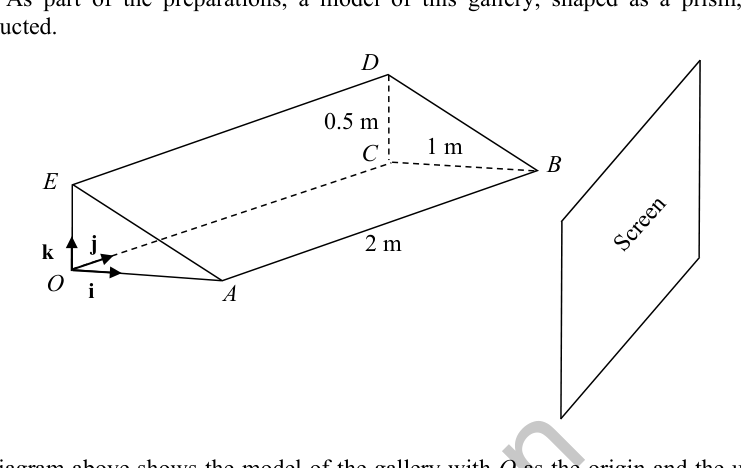
为了即将举行的一场赛车比赛,将在赛道附近设立一个观众看台。作为准备工作的一部分,制作了一个棱柱形的看台模型。 上图展示了该看台的模型,以 OO 为原点,单位向量 i\mathbf{i}、j\mathbf{j} 和 k\mathbf{k} 分别平行于 OAOA、OCOC 和 OEOE。点 (x,y,z)(x, y, z) 的坐标是相对于原点 OO 定义的,单位为米。 已知 OA=CB=1 mOA = CB = 1\text{ m},OC=AB=ED=2 mOC = AB = ED = 2\text{ m},且 OE=CD=0.5 mOE = CD = 0.5\text{ m}。 计划在平面 ABDEABDE 上方建造一个遮阳篷。在模型中,该遮阳篷是一个矩形平面,它与平面 ABDEABDE 相交于直线 EDED。

  1. (a)

    求平面 ABDEABDE 的笛卡尔方程。

  2. (b)

    已知遮阳篷的方程为 −0.5x+z=h-0.5x + z = h,证明 h=0.5h = 0.5。

  3. (c)

    求平面 ABDEABDE 与遮阳篷之间的锐角夹角。

  4. (d)

    一束聚光灯照向看台,光束呈直线 ll 形式,其笛卡尔方程为 x−a=zx - a = z,y=1y = 1(其中 aa 为某个实数)。光束落在矩形表面 ABDEABDE 上的点 MM 处。

    用 aa 表示点 MM 的位置向量,并由此求出 aa 的取值范围。

  5. (e)

    一个大型矩形平板显示屏将放置在看台前方的某段距离处。该显示屏可以看作是垂直平面 12x+5y=d12x + 5y = d 的一部分,其中 d>50d > 50。已知 a=12a = \frac{1}{2},求 dd 的值,使得点 MM 到显示屏的最短距离为 4 m4\text{ m}。

先不看答案,让 AI 诊断你卡在哪里?

它不会直接告诉你答案,而是问你卡在哪一步看看 AI 是怎么陪你一步步弄懂这道题的

完整解法

10(a)

1. Determine the position vectors of three points on the plane, such as $A$, $B$, and $E$.

Given the origin O(0,0,0)O(0,0,0) and unit vectors i\mathbf{i}, j\mathbf{j}, k\mathbf{k} along OAOA, OCOC, OEOE respectively:
OA⃗=1i  ⟹  A(1,0,0)\vec{OA} = 1\mathbf{i} \implies A(1, 0, 0)
OC⃗=2j\vec{OC} = 2\mathbf{j} and CBCB is parallel to OAOA with CB=1  ⟹  B(1,2,0)CB = 1 \implies B(1, 2, 0)
OE⃗=0.5k  ⟹  E(0,0,0.5)\vec{OE} = 0.5\mathbf{k} \implies E(0, 0, 0.5)

2. Form two directional vectors on the plane and compute their cross product to find the normal vector.

AB⃗=OB⃗−OA⃗=(120)−(100)=(020)\vec{AB} = \vec{OB} - \vec{OA} = \begin{pmatrix} 1 \\ 2 \\ 0 \end{pmatrix} - \begin{pmatrix} 1 \\ 0 \\ 0 \end{pmatrix} = \begin{pmatrix} 0 \\ 2 \\ 0 \end{pmatrix}

AE⃗=OE⃗−OA⃗=(000.5)−(100)=(−100.5)\vec{AE} = \vec{OE} - \vec{OA} = \begin{pmatrix} 0 \\ 0 \\ 0.5 \end{pmatrix} - \begin{pmatrix} 1 \\ 0 \\ 0 \end{pmatrix} = \begin{pmatrix} -1 \\ 0 \\ 0.5 \end{pmatrix}

Let the normal vector to the plane be n\mathbf{n}.
n=AB⃗×AE⃗=(020)×(−100.5)=((2)(0.5)−(0)(0)(0)(−1)−(0)(0.5)(0)(0)−(2)(−1))=(102)\mathbf{n} = \vec{AB} \times \vec{AE} = \begin{pmatrix} 0 \\ 2 \\ 0 \end{pmatrix} \times \begin{pmatrix} -1 \\ 0 \\ 0.5 \end{pmatrix} = \begin{pmatrix} (2)(0.5) - (0)(0) \\ (0)(-1) - (0)(0.5) \\ (0)(0) - (2)(-1) \end{pmatrix} = \begin{pmatrix} 1 \\ 0 \\ 2 \end{pmatrix}

3. Form the cartesian equation of the plane.

The equation of the plane is given by r⋅n=a⋅n\mathbf{r} \cdot \mathbf{n} = \mathbf{a} \cdot \mathbf{n}, where a\mathbf{a} is a known position vector on the plane (e.g., AA).
r⋅(102)=(100)⋅(102)\mathbf{r} \cdot \begin{pmatrix} 1 \\ 0 \\ 2 \end{pmatrix} = \begin{pmatrix} 1 \\ 0 \\ 0 \end{pmatrix} \cdot \begin{pmatrix} 1 \\ 0 \\ 2 \end{pmatrix}
(xyz)⋅(102)=(1)(1)+(0)(0)+(0)(2)\begin{pmatrix} x \\ y \\ z \end{pmatrix} \cdot \begin{pmatrix} 1 \\ 0 \\ 2 \end{pmatrix} = (1)(1) + (0)(0) + (0)(2)
x+2z=1x + 2z = 1

答案

x+2z=1x + 2z = 1

10(b)

1. Determine the coordinates of a point on the line $ED$, such as point $E$.

From the given information, the origin is O(0,0,0)O(0, 0, 0) and the unit vector k\mathbf{k} is parallel to OEOE.
Since OE=0.5 mOE = 0.5\text{ m}, the coordinates of EE are (0,0,0.5)(0, 0, 0.5).

2. Substitute the coordinates of $E$ into the equation of the shelter to show the value of $h$.

The shelter intersects the plane ABDEABDE in the line EDED, which means the point EE lies on the shelter.
Substitute x=0x = 0 and z=0.5z = 0.5 into the shelter's equation −0.5x+z=h-0.5x + z = h:
−0.5(0)+0.5=h-0.5(0) + 0.5 = h
h=0.5h = 0.5 (shown)

答案

h = 0.5 (shown)

10(c)

1. Find the normal vectors for the plane $ABDE$ and the shelter.

To answer this, we need the normal vector of plane ABDEABDE (which would have been found in part (a)).
From the coordinates A(1,0,0)A(1,0,0), B(1,2,0)B(1,2,0), and E(0,0,0.5)E(0,0,0.5), we have AB⃗=(020)\vec{AB} = \begin{pmatrix} 0 \\ 2 \\ 0 \end{pmatrix} and AE⃗=(−100.5)\vec{AE} = \begin{pmatrix} -1 \\ 0 \\ 0.5 \end{pmatrix}.
A normal vector to the plane ABDEABDE is n1=AB⃗×AE⃗=(102)\mathbf{n}_1 = \vec{AB} \times \vec{AE} = \begin{pmatrix} 1 \\ 0 \\ 2 \end{pmatrix}.

The equation of the shelter (from part b) is given as −0.5x+z=0.5-0.5x + z = 0.5, which can be equivalently written as −x+2z=1-x + 2z = 1. A normal vector for the shelter is therefore n2=(−102)\mathbf{n}_2 = \begin{pmatrix} -1 \\ 0 \\ 2 \end{pmatrix}.

2. Calculate the acute angle between the two planes using their normal vectors.

Let θ\theta be the acute angle between the planes. We use the scalar product of their normal vectors:
cos⁡θ=∣n1⋅n2∣∣n1∣∣n2∣\cos \theta = \frac{|\mathbf{n}_1 \cdot \mathbf{n}_2|}{|\mathbf{n}_1| |\mathbf{n}_2|}
cos⁡θ=∣(102)⋅(−102)∣12+02+22(−1)2+02+22\cos \theta = \frac{\left| \begin{pmatrix} 1 \\ 0 \\ 2 \end{pmatrix} \cdot \begin{pmatrix} -1 \\ 0 \\ 2 \end{pmatrix} \right|}{\sqrt{1^2 + 0^2 + 2^2} \sqrt{(-1)^2 + 0^2 + 2^2}}
cos⁡θ=∣(1)(−1)+(0)(0)+(2)(2)∣55\cos \theta = \frac{|(1)(-1) + (0)(0) + (2)(2)|}{\sqrt{5} \sqrt{5}}
cos⁡θ=∣−1+4∣5\cos \theta = \frac{|-1 + 4|}{5}
cos⁡θ=35=0.6\cos \theta = \frac{3}{5} = 0.6
θ=cos⁡−1(0.6)≈53.1∘ (to 1 d.p.)\theta = \cos^{-1}(0.6) \approx 53.1^\circ \text{ (to 1 d.p.)}

答案

53.1∘53.1^\circ

10(d)

1. Determine the cartesian equation of the plane $ABDE$ (as required from part a).

From the given side lengths and orientations, the coordinates of the vertices are A(1,0,0)A(1, 0, 0), B(1,2,0)B(1, 2, 0), and E(0,0,0.5)E(0, 0, 0.5).

The direction vectors of the plane are:
AB⃗=(020)\vec{AB} = \begin{pmatrix} 0 \\ 2 \\ 0 \end{pmatrix} and AE⃗=(−100.5)\vec{AE} = \begin{pmatrix} -1 \\ 0 \\ 0.5 \end{pmatrix}.

The normal vector to plane ABDEABDE is:
n=AB⃗×AE⃗=(020)×(−100.5)=(102)\mathbf{n} = \vec{AB} \times \vec{AE} = \begin{pmatrix} 0 \\ 2 \\ 0 \end{pmatrix} \times \begin{pmatrix} -1 \\ 0 \\ 0.5 \end{pmatrix} = \begin{pmatrix} 1 \\ 0 \\ 2 \end{pmatrix}.

The equation of plane ABDEABDE is:
r⋅(102)=(100)⋅(102)=1  ⟹  x+2z=1\mathbf{r} \cdot \begin{pmatrix} 1 \\ 0 \\ 2 \end{pmatrix} = \begin{pmatrix} 1 \\ 0 \\ 0 \end{pmatrix} \cdot \begin{pmatrix} 1 \\ 0 \\ 2 \end{pmatrix} = 1 \implies x + 2z = 1.

2. Express the line $l$ in terms of $z$ and substitute it into the plane equation.

The line ll is given by x−a=z  ⟹  x=z+ax - a = z \implies x = z + a, and y=1y = 1.

Substitute xx into the equation of plane ABDEABDE:
(z+a)+2z=1(z + a) + 2z = 1
3z=1−a  ⟹  z=1−a33z = 1 - a \implies z = \frac{1 - a}{3}

3. Find the $x$-coordinate and state the position vector of point $M$.

x=z+a=1−a3+a=2a+13x = z + a = \frac{1 - a}{3} + a = \frac{2a + 1}{3}.

Given y=1y = 1, the position vector of MM is:
OM⃗=(2a+1311−a3)\vec{OM} = \begin{pmatrix} \frac{2a + 1}{3} \\ 1 \\ \frac{1 - a}{3} \end{pmatrix}

4. Use the boundaries of the rectangular surface $ABDE$ to find the range of $a$.

For MM to land on the finite rectangular surface ABDEABDE, its xx-coordinate must lie between the xx-coordinates of the edges EDED (where x=0x=0) and ABAB (where x=1x=1).
(Note: The yy-coordinate is 11, which safely lies within the yy-boundaries of 00 to 22, and the zz-boundary check is naturally equivalent to the xx-boundary check due to the plane equation).

0≤x≤10 \le x \le 1
0≤2a+13≤10 \le \frac{2a + 1}{3} \le 1
0≤2a+1≤30 \le 2a + 1 \le 3
−1≤2a≤2-1 \le 2a \le 2
−12≤a≤1-\frac{1}{2} \le a \le 1

答案

OM⃗=(2a+1311−a3)\vec{OM} = \begin{pmatrix} \frac{2a+1}{3} \\ 1 \\ \frac{1-a}{3} \end{pmatrix}, and −12≤a≤1-\frac{1}{2} \le a \le 1

10(e)

1. Find the position vector of point $M$ using the result from part (d) with $a = \frac{1}{2}$.

From part (d), the position vector of MM is (2a+1311−a3)\begin{pmatrix} \frac{2a+1}{3} \\ 1 \\ \frac{1-a}{3} \end{pmatrix}.
Substituting a=12a = \frac{1}{2}:
OM→=(2(1/2)+1311−1/23)=(2/311/6)\overrightarrow{OM} = \begin{pmatrix} \frac{2(1/2)+1}{3} \\ 1 \\ \frac{1-1/2}{3} \end{pmatrix} = \begin{pmatrix} 2/3 \\ 1 \\ 1/6 \end{pmatrix}

2. Set up the equation for the shortest distance from $M$ to the vertical plane.

The screen plane equation is 12x+5y+0z=d12x + 5y + 0z = d.
The shortest distance from M(23,1,16)M \left(\frac{2}{3}, 1, \frac{1}{6}\right) to the plane is given as 4 m4\text{ m}. Using the perpendicular distance formula:
∣12(23)+5(1)+0(16)−d∣122+52+02=4\frac{\left| 12\left(\frac{2}{3}\right) + 5(1) + 0\left(\frac{1}{6}\right) - d \right|}{\sqrt{12^2 + 5^2 + 0^2}} = 4
∣8+5−d∣144+25=4\frac{|8 + 5 - d|}{\sqrt{144 + 25}} = 4
∣13−d∣13=4\frac{|13 - d|}{13} = 4

3. Solve the modulus equation for $d$.

∣13−d∣=52|13 - d| = 52
13−d=52or13−d=−5213 - d = 52 \quad \text{or} \quad 13 - d = -52
d=−39ord=65d = -39 \quad \text{or} \quad d = 65

4. Determine the correct value of $d$ based on the given constraint.

Since we are given that d>50d > 50, we reject d=−39d = -39.
Therefore, d=65d = 65.

答案

d=65d = 65

AI 分析,可能出错

用 AI 批改,圈出写错的那一步,并自动将你的薄弱点存入错题本,形成你的错因库。

同一知识点的其他题

  1. 1直线 l1l_1 和 l2l_2 的方程分别为 r=(4110)+λ(1−1−6),λ∈R\mathbf{r} = \begin{pmatrix} 4 \\ 1 \\ 10 \end{pmatrix} + \lambda \begin{pmatrix} 1 \\ -1 \\ -6 \end{pmatrix}, \lambda \in \mathbb{R}…
  2. 2一家钻探公司计划在山中铺设一条直管道 ABAB。点 (x,y,z)(x, y, z) 是相对于山脚下坐标为 (0,0,0)(0, 0, 0) 的主控制中心定义的,其中单位为米。xx 轴指向东,yy 轴指向北,zz 轴垂直向上。点 AA 的坐标为 (−200,150,10)(-200, 150, 10)…
  3. 3平面 Π1\Pi_1 的方程为 x+y+z=3x + y + z = 3。一条直线穿过点 PP 和 QQ,它们的位置向量分别为 i+j+2k\mathbf{i} + \mathbf{j} + 2\mathbf{k} 和 4i+2j−k4\mathbf{i} + 2\mathbf{j} - \mathbf{k}…
  4. 4平面 Π1\Pi_1 和 Π2\Pi_2 的向量方程分别为 r=λ1(i+j−k)+μ1(2i−j+k)andr=λ2(i+2j+k)+μ2(3i+j−k)\mathbf{r} = \lambda_1(\mathbf{i} + \mathbf{j} - \mathbf{k}) + \mu_1(2\mathbf{i} - \mathbf{j} + \mathbf{k}) \quad \text{and} \quad \mathbf{r} = \lambda_2(\mathbf{i} + 2\mathbf{j} + \mathbf{k}) + \mu_2(3\mathbf{i} + \mathbf{j} - \mathbf{k})…
  5. 5一位室内设计师正计划设计一个下拉式衣柜升降机。为了测试他的设想,设计师制作了一个它的微缩模型。在这个模型中,点 (x,y,z)(x, y, z) 是相对于模型的一个拐角 O(0,0,0)O(0, 0, 0) 来定义的。模型中使用的杆可以用直线方程来建模。 主杆可…