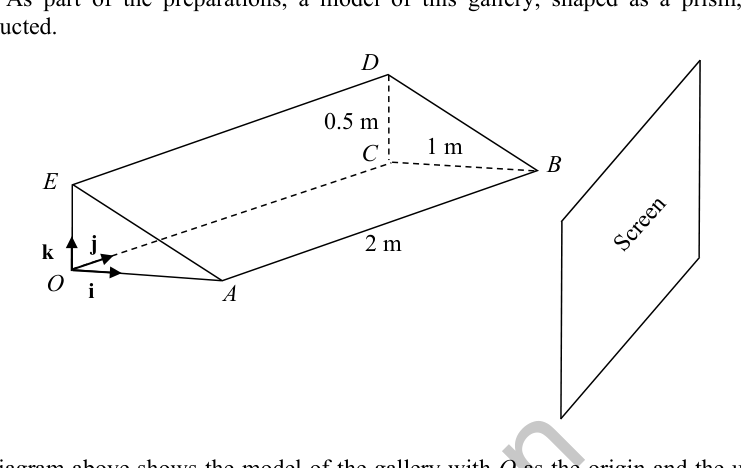
For an upcoming motor-car race, a spectators' gallery is to be set up near the racing track. As part of the preparations, a model of this gallery, shaped as a prism, is constructed. The diagram above shows the model of the gallery with OO as the origin and the unit vectors i\mathbf{i}, j\mathbf{j} and k\mathbf{k} are parallel to OAOA, OCOC and OEOE respectively. Points (x,y,z)(x, y, z) are defined relative to OO, where units are in metres. It is given that OA=CB=1 mOA = CB = 1\text{ m}, OC=AB=ED=2 mOC = AB = ED = 2\text{ m} and OE=CD=0.5 mOE = CD = 0.5\text{ m}. A shelter is to be constructed above the plane ABDEABDE. On the model, this shelter is a rectangular plane that intersects plane ABDEABDE in the line EDED.

  1. (a)

    Find a cartesian equation of the plane ABDEABDE.

  2. (b)

    Given that the equation of the shelter is −0.5x+z=h-0.5x + z = h, show that h=0.5h = 0.5.

  3. (c)

    Find the acute angle between the plane ABDEABDE and the shelter.

  4. (d)

    A spotlight is shone towards the gallery and the beam of light is in the form of a line ll with cartesian equation x−a=zx - a = z, y=1y = 1 for some real number aa. The beam lands on a point MM on the rectangular surface ABDEABDE.

    Find in terms of aa, the position vector of MM, and hence find the range of values of aa.

  5. (e)

    A large rectangular flat screen is to be placed in front of the gallery at a distance away. The screen can be taken to be part of a vertical plane with equation 12x+5y=d12x + 5y = d, where d>50d > 50. Using a=12a = \frac{1}{2}, find the value of dd so that the shortest distance between point MM and the screen is 4 m4\text{ m}.

Work through it with AI →

It won't just hand you the answer — it asks where you're stuck.How the checker works

Worked solution

10(a)

1. Determine the position vectors of three points on the plane, such as $A$, $B$, and $E$.

Given the origin O(0,0,0)O(0,0,0) and unit vectors i\mathbf{i}, j\mathbf{j}, k\mathbf{k} along OAOA, OCOC, OEOE respectively:
OA⃗=1i  ⟹  A(1,0,0)\vec{OA} = 1\mathbf{i} \implies A(1, 0, 0)
OC⃗=2j\vec{OC} = 2\mathbf{j} and CBCB is parallel to OAOA with CB=1  ⟹  B(1,2,0)CB = 1 \implies B(1, 2, 0)
OE⃗=0.5k  ⟹  E(0,0,0.5)\vec{OE} = 0.5\mathbf{k} \implies E(0, 0, 0.5)

2. Form two directional vectors on the plane and compute their cross product to find the normal vector.

AB⃗=OB⃗−OA⃗=(120)−(100)=(020)\vec{AB} = \vec{OB} - \vec{OA} = \begin{pmatrix} 1 \\ 2 \\ 0 \end{pmatrix} - \begin{pmatrix} 1 \\ 0 \\ 0 \end{pmatrix} = \begin{pmatrix} 0 \\ 2 \\ 0 \end{pmatrix}

AE⃗=OE⃗−OA⃗=(000.5)−(100)=(−100.5)\vec{AE} = \vec{OE} - \vec{OA} = \begin{pmatrix} 0 \\ 0 \\ 0.5 \end{pmatrix} - \begin{pmatrix} 1 \\ 0 \\ 0 \end{pmatrix} = \begin{pmatrix} -1 \\ 0 \\ 0.5 \end{pmatrix}

Let the normal vector to the plane be n\mathbf{n}.
n=AB⃗×AE⃗=(020)×(−100.5)=((2)(0.5)−(0)(0)(0)(−1)−(0)(0.5)(0)(0)−(2)(−1))=(102)\mathbf{n} = \vec{AB} \times \vec{AE} = \begin{pmatrix} 0 \\ 2 \\ 0 \end{pmatrix} \times \begin{pmatrix} -1 \\ 0 \\ 0.5 \end{pmatrix} = \begin{pmatrix} (2)(0.5) - (0)(0) \\ (0)(-1) - (0)(0.5) \\ (0)(0) - (2)(-1) \end{pmatrix} = \begin{pmatrix} 1 \\ 0 \\ 2 \end{pmatrix}

3. Form the cartesian equation of the plane.

The equation of the plane is given by r⋅n=a⋅n\mathbf{r} \cdot \mathbf{n} = \mathbf{a} \cdot \mathbf{n}, where a\mathbf{a} is a known position vector on the plane (e.g., AA).
r⋅(102)=(100)⋅(102)\mathbf{r} \cdot \begin{pmatrix} 1 \\ 0 \\ 2 \end{pmatrix} = \begin{pmatrix} 1 \\ 0 \\ 0 \end{pmatrix} \cdot \begin{pmatrix} 1 \\ 0 \\ 2 \end{pmatrix}
(xyz)⋅(102)=(1)(1)+(0)(0)+(0)(2)\begin{pmatrix} x \\ y \\ z \end{pmatrix} \cdot \begin{pmatrix} 1 \\ 0 \\ 2 \end{pmatrix} = (1)(1) + (0)(0) + (0)(2)
x+2z=1x + 2z = 1

Answer

x+2z=1x + 2z = 1

10(b)

1. Determine the coordinates of a point on the line $ED$, such as point $E$.

From the given information, the origin is O(0,0,0)O(0, 0, 0) and the unit vector k\mathbf{k} is parallel to OEOE.
Since OE=0.5 mOE = 0.5\text{ m}, the coordinates of EE are (0,0,0.5)(0, 0, 0.5).

2. Substitute the coordinates of $E$ into the equation of the shelter to show the value of $h$.

The shelter intersects the plane ABDEABDE in the line EDED, which means the point EE lies on the shelter.
Substitute x=0x = 0 and z=0.5z = 0.5 into the shelter's equation −0.5x+z=h-0.5x + z = h:
−0.5(0)+0.5=h-0.5(0) + 0.5 = h
h=0.5h = 0.5 (shown)

Answer

h = 0.5 (shown)

10(c)

1. Find the normal vectors for the plane $ABDE$ and the shelter.

To answer this, we need the normal vector of plane ABDEABDE (which would have been found in part (a)).
From the coordinates A(1,0,0)A(1,0,0), B(1,2,0)B(1,2,0), and E(0,0,0.5)E(0,0,0.5), we have AB⃗=(020)\vec{AB} = \begin{pmatrix} 0 \\ 2 \\ 0 \end{pmatrix} and AE⃗=(−100.5)\vec{AE} = \begin{pmatrix} -1 \\ 0 \\ 0.5 \end{pmatrix}.
A normal vector to the plane ABDEABDE is n1=AB⃗×AE⃗=(102)\mathbf{n}_1 = \vec{AB} \times \vec{AE} = \begin{pmatrix} 1 \\ 0 \\ 2 \end{pmatrix}.

The equation of the shelter (from part b) is given as −0.5x+z=0.5-0.5x + z = 0.5, which can be equivalently written as −x+2z=1-x + 2z = 1. A normal vector for the shelter is therefore n2=(−102)\mathbf{n}_2 = \begin{pmatrix} -1 \\ 0 \\ 2 \end{pmatrix}.

2. Calculate the acute angle between the two planes using their normal vectors.

Let θ\theta be the acute angle between the planes. We use the scalar product of their normal vectors:
cos⁡θ=∣n1⋅n2∣∣n1∣∣n2∣\cos \theta = \frac{|\mathbf{n}_1 \cdot \mathbf{n}_2|}{|\mathbf{n}_1| |\mathbf{n}_2|}
cos⁡θ=∣(102)⋅(−102)∣12+02+22(−1)2+02+22\cos \theta = \frac{\left| \begin{pmatrix} 1 \\ 0 \\ 2 \end{pmatrix} \cdot \begin{pmatrix} -1 \\ 0 \\ 2 \end{pmatrix} \right|}{\sqrt{1^2 + 0^2 + 2^2} \sqrt{(-1)^2 + 0^2 + 2^2}}
cos⁡θ=∣(1)(−1)+(0)(0)+(2)(2)∣55\cos \theta = \frac{|(1)(-1) + (0)(0) + (2)(2)|}{\sqrt{5} \sqrt{5}}
cos⁡θ=∣−1+4∣5\cos \theta = \frac{|-1 + 4|}{5}
cos⁡θ=35=0.6\cos \theta = \frac{3}{5} = 0.6
θ=cos⁡−1(0.6)≈53.1∘ (to 1 d.p.)\theta = \cos^{-1}(0.6) \approx 53.1^\circ \text{ (to 1 d.p.)}

Answer

53.1∘53.1^\circ

10(d)

1. Determine the cartesian equation of the plane $ABDE$ (as required from part a).

From the given side lengths and orientations, the coordinates of the vertices are A(1,0,0)A(1, 0, 0), B(1,2,0)B(1, 2, 0), and E(0,0,0.5)E(0, 0, 0.5).

The direction vectors of the plane are:
AB⃗=(020)\vec{AB} = \begin{pmatrix} 0 \\ 2 \\ 0 \end{pmatrix} and AE⃗=(−100.5)\vec{AE} = \begin{pmatrix} -1 \\ 0 \\ 0.5 \end{pmatrix}.

The normal vector to plane ABDEABDE is:
n=AB⃗×AE⃗=(020)×(−100.5)=(102)\mathbf{n} = \vec{AB} \times \vec{AE} = \begin{pmatrix} 0 \\ 2 \\ 0 \end{pmatrix} \times \begin{pmatrix} -1 \\ 0 \\ 0.5 \end{pmatrix} = \begin{pmatrix} 1 \\ 0 \\ 2 \end{pmatrix}.

The equation of plane ABDEABDE is:
r⋅(102)=(100)⋅(102)=1  ⟹  x+2z=1\mathbf{r} \cdot \begin{pmatrix} 1 \\ 0 \\ 2 \end{pmatrix} = \begin{pmatrix} 1 \\ 0 \\ 0 \end{pmatrix} \cdot \begin{pmatrix} 1 \\ 0 \\ 2 \end{pmatrix} = 1 \implies x + 2z = 1.

2. Express the line $l$ in terms of $z$ and substitute it into the plane equation.

The line ll is given by x−a=z  ⟹  x=z+ax - a = z \implies x = z + a, and y=1y = 1.

Substitute xx into the equation of plane ABDEABDE:
(z+a)+2z=1(z + a) + 2z = 1
3z=1−a  ⟹  z=1−a33z = 1 - a \implies z = \frac{1 - a}{3}

3. Find the $x$-coordinate and state the position vector of point $M$.

x=z+a=1−a3+a=2a+13x = z + a = \frac{1 - a}{3} + a = \frac{2a + 1}{3}.

Given y=1y = 1, the position vector of MM is:
OM⃗=(2a+1311−a3)\vec{OM} = \begin{pmatrix} \frac{2a + 1}{3} \\ 1 \\ \frac{1 - a}{3} \end{pmatrix}

4. Use the boundaries of the rectangular surface $ABDE$ to find the range of $a$.

For MM to land on the finite rectangular surface ABDEABDE, its xx-coordinate must lie between the xx-coordinates of the edges EDED (where x=0x=0) and ABAB (where x=1x=1).
(Note: The yy-coordinate is 11, which safely lies within the yy-boundaries of 00 to 22, and the zz-boundary check is naturally equivalent to the xx-boundary check due to the plane equation).

0≤x≤10 \le x \le 1
0≤2a+13≤10 \le \frac{2a + 1}{3} \le 1
0≤2a+1≤30 \le 2a + 1 \le 3
−1≤2a≤2-1 \le 2a \le 2
−12≤a≤1-\frac{1}{2} \le a \le 1

Answer

OM⃗=(2a+1311−a3)\vec{OM} = \begin{pmatrix} \frac{2a+1}{3} \\ 1 \\ \frac{1-a}{3} \end{pmatrix}, and −12≤a≤1-\frac{1}{2} \le a \le 1

10(e)

1. Find the position vector of point $M$ using the result from part (d) with $a = \frac{1}{2}$.

From part (d), the position vector of MM is (2a+1311−a3)\begin{pmatrix} \frac{2a+1}{3} \\ 1 \\ \frac{1-a}{3} \end{pmatrix}.
Substituting a=12a = \frac{1}{2}:
OM→=(2(1/2)+1311−1/23)=(2/311/6)\overrightarrow{OM} = \begin{pmatrix} \frac{2(1/2)+1}{3} \\ 1 \\ \frac{1-1/2}{3} \end{pmatrix} = \begin{pmatrix} 2/3 \\ 1 \\ 1/6 \end{pmatrix}

2. Set up the equation for the shortest distance from $M$ to the vertical plane.

The screen plane equation is 12x+5y+0z=d12x + 5y + 0z = d.
The shortest distance from M(23,1,16)M \left(\frac{2}{3}, 1, \frac{1}{6}\right) to the plane is given as 4 m4\text{ m}. Using the perpendicular distance formula:
∣12(23)+5(1)+0(16)−d∣122+52+02=4\frac{\left| 12\left(\frac{2}{3}\right) + 5(1) + 0\left(\frac{1}{6}\right) - d \right|}{\sqrt{12^2 + 5^2 + 0^2}} = 4
∣8+5−d∣144+25=4\frac{|8 + 5 - d|}{\sqrt{144 + 25}} = 4
∣13−d∣13=4\frac{|13 - d|}{13} = 4

3. Solve the modulus equation for $d$.

∣13−d∣=52|13 - d| = 52
13−d=52or13−d=−5213 - d = 52 \quad \text{or} \quad 13 - d = -52
d=−39ord=65d = -39 \quad \text{or} \quad d = 65

4. Determine the correct value of $d$ based on the given constraint.

Since we are given that d>50d > 50, we reject d=−39d = -39.
Therefore, d=65d = 65.

Answer

d=65d = 65

AI analysis — may contain mistakes.

Worked this one out on paper? Snap your steps and Gigle's AI math checker will circle the step where it went wrong.

More questions on this topic

  1. 1The lines l1l_1 and l2l_2 have equations r=(4110)+λ(1−1−6),λ∈R\mathbf{r} = \begin{pmatrix} 4 \\ 1 \\ 10 \end{pmatrix} + \lambda \begin{pmatrix} 1 \\ -1 \\ -6 \end{pmatrix}, \lambda \in \mathbb{R}…
  2. 2A drilling company plans to install a straight pipeline ABAB through a mountain. Points (x,y,z)(x, y, z) are defined relative…
  3. 3A plane Π1\Pi_1 has equation x+y+z=3x + y + z = 3. A line passes through the points PP and QQ with position vectors i+j+2k\mathbf{i} + \mathbf{j} + 2\mathbf{k}…
  4. 4The planes Π1\Pi_1 and Π2\Pi_2 have vector equations r=λ1(i+j−k)+μ1(2i−j+k)andr=λ2(i+2j+k)+μ2(3i+j−k)\mathbf{r} = \lambda_1(\mathbf{i} + \mathbf{j} - \mathbf{k}) + \mu_1(2\mathbf{i} - \mathbf{j} + \mathbf{k}) \quad \text{and} \quad \mathbf{r} = \lambda_2(\mathbf{i} + 2\mathbf{j} + \mathbf{k}) + \mu_2(3\mathbf{i} + \mathbf{j} - \mathbf{k})…
  5. 5A home interior designer is looking to design a pull-down wardrobe lift. To test his concept, the designer built a small…