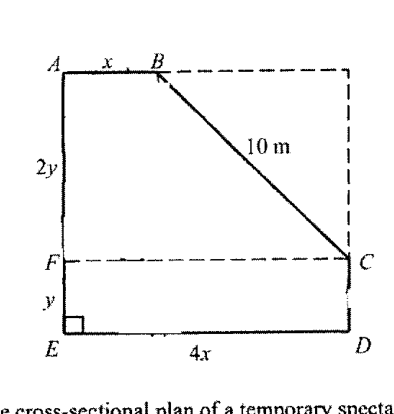
ABCDEFABCDEF 是一个临时观众看台的横截面图,其中 ABAB 平行于 FCFC 和 EDED,且 AEAE 平行于 CDCD。
已知 AB=xAB = x,ED=4xED = 4x,FE=yFE = y,AF=2yAF = 2y 且 BC=10 mBC = 10\text{ m}。

  1. (a)

    用 xx 表示 yy。

  2. (b)

    证明看台横截面面积 SS 由下式给出:
    S=92x100−9x2.S = \frac{9}{2}x\sqrt{100 - 9x^2}.

  3. (c)

    若 xx 是可变的,求 SS 的驻值。

  4. (d)

    由此,确定它是极大值还是极小值。

先不看答案,让 AI 诊断你卡在哪里?

它不会直接告诉你答案,而是问你卡在哪一步看看 AI 是怎么陪你一步步弄懂这道题的

完整解法

9(a)

1. Find the horizontal and vertical distances between points $B$ and $C$.

Horizontal distance between BB and CC is FC−AB=4x−x=3xFC - AB = 4x - x = 3x.
Vertical distance between BB and CC is AF=2yAF = 2y.

2. Apply Pythagoras' theorem to the right-angled triangle formed by $B$, $C$, and their horizontal/vertical projections.

(3x)2+(2y)2=BC29x2+4y2=1029x2+4y2=100(3x)^2 + (2y)^2 = BC^2 9x^2 + 4y^2 = 10^2 9x^2 + 4y^2 = 100

3. Rearrange the equation to express $y$ in terms of $x$.

4y2=100−9x2y2=100−9x24y=100−9x224y^2 = 100 - 9x^2 y^2 = \frac{100 - 9x^2}{4} y = \frac{\sqrt{100 - 9x^2}}{2} (since y>0y > 0)

答案

y=12100−9x2y = \frac{1}{2}\sqrt{100 - 9x^2}

9(b)

1. Find the expression for $y$ in terms of $x$ (from part a).

By drawing a vertical line from BB down to FCFC, a right-angled triangle is formed with horizontal side 4x−x=3x4x - x = 3x and vertical side 2y2y.
Using Pythagoras' theorem:
(3x)2+(2y)2=102(3x)^2 + (2y)^2 = 10^2
9x2+4y2=1009x^2 + 4y^2 = 100
y=12100−9x2y = \frac{1}{2}\sqrt{100 - 9x^2}

2. Express the total area $S$ in terms of $x$ and $y$ by splitting the figure.

The cross-section can be split into the trapezium ABCFABCF and the rectangle FCDEFCDE.
Area of trapezium ABCF=12(AB+FC)×AFABCF = \frac{1}{2}(AB + FC) \times AF
=12(x+4x)(2y)=5xy= \frac{1}{2}(x + 4x)(2y) = 5xy
Area of rectangle FCDE=ED×FEFCDE = ED \times FE
=4x×y=4xy= 4x \times y = 4xy
Total area S=5xy+4xy=9xyS = 5xy + 4xy = 9xy

3. Substitute $y$ into the area expression to obtain the final formula.

Substitute y=12100−9x2y = \frac{1}{2}\sqrt{100 - 9x^2} into S=9xyS = 9xy:
S=9x(12100−9x2)S = 9x \left( \frac{1}{2}\sqrt{100 - 9x^2} \right)
S=92x100−9x2S = \frac{9}{2}x\sqrt{100 - 9x^2} (shown)

答案

S=92x100−9x2S = \frac{9}{2}x\sqrt{100 - 9x^2}

9(c)

1. Differentiate $S$ with respect to $x$ using the product and chain rules.

S=92x(100−9x2)12S = \frac{9}{2}x(100 - 9x^2)^{\frac{1}{2}}

dSdx=92(100−9x2)12+92x[12(100−9x2)−12(−18x)]\frac{dS}{dx} = \frac{9}{2}(100 - 9x^2)^{\frac{1}{2}} + \frac{9}{2}x \left[ \frac{1}{2}(100 - 9x^2)^{-\frac{1}{2}}(-18x) \right]
dSdx=92100−9x2−81x22100−9x2\frac{dS}{dx} = \frac{9}{2}\sqrt{100 - 9x^2} - \frac{81x^2}{2\sqrt{100 - 9x^2}}

2. Set the derivative to zero to find the stationary point.

For a stationary value, dSdx=0\frac{dS}{dx} = 0:
92100−9x2−81x22100−9x2=0\frac{9}{2}\sqrt{100 - 9x^2} - \frac{81x^2}{2\sqrt{100 - 9x^2}} = 0
92100−9x2=81x22100−9x2\frac{9}{2}\sqrt{100 - 9x^2} = \frac{81x^2}{2\sqrt{100 - 9x^2}}

3. Solve for $x^2$.

Multiply both sides by 2100−9x22\sqrt{100 - 9x^2}:
9(100−9x2)=81x29(100 - 9x^2) = 81x^2
900−81x2=81x2900 - 81x^2 = 81x^2
162x2=900162x^2 = 900
x2=900162=509x^2 = \frac{900}{162} = \frac{50}{9}

4. Substitute $x^2$ back into the expression for $S$ to find the stationary value.

Since x>0x > 0 (as it represents a length), x=503=523x = \frac{\sqrt{50}}{3} = \frac{5\sqrt{2}}{3}.
Substitute xx and x2x^2 into SS:
S=92(523)100−9(509)S = \frac{9}{2} \left( \frac{5\sqrt{2}}{3} \right) \sqrt{100 - 9\left(\frac{50}{9}\right)}
S=1522100−50S = \frac{15\sqrt{2}}{2} \sqrt{100 - 50}
S=152250S = \frac{15\sqrt{2}}{2} \sqrt{50}
S=1522(52)S = \frac{15\sqrt{2}}{2} (5\sqrt{2})
S=75×22=75S = \frac{75 \times 2}{2} = 75

答案

7575

9(d)

1. Use the first derivative test to determine the nature of the stationary point

From part (c), dSdx=450−81x2100−9x2\frac{dS}{dx} = \frac{450 - 81x^2}{\sqrt{100 - 9x^2}} and the stationary point is at x=503≈2.357x = \frac{\sqrt{50}}{3} \approx 2.357.

Testing values around x=2.357x = 2.357:
When x=2x = 2, dSdx=450−81(2)2100−9(2)2=1268>0\frac{dS}{dx} = \frac{450 - 81(2)^2}{\sqrt{100 - 9(2)^2}} = \frac{126}{8} > 0
When x=3x = 3, dSdx=450−81(3)2100−9(3)2=−27919<0\frac{dS}{dx} = \frac{450 - 81(3)^2}{\sqrt{100 - 9(3)^2}} = \frac{-279}{\sqrt{19}} < 0

2. Conclude the nature of the stationary value

Since the gradient dSdx\frac{dS}{dx} changes from positive to negative as xx increases through the stationary point, the stationary value is a maximum.

答案

Maximum value

AI 分析,可能出错

用 AI 批改,圈出写错的那一步,并自动将你的薄弱点存入错题本,形成你的错因库。

同一知识点的其他题

  1. 1如图所示,一个建在矩形底面上的温室。建造拱形屋顶和两个完全相同的半圆形侧面共使用了 140 m2140\text{ m}^2 的聚乙烯薄膜。每个半圆的半径为 r mr\text{ m},温室的长度为 y my\text{ m}。 证明温室的体积 V m3V\text{ m}^3…
  2. 2在三角形 ABCABC 中,AB=x cmAB = x\ \text{cm},AC=3x cmAC = 3x\ \text{cm},且角 BAC=2π3BAC = \dfrac{2\pi}{3}。如果 xx 以 0.5 cm/s0.5\ \text{cm/s} 的速率增加,求当 x=4x = 4…
  3. 3已知一条曲线的方程为 y=2x−33x+4y = \frac{2x - 3}{3x + 4},其中 x≠−43x \ne -\frac{4}{3}。 曲线在点 PP(其中 x>0x > 0)处的法线平行于直线 y=−2517x+2y = -\frac{25}{17}x + 2。…
  4. 4求曲线 y=2x2−ln⁡x+cy = 2x^2 - \ln x + c 的导函数。 曲线在点 TT 处与正 xx 轴相切。求 TT 的坐标。 证明 c=−ln⁡2ec = -\ln 2\sqrt{e}。 求在点 TT 处 d2ydx2\frac{\text{d}^2y}{\text{d}x^2}…
  5. 5曲线 y=2tan⁡3x−1y = 2\tan 3x - 1 在点 P(π3,−1)P\left(\frac{\pi}{3}, -1\right) 处的法线交 yy 轴于点 AA,交 xx 轴于点 BB。求三角形 AOBAOB 的精确面积。