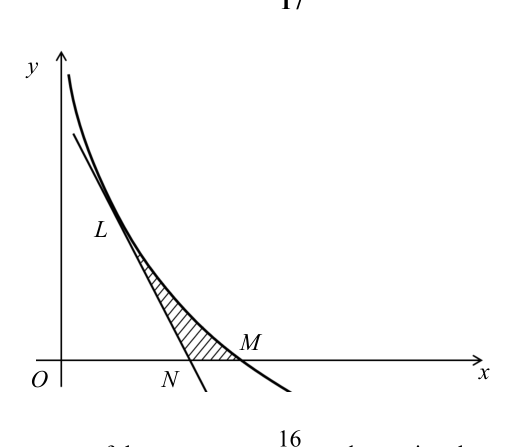
1. Find the coordinates of $M$, where the curve cuts the $x$-axis.
At M, y=0:
(x+1)216−1=0
(x+1)2=16
Since x>0 from the diagram,
x+1=4⟹x=3
So, M is (3,0).
2. Find the $x$-coordinate of $L$ using the given gradient of the tangent.
y=16(x+1)−2−1
dxdy=−32(x+1)−3
Given the gradient is −4:
−32(x+1)−3=−4
(x+1)3=8
x+1=2⟹x=1
3. Find the $y$-coordinate of $L$ and the equation of the tangent to find $N$.
When x=1, y=(1+1)216−1=4−1=3.
So, L is (1,3).
Equation of the tangent at L:
y−3=−4(x−1)
y=−4x+7
At N, the tangent cuts the x-axis (y=0):
−4x+7=0⟹x=1.75
So, N is (1.75,0).
4. Calculate the area under the curve from $x = 1$ to $x = 3$.
Area under curve=∫13((x+1)216−1)dx
=[−x+116−x]13
=(−416−3)−(−216−1)
=(−4−3)−(−8−1)
=−7−(−9)=2
5. Calculate the area of the shaded region $LMN$.
The shaded area is the area under the curve minus the area of the triangle formed by the tangent, the x-axis, and the vertical line x=1.
Area of triangle=21×base×height
=21×(1.75−1)×3
=21×0.75×3=1.125
Shaded Area=2−1.125=0.875