下图展示了由正方形组成的一系列图案。阶段 0 由一个边长为 1 的正方形表示。在随后的每个阶段中,将前一阶段中最小正方形边长一半的正方形,添加到前一阶段中正方形的未占用顶点上。 设 为阶段 0 的正方形面积, 为阶段 新添加的每个正方形的面积。例如, 且 。
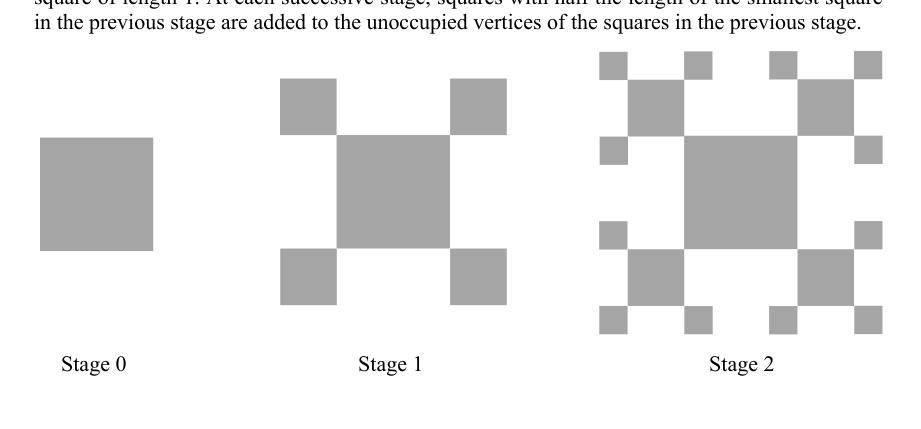
- (a)
求 的表达式,用 表示你的答案。
- (b)
证明在阶段 新添加的正方形的总面积为 。
- (c)
证明在阶段 所有正方形的总面积为 。
- (d)
当在每个阶段添加新正方形的过程无限进行下去时,就形成了一个正方形分形。
给出为什么该正方形分形的面积收敛的理由,并写出该面积的值。
- (e)
已知阶段 中正方形的总面积首次超过正方形分形面积的 90%。求 的值,并求出阶段 时的正方形总数。
它不会直接告诉你答案,而是问你卡在哪一步看看 AI 是怎么陪你一步步弄懂这道题的
完整解法
12(a)
1. Determine the side length of the squares added in Stage $n$.
Let the side length of the squares added in Stage be .
Since the side length is halved at each successive stage and , we have a geometric sequence:
2. Calculate the area $A_n$ in terms of $n$.
The area of each square is the square of its side length:
12(b)
1. Determine the area of each new square added at Stage $n$ (from part a).
Since the side length of the square halves at each stage, the area of the square becomes of the previous stage's square.
With and , the area of each new square at Stage is:
2. Determine the number of new squares added at Stage $n$.
At Stage 1, new squares are added.
In each subsequent stage, new squares are added to the unoccupied vertices of each square added in the previous stage.
Thus, the number of new squares multiplies by at each stage, forming a geometric sequence with first term and common ratio :
Number of new squares at Stage
3. Calculate the total area of the new squares added at Stage $n$.
Total area = (Number of new squares)
12(c)
1. Express the total area of Stage $n$ as the sum of the initial Stage 0 area and the areas added in all subsequent stages up to $n$.
2. Calculate the sum of the new areas added from Stage 1 to Stage $n$ using the geometric series sum formula.
The series is a geometric progression with first term , common ratio , and terms.
3. Add the area of Stage 0 and simplify to obtain the final expression.
5 - 4\left(\frac{3}{4}\right)^n \text{ (Shown)}
12(d)
1. Give a mathematical reason for convergence
As , the term approaches because the common ratio satisfies .
2. Calculate the value of the converging area
Using the expression from part (c):
Reason: As , because .
Value:
12(e)
1. Set up the inequality for the area at Stage $m$ using the area of the square fractal.
From part (d), the area of the square fractal is .
The total area in Stage must exceed 90% of this value:
2. Solve the inequality to find the integer value of $m$.
Taking natural logarithms on both sides:
Since is negative, the inequality sign flips:
Since must be an integer, .
3. Identify the pattern for the number of squares added at each stage.
The number of new squares added at each stage forms a sequence:
Stage 1: squares
Stage 2: squares
Stage 3: squares
This is a geometric progression with first term and common ratio .
4. Calculate the total number of squares at Stage 8.
The sum of new squares added from Stage 1 to Stage 8 is:
The total number of squares includes the initial square at Stage 0:
, total number of squares =
AI 分析,可能出错
用 AI 批改,圈出写错的那一步,并自动将你的薄弱点存入错题本,形成你的错因库。