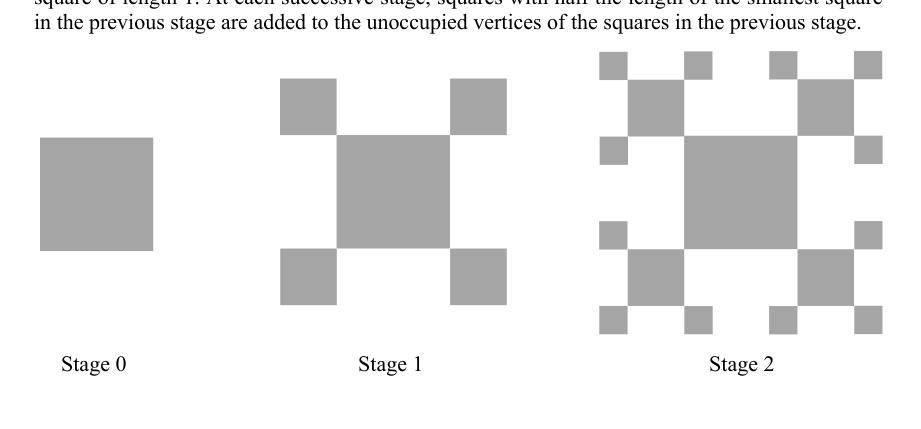
The diagrams below show a sequence of patterns formed by squares. Stage 0 is represented by a square of length 1. At each successive stage, squares with half the length of the smallest square in the previous stage are added to the unoccupied vertices of the squares in the previous stage. Let be the area of the square in Stage 0 and be the area of each new square added in Stage . For example, and .
- (a)
Find an expression for , giving your answer in terms of .
- (b)
Show that the total area of new squares added in Stage is given by .
- (c)
Show that the total area of all the squares in Stage is given by .
- (d)
A square fractal is formed when this process of adding new squares at each stage continues indefinitely.
Give a reason why the area of the square fractal converges and write down its value.
- (e)
The total area of the squares in Stage first exceeds 90% of the area of the square fractal. Find the value of and find the total number of squares at Stage .
It won't just hand you the answer — it asks where you're stuck.How the checker works
Worked solution
12(a)
1. Determine the side length of the squares added in Stage $n$.
Let the side length of the squares added in Stage be .
Since the side length is halved at each successive stage and , we have a geometric sequence:
2. Calculate the area $A_n$ in terms of $n$.
The area of each square is the square of its side length:
12(b)
1. Determine the area of each new square added at Stage $n$ (from part a).
Since the side length of the square halves at each stage, the area of the square becomes of the previous stage's square.
With and , the area of each new square at Stage is:
2. Determine the number of new squares added at Stage $n$.
At Stage 1, new squares are added.
In each subsequent stage, new squares are added to the unoccupied vertices of each square added in the previous stage.
Thus, the number of new squares multiplies by at each stage, forming a geometric sequence with first term and common ratio :
Number of new squares at Stage
3. Calculate the total area of the new squares added at Stage $n$.
Total area = (Number of new squares)
12(c)
1. Express the total area of Stage $n$ as the sum of the initial Stage 0 area and the areas added in all subsequent stages up to $n$.
2. Calculate the sum of the new areas added from Stage 1 to Stage $n$ using the geometric series sum formula.
The series is a geometric progression with first term , common ratio , and terms.
3. Add the area of Stage 0 and simplify to obtain the final expression.
5 - 4\left(\frac{3}{4}\right)^n \text{ (Shown)}
12(d)
1. Give a mathematical reason for convergence
As , the term approaches because the common ratio satisfies .
2. Calculate the value of the converging area
Using the expression from part (c):
Reason: As , because .
Value:
12(e)
1. Set up the inequality for the area at Stage $m$ using the area of the square fractal.
From part (d), the area of the square fractal is .
The total area in Stage must exceed 90% of this value:
2. Solve the inequality to find the integer value of $m$.
Taking natural logarithms on both sides:
Since is negative, the inequality sign flips:
Since must be an integer, .
3. Identify the pattern for the number of squares added at each stage.
The number of new squares added at each stage forms a sequence:
Stage 1: squares
Stage 2: squares
Stage 3: squares
This is a geometric progression with first term and common ratio .
4. Calculate the total number of squares at Stage 8.
The sum of new squares added from Stage 1 to Stage 8 is:
The total number of squares includes the initial square at Stage 0:
, total number of squares =
AI analysis — may contain mistakes.
Worked this one out on paper? Snap your steps and Gigle's AI math checker will circle the step where it went wrong.
More questions on this topic
- 1The sum of the first terms of a series is given by . Show that this series follows an arithmetic pr…
- 2The sum of the first terms of a series is given by . Show that this series follows an arithmetic pr…
- 3等比数列中,若、是方程的两根,则的值为 A. B. C. …
- 4The sum of the first 100 terms of an arithmetic progression is 10,000. The first, second and fifth terms of this progres…
- 5A sequence of numbers has sum where . It is given th…