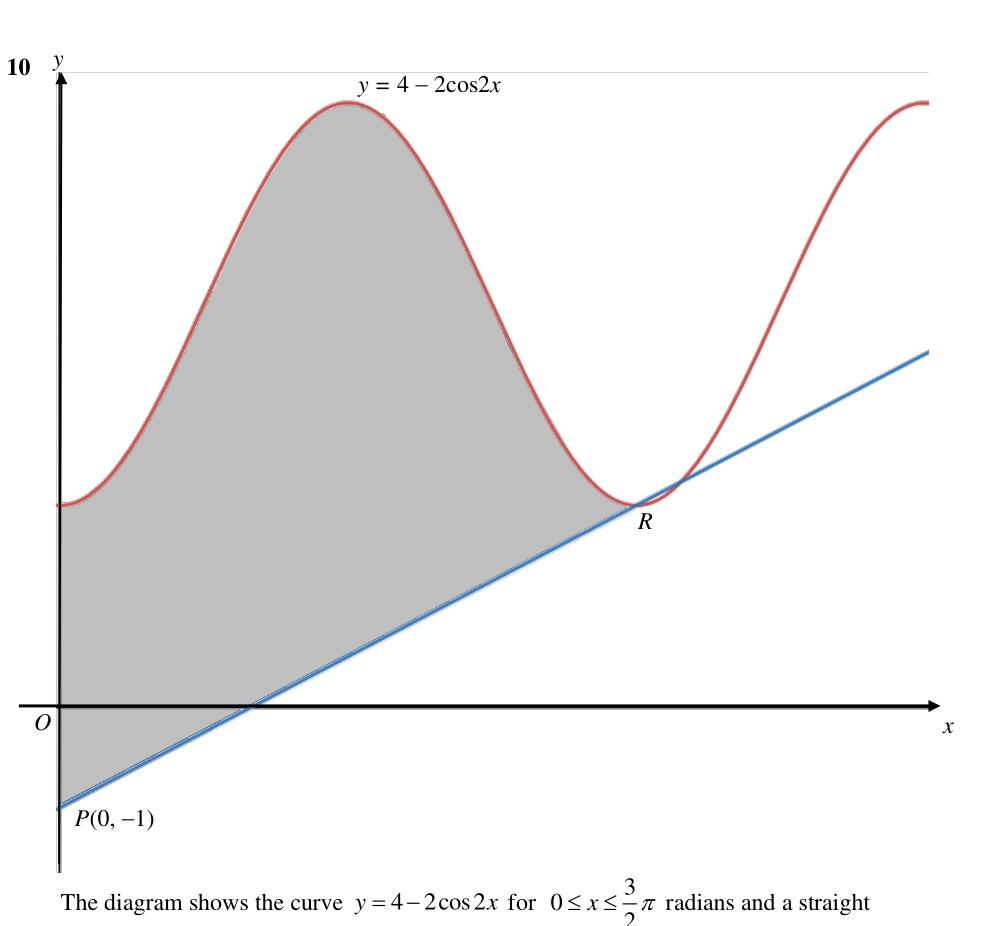
1. Find the coordinates of the minimum point $R$.
For y=4−2cos2x to be a minimum, cos2x must be at its maximum value of 1.
y=4−2(1)=2
cos2x=1⟹2x=0,2π,4π,…
From the diagram, R is the first minimum after x=0, so 2x=2π⟹x=π.
The coordinates of R are (π,2).
2. Find the equation of the line $PR$.
The line passes through P(0,−1) and R(π,2).
Gradient m=π−02−(−1)=π3
The y-intercept is −1.
Equation of line PR: y=π3x−1
3. Set up the definite integral for the area bounded by the curve and the line.
Area=∫0π[(4−2cos2x)−(π3x−1)]dx
Area=∫0π(5−2cos2x−π3x)dx
4. Integrate the expression.
∫(5−2cos2x−π3x)dx=5x−sin2x−2π3x2
5. Evaluate the definite integral to find the final area.
Area=[5x−sin2x−2π3x2]0π
=(5π−sin2π−2π3(π)2)−(0−sin0−0)
=5π−0−23π=27π