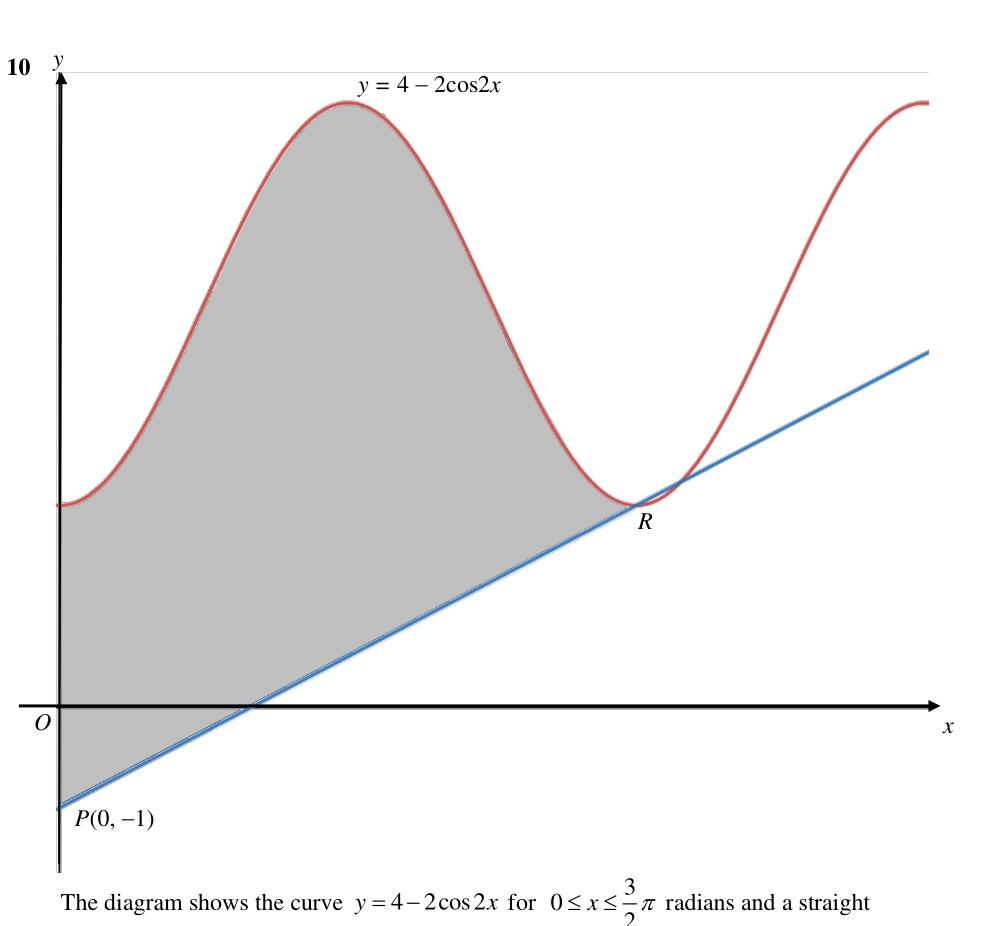
The diagram shows the curve for radians and a straight line passing through points and . The coordinates of are and is a minimum point of the curve. Find the area of the region bounded by the curve , the line segment and the -axis. Continuation of working space for question 10.
Area curve and linesAmplitude periodicityParallel perpendicularIntegration linear argumentStandard integralsEvaluating definite integrals中文
It won't just hand you the answer — it asks where you're stuck.How the checker works
Worked solution
10
1. Find the coordinates of the minimum point $R$.
For to be a minimum, must be at its maximum value of .
From the diagram, is the first minimum after , so .
The coordinates of are .
2. Find the equation of the line $PR$.
The line passes through and .
Gradient
The -intercept is .
Equation of line :
3. Set up the definite integral for the area bounded by the curve and the line.
4. Integrate the expression.
5. Evaluate the definite integral to find the final area.
Answer
AI analysis — may contain mistakes.
Worked this one out on paper? Snap your steps and Gigle's AI math checker will circle the step where it went wrong.
More questions on this topic
- 1The figure shows part of the curve . and are two points on the curve. Given that …
- 2The diagram shows part of the curve which crosses the -axis at and the -axis at …
- 3The diagram shows part of the curve . The line is tangent to the curve at . The points an…
- 4The diagram shows part of the curve and two lines and . The lines and are ta…
- 5The diagram below shows the graph of and the tangent to the curve where the curve intersects the …