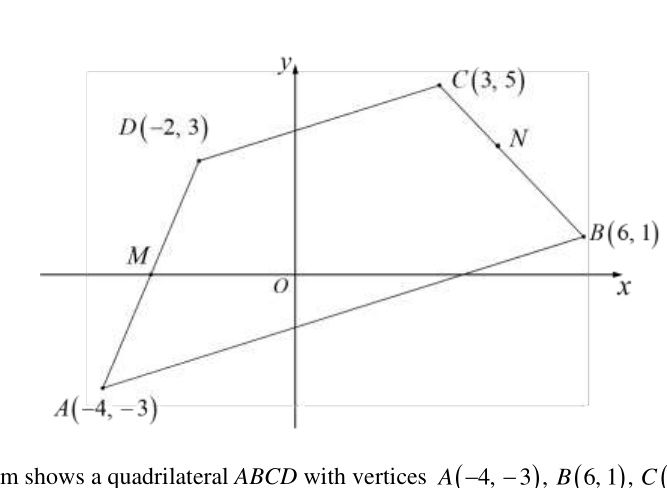
下图显示了一个顶点为 A(−4,−3)A(-4, -3)、B(6,1)B(6, 1)、C(3,5)C(3, 5) 和 D(−2,3)D(-2, 3) 的四边形 ABCDABCD。MM 位于 x 轴上,是边 ADAD 的中点。

  1. (a)

    解释为什么 ABCDABCD 是一个梯形。

  2. (b)

    求 MM 的坐标。

  3. (c)

    点 N 在边 BC 上。已知四边形 MNCD 的面积为 654\frac{65}{4} 平方单位,求 N 的坐标。

先不看答案,让 AI 诊断你卡在哪里?

它不会直接告诉你答案,而是问你卡在哪一步看看 AI 是怎么陪你一步步弄懂这道题的

完整解法

9(a)

1. Calculate the gradient of side AB.

Gradient of AB=1−(−3)6−(−4)=410=25AB = \frac{1 - (-3)}{6 - (-4)} = \frac{4}{10} = \frac{2}{5}

2. Calculate the gradient of side DC.

Gradient of DC=5−33−(−2)=25DC = \frac{5 - 3}{3 - (-2)} = \frac{2}{5}

3. Conclude that ABCD is a trapezium based on parallel sides.

Since the gradient of ABAB equals the gradient of DCDC, the lines ABAB and DCDC are parallel. A quadrilateral with exactly one pair of parallel sides is a trapezium.

答案

Gradient of AB=25AB = \frac{2}{5} and Gradient of DC=25DC = \frac{2}{5}. Since the gradients are equal, ABAB is parallel to DCDC. A quadrilateral with one pair of parallel opposite sides is a trapezium.

9(b)

1. Apply the midpoint formula to points $A$ and $D$

Coordinates of M=(−4+(−2)2,−3+32)M = \left( \frac{-4 + (-2)}{2}, \frac{-3 + 3}{2} \right)

2. Evaluate the coordinates

M=(−62,02)=(−3,0)M = \left( \frac{-6}{2}, \frac{0}{2} \right) = (-3, 0)

答案

(−3,0)(-3, 0)

9(c)

1. Find the coordinates of $M$ (from part b).

MM is the midpoint of A(−4,−3)A(-4, -3) and D(−2,3)D(-2, 3).
M=(−4+(−2)2,−3+32)=(−3,0)M = \left(\frac{-4 + (-2)}{2}, \frac{-3 + 3}{2}\right) = (-3, 0)

2. Find the equation of the line $BC$.

Gradient of BC=5−13−6=4−3=−43BC = \frac{5 - 1}{3 - 6} = \frac{4}{-3} = -\frac{4}{3}
Equation of BCBC:
y−1=−43(x−6)y - 1 = -\frac{4}{3}(x - 6)
y=−43x+8+1y = -\frac{4}{3}x + 8 + 1
y=−43x+9y = -\frac{4}{3}x + 9

3. Express the coordinates of $N$ and set up the area equation for quadrilateral $MNCD$.

Let NN be (x,−43x+9)(x, -\frac{4}{3}x + 9).
Using the shoelace formula for the area of MNCDMNCD with vertices M(−3,0)M(-3, 0), N(x,−43x+9)N(x, -\frac{4}{3}x + 9), C(3,5)C(3, 5), and D(−2,3)D(-2, 3):
Area=12∣−3x3−2−30−43x+9530∣=654\text{Area} = \frac{1}{2} \left| \begin{matrix} -3 & x & 3 & -2 & -3 \\ 0 & -\frac{4}{3}x + 9 & 5 & 3 & 0 \end{matrix} \right| = \frac{65}{4}
12∣(−3(−43x+9)+5x+9+0)−(0+3(−43x+9)−10−9)∣=654\frac{1}{2} \left| \left( -3\left(-\frac{4}{3}x + 9\right) + 5x + 9 + 0 \right) - \left( 0 + 3\left(-\frac{4}{3}x + 9\right) - 10 - 9 \right) \right| = \frac{65}{4}

4. Simplify the area equation.

12∣(4x−27+5x+9)−(−4x+27−19)∣=654\frac{1}{2} \left| (4x - 27 + 5x + 9) - (-4x + 27 - 19) \right| = \frac{65}{4}
12∣(9x−18)−(−4x+8)∣=654\frac{1}{2} \left| (9x - 18) - (-4x + 8) \right| = \frac{65}{4}
12∣13x−26∣=654\frac{1}{2} \left| 13x - 26 \right| = \frac{65}{4}
∣13x−26∣=652=32.5|13x - 26| = \frac{65}{2} = 32.5

5. Solve for $x$ and find the corresponding $y$-coordinate.

13x−26=32.5or13x−26=−32.513x - 26 = 32.5 \quad \text{or} \quad 13x - 26 = -32.5
13x=58.5or13x=−6.513x = 58.5 \quad \text{or} \quad 13x = -6.5
x=4.5orx=−0.5x = 4.5 \quad \text{or} \quad x = -0.5
Since NN lies on the line segment BCBC, its xx-coordinate must be between xC=3x_C=3 and xB=6x_B=6. Thus, x=4.5x = 4.5.
Substitute x=4.5x = 4.5 into the equation of BCBC:
y=−43(4.5)+9=−6+9=3y = -\frac{4}{3}(4.5) + 9 = -6 + 9 = 3
The coordinates of NN are (4.5,3)(4.5, 3).

答案

(4.5,3)(4.5, 3)

AI 分析,可能出错

用 AI 批改,圈出写错的那一步,并自动将你的薄弱点存入错题本,形成你的错因库。

同一知识点的其他题

  1. 1已知一条曲线的方程为 y=2x−33x+4y = \frac{2x - 3}{3x + 4},其中 x≠−43x \ne -\frac{4}{3}。 曲线在点 PP(其中 x>0x > 0)处的法线平行于直线 y=−2517x+2y = -\frac{25}{17}x + 2。…
  2. 2曲线 y=2tan⁡3x−1y = 2\tan 3x - 1 在点 P(π3,−1)P\left(\frac{\pi}{3}, -1\right) 处的法线交 yy 轴于点 AA,交 xx 轴于点 BB。求三角形 AOBAOB 的精确面积。
  3. 3点 PP 在曲线 y=ln⁡(x+1x−1)y = \ln\left(\frac{x+1}{x-1}\right)(x>1x > 1)上。该曲线在点 PP 处的法线平行于直线 2y=3x+22y = 3x + 2。曲线在点 PP 处的切线交 yy 轴于点 QQ。求…
  4. 4图中显示了曲线 y=g(x)y = g(x) 的一部分。(2,8)(2, 8) 和 (6,1)(6, 1) 是曲线上的两个点。 已知 ∫26y dx=32\int_{2}^{6} y \text{ } dx = 32,求 ∫18x dy\int_{1}^{8} x \text{ } dy…
  5. 5图示为曲线 y=3e−12x−6y = 3e^{-\frac{1}{2}x} - 6 的一部分,该曲线与 xx 轴相交于点 PP,与 yy 轴相交于点 QQ。曲线在点 QQ 处的法线与 xx 轴交于点 RR。求 法线的方程, 阴影区域的面积。