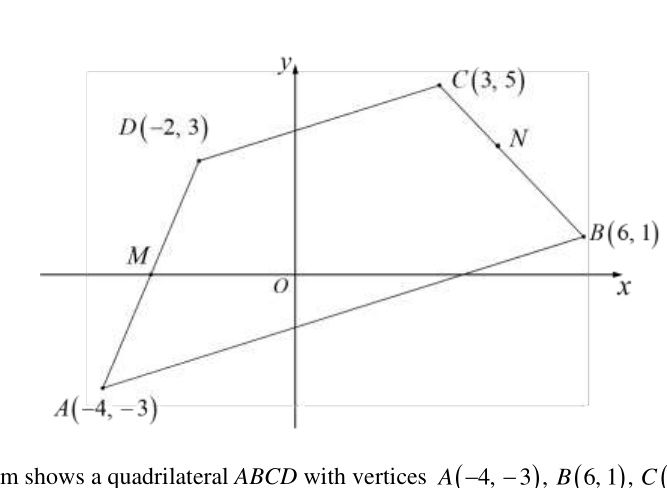
The diagram shows a quadrilateral ABCDABCD with vertices A(−4,−3)A(-4, -3), B(6,1)B(6, 1), C(3,5)C(3, 5) and D(−2,3)D(-2, 3). MM which lies on the x-axis is the midpoint of the side ADAD.

  1. (a)

    Explain why ABCDABCD is a trapezium.

  2. (b)

    Find the coordinates of MM.

  3. (c)

    A point N is on the side BC. Given that the area of the quadrilateral MNCD is 654\frac{65}{4} units^2, find the coordinates of N.

Work through it with AI →

It won't just hand you the answer — it asks where you're stuck.How the checker works

Worked solution

9(a)

1. Calculate the gradient of side AB.

Gradient of AB=1−(−3)6−(−4)=410=25AB = \frac{1 - (-3)}{6 - (-4)} = \frac{4}{10} = \frac{2}{5}

2. Calculate the gradient of side DC.

Gradient of DC=5−33−(−2)=25DC = \frac{5 - 3}{3 - (-2)} = \frac{2}{5}

3. Conclude that ABCD is a trapezium based on parallel sides.

Since the gradient of ABAB equals the gradient of DCDC, the lines ABAB and DCDC are parallel. A quadrilateral with exactly one pair of parallel sides is a trapezium.

Answer

Gradient of AB=25AB = \frac{2}{5} and Gradient of DC=25DC = \frac{2}{5}. Since the gradients are equal, ABAB is parallel to DCDC. A quadrilateral with one pair of parallel opposite sides is a trapezium.

9(b)

1. Apply the midpoint formula to points $A$ and $D$

Coordinates of M=(−4+(−2)2,−3+32)M = \left( \frac{-4 + (-2)}{2}, \frac{-3 + 3}{2} \right)

2. Evaluate the coordinates

M=(−62,02)=(−3,0)M = \left( \frac{-6}{2}, \frac{0}{2} \right) = (-3, 0)

Answer

(−3,0)(-3, 0)

9(c)

1. Find the coordinates of $M$ (from part b).

MM is the midpoint of A(−4,−3)A(-4, -3) and D(−2,3)D(-2, 3).
M=(−4+(−2)2,−3+32)=(−3,0)M = \left(\frac{-4 + (-2)}{2}, \frac{-3 + 3}{2}\right) = (-3, 0)

2. Find the equation of the line $BC$.

Gradient of BC=5−13−6=4−3=−43BC = \frac{5 - 1}{3 - 6} = \frac{4}{-3} = -\frac{4}{3}
Equation of BCBC:
y−1=−43(x−6)y - 1 = -\frac{4}{3}(x - 6)
y=−43x+8+1y = -\frac{4}{3}x + 8 + 1
y=−43x+9y = -\frac{4}{3}x + 9

3. Express the coordinates of $N$ and set up the area equation for quadrilateral $MNCD$.

Let NN be (x,−43x+9)(x, -\frac{4}{3}x + 9).
Using the shoelace formula for the area of MNCDMNCD with vertices M(−3,0)M(-3, 0), N(x,−43x+9)N(x, -\frac{4}{3}x + 9), C(3,5)C(3, 5), and D(−2,3)D(-2, 3):
Area=12∣−3x3−2−30−43x+9530∣=654\text{Area} = \frac{1}{2} \left| \begin{matrix} -3 & x & 3 & -2 & -3 \\ 0 & -\frac{4}{3}x + 9 & 5 & 3 & 0 \end{matrix} \right| = \frac{65}{4}
12∣(−3(−43x+9)+5x+9+0)−(0+3(−43x+9)−10−9)∣=654\frac{1}{2} \left| \left( -3\left(-\frac{4}{3}x + 9\right) + 5x + 9 + 0 \right) - \left( 0 + 3\left(-\frac{4}{3}x + 9\right) - 10 - 9 \right) \right| = \frac{65}{4}

4. Simplify the area equation.

12∣(4x−27+5x+9)−(−4x+27−19)∣=654\frac{1}{2} \left| (4x - 27 + 5x + 9) - (-4x + 27 - 19) \right| = \frac{65}{4}
12∣(9x−18)−(−4x+8)∣=654\frac{1}{2} \left| (9x - 18) - (-4x + 8) \right| = \frac{65}{4}
12∣13x−26∣=654\frac{1}{2} \left| 13x - 26 \right| = \frac{65}{4}
∣13x−26∣=652=32.5|13x - 26| = \frac{65}{2} = 32.5

5. Solve for $x$ and find the corresponding $y$-coordinate.

13x−26=32.5or13x−26=−32.513x - 26 = 32.5 \quad \text{or} \quad 13x - 26 = -32.5
13x=58.5or13x=−6.513x = 58.5 \quad \text{or} \quad 13x = -6.5
x=4.5orx=−0.5x = 4.5 \quad \text{or} \quad x = -0.5
Since NN lies on the line segment BCBC, its xx-coordinate must be between xC=3x_C=3 and xB=6x_B=6. Thus, x=4.5x = 4.5.
Substitute x=4.5x = 4.5 into the equation of BCBC:
y=−43(4.5)+9=−6+9=3y = -\frac{4}{3}(4.5) + 9 = -6 + 9 = 3
The coordinates of NN are (4.5,3)(4.5, 3).

Answer

(4.5,3)(4.5, 3)

AI analysis — may contain mistakes.

Worked this one out on paper? Snap your steps and Gigle's AI math checker will circle the step where it went wrong.

More questions on this topic

  1. 1A curve has the equation y=2x−33x+4y = \frac{2x - 3}{3x + 4}, where x≠−43x \ne -\frac{4}{3}. The normal to the point PP on the cur…
  2. 2The normal to the curve y=2tan⁡3x−1y = 2\tan 3x - 1 at point P(π3,−1)P\left(\frac{\pi}{3}, -1\right) crosses the yy-axis at point AA…
  3. 3The point PP lies on the curve y=ln⁡(x+1x−1)y = \ln\left(\frac{x+1}{x-1}\right) for x>1x > 1. The normal to the curve at PP is par…
  4. 4The figure shows part of the curve y=g(x)y = g(x). (2,8)(2, 8) and (6,1)(6, 1) are two points on the curve. Given that ∫26y dx=32\int_{2}^{6} y \text{ } dx = 32…
  5. 5The diagram shows part of the curve y=3e−12x−6y = 3e^{-\frac{1}{2}x} - 6 which crosses the xx-axis at PP and the yy-axis at QQ…