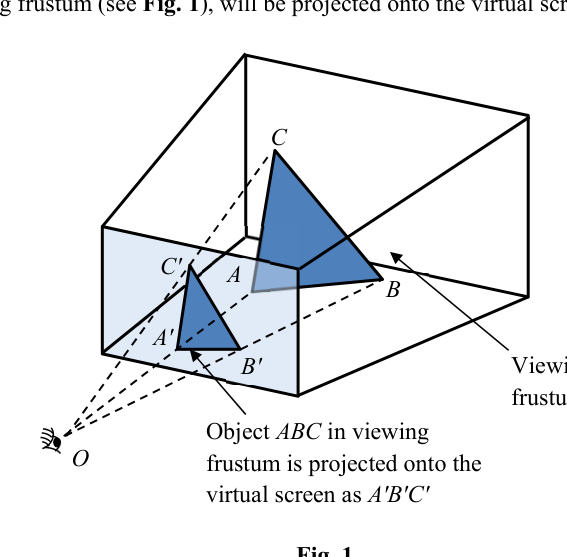
为了构建虚拟现实(VR)体验,需要创建一个包含几何模型的虚拟世界。以原点 OO 为基准,虚拟世界中的每个点都表示为坐标 (x,y,z)(x, y, z)。透视投影是一种将虚拟世界中的点投影到虚拟屏幕上,同时保持物体在不同距离下的缩放特性的技术。在 VR 中正确实现这一点有助于感知深度 and 比例。此外,只有位于位于 OO 处的眼睛前方的区域(称为视景体,见图 1)内的点才会被投影到虚拟屏幕上。 在图 1 中,视景体中的一个三角形物体 ABCABC(其中 A(36,36,12)A(36,36,12) 且 B(24,48,72)B(24,48,72))被投影到虚拟屏幕上,得到图像 A′B′C′A'B'C'。已知 A′A' 的坐标为 (3,3,1)(3,3,1),且穿过 A′A' 和 B′B' 的直线平行于向量 2i+j−2k2\mathbf{i}+\mathbf{j}-2\mathbf{k}。

  1. (i)

    证明 B′B' 的坐标为 (1,2,3)(1,2,3)。

  2. (ii)

    已知 C′C' 的坐标为 (1,4,2)(1,4,2),求虚拟屏幕的数量积形式方程。

  3. (iii)

    求三角形 A′B′C′A'B'C' 的精确面积。

  4. (iv)

    如果 BC→\overrightarrow{BC} 在虚拟屏幕法线上的投影长度为 5729\tfrac{57}{29} 个单位,求 CC 可能的位置向量,答案用精确形式表示。

先不看答案,让 AI 诊断你卡在哪里?

它不会直接告诉你答案,而是问你卡在哪一步看看 AI 是怎么陪你一步步弄懂这道题的

完整解法

7(i)

1. Form the vector equation of the line passing through the origin $O$ and point $B$.

Since the projection is from OO, the image point B′B' must lie on the line passing through O(0,0,0)O(0, 0, 0) and B(24,48,72)B(24, 48, 72).
The direction vector of this line is OB→=(244872)\overrightarrow{OB} = \begin{pmatrix} 24 \\ 48 \\ 72 \end{pmatrix}, which is parallel to (123)\begin{pmatrix} 1 \\ 2 \\ 3 \end{pmatrix}.
The equation of line OBOB is:
lOB:r=μ(123)l_{OB}: \mathbf{r} = \mu \begin{pmatrix} 1 \\ 2 \\ 3 \end{pmatrix}

2. Form the vector equation of the line passing through $A'$ and $B'$.

We are given that A′A' has coordinates (3,3,1)(3, 3, 1) and the line A′B′A'B' is parallel to 2i+j−2k2\mathbf{i} + \mathbf{j} - 2\mathbf{k}.
The equation of line A′B′A'B' is:
lA′B′:r=(331)+λ(21−2)l_{A'B'}: \mathbf{r} = \begin{pmatrix} 3 \\ 3 \\ 1 \end{pmatrix} + \lambda \begin{pmatrix} 2 \\ 1 \\ -2 \end{pmatrix}

3. Equate the two line equations to find their point of intersection, $B'$.

Since B′B' lies on both lines, we equate their position vectors:
(μ2μ3μ)=(3+2λ3+λ1−2λ)\begin{pmatrix} \mu \\ 2\mu \\ 3\mu \end{pmatrix} = \begin{pmatrix} 3 + 2\lambda \\ 3 + \lambda \\ 1 - 2\lambda \end{pmatrix}
This gives a system of linear equations:
μ=3+2λ— (1)\mu = 3 + 2\lambda \quad \text{--- (1)}
2μ=3+λ— (2)2\mu = 3 + \lambda \quad \text{--- (2)}
3μ=1−2λ— (3)3\mu = 1 - 2\lambda \quad \text{--- (3)}

4. Solve the system of equations for the parameters $\lambda$ and $\mu$.

Substitute equation (1) into equation (2):
2(3+2λ)=3+λ2(3 + 2\lambda) = 3 + \lambda
6+4λ=3+λ6 + 4\lambda = 3 + \lambda
3λ=−3  ⟹  λ=−13\lambda = -3 \implies \lambda = -1
Substitute λ=−1\lambda = -1 into equation (1):
μ=3+2(−1)=1\mu = 3 + 2(-1) = 1
(Check for consistency with equation (3): 3(1)=33(1) = 3 and 1−2(−1)=31 - 2(-1) = 3. The lines intersect consistently.)

5. Determine the position vector and coordinates of $B'$.

Using μ=1\mu = 1, the position vector of B′B' is:
OB′→=1(123)=(123)\overrightarrow{OB'} = 1 \begin{pmatrix} 1 \\ 2 \\ 3 \end{pmatrix} = \begin{pmatrix} 1 \\ 2 \\ 3 \end{pmatrix}
Hence, the coordinates of B′B' are (1,2,3)(1, 2, 3).

答案

The coordinates of B′B' are (1,2,3)(1, 2, 3).

7(ii)

1. Find two non-parallel direction vectors that lie on the virtual screen.

From part (i), the line through A′A' and B′B' is parallel to d1=(21−2)\mathbf{d}_1 = \begin{pmatrix} 2 \\ 1 \\ -2 \end{pmatrix}.

Using the coordinates of A′A' and C′C', we find another direction vector on the plane:
A′C′→=OC′→−OA′→=(142)−(331)=(−211)\overrightarrow{A'C'} = \overrightarrow{OC'} - \overrightarrow{OA'} = \begin{pmatrix} 1 \\ 4 \\ 2 \end{pmatrix} - \begin{pmatrix} 3 \\ 3 \\ 1 \end{pmatrix} = \begin{pmatrix} -2 \\ 1 \\ 1 \end{pmatrix}

2. Determine a normal vector to the virtual screen by taking the cross product of the two direction vectors.

n=d1×A′C′→=(21−2)×(−211)\mathbf{n} = \mathbf{d}_1 \times \overrightarrow{A'C'} = \begin{pmatrix} 2 \\ 1 \\ -2 \end{pmatrix} \times \begin{pmatrix} -2 \\ 1 \\ 1 \end{pmatrix}
n=((1)(1)−(−2)(1)(−2)(−2)−(2)(1)(2)(1)−(1)(−2))=(324)\mathbf{n} = \begin{pmatrix} (1)(1) - (-2)(1) \\ (-2)(-2) - (2)(1) \\ (2)(1) - (1)(-2) \end{pmatrix} = \begin{pmatrix} 3 \\ 2 \\ 4 \end{pmatrix}

3. Formulate the equation of the plane in scalar product form $\mathbf{r} \cdot \mathbf{n} = \mathbf{a} \cdot \mathbf{n}$.

r⋅n=OA′→⋅n\mathbf{r} \cdot \mathbf{n} = \overrightarrow{OA'} \cdot \mathbf{n}
r⋅(324)=(331)⋅(324)\mathbf{r} \cdot \begin{pmatrix} 3 \\ 2 \\ 4 \end{pmatrix} = \begin{pmatrix} 3 \\ 3 \\ 1 \end{pmatrix} \cdot \begin{pmatrix} 3 \\ 2 \\ 4 \end{pmatrix}
r⋅(324)=3(3)+3(2)+1(4)\mathbf{r} \cdot \begin{pmatrix} 3 \\ 2 \\ 4 \end{pmatrix} = 3(3) + 3(2) + 1(4)
r⋅(324)=19\mathbf{r} \cdot \begin{pmatrix} 3 \\ 2 \\ 4 \end{pmatrix} = 19

答案

r⋅(324)=19\mathbf{r} \cdot \begin{pmatrix} 3 \\ 2 \\ 4 \end{pmatrix} = 19

7(iii)

1. Find the displacement vectors $\overrightarrow{A'B'}$ and $\overrightarrow{A'C'}$.

A′B′→=OB′→−OA′→=(123)−(331)=(−2−12)\overrightarrow{A'B'} = \overrightarrow{OB'} - \overrightarrow{OA'} = \begin{pmatrix} 1 \\ 2 \\ 3 \end{pmatrix} - \begin{pmatrix} 3 \\ 3 \\ 1 \end{pmatrix} = \begin{pmatrix} -2 \\ -1 \\ 2 \end{pmatrix}
A′C′→=OC′→−OA′→=(142)−(331)=(−211)\overrightarrow{A'C'} = \overrightarrow{OC'} - \overrightarrow{OA'} = \begin{pmatrix} 1 \\ 4 \\ 2 \end{pmatrix} - \begin{pmatrix} 3 \\ 3 \\ 1 \end{pmatrix} = \begin{pmatrix} -2 \\ 1 \\ 1 \end{pmatrix}

2. Evaluate the cross product of the two displacement vectors.

A′B′→×A′C′→=(−2−12)×(−211)=((−1)(1)−(2)(1)(2)(−2)−(−2)(1)(−2)(1)−(−1)(−2))=(−3−2−4)\overrightarrow{A'B'} \times \overrightarrow{A'C'} = \begin{pmatrix} -2 \\ -1 \\ 2 \end{pmatrix} \times \begin{pmatrix} -2 \\ 1 \\ 1 \end{pmatrix} = \begin{pmatrix} (-1)(1) - (2)(1) \\ (2)(-2) - (-2)(1) \\ (-2)(1) - (-1)(-2) \end{pmatrix} = \begin{pmatrix} -3 \\ -2 \\ -4 \end{pmatrix}
(Note: This cross product may have already been calculated in part (ii) to find the normal of the plane.)

3. Calculate the area of the triangle using the magnitude of the cross product.

Area of △A′B′C′=12∣A′B′→×A′C′→∣\text{Area of } \triangle A'B'C' = \frac{1}{2} |\overrightarrow{A'B'} \times \overrightarrow{A'C'}|
Area=12(−3)2+(−2)2+(−4)2\text{Area} = \frac{1}{2} \sqrt{(-3)^2 + (-2)^2 + (-4)^2}
Area=129+4+16=292 units2\text{Area} = \frac{1}{2} \sqrt{9 + 4 + 16} = \frac{\sqrt{29}}{2} \text{ units}^2

答案

292\frac{\sqrt{29}}{2}

7(iv)

1. Express the position vector of $C$ in terms of an unknown scalar.

Since C′C' is the perspective projection of CC from the projection centre OO, the points OO, C′C', and CC must be collinear. Thus, OC→\overrightarrow{OC} is a scalar multiple of OC′→\overrightarrow{OC'}. Since CC lies in front of OO, we have OC→=kOC′→\overrightarrow{OC} = k \overrightarrow{OC'} for some scalar k>0k > 0.
OC→=k(142)=(k4k2k)\overrightarrow{OC} = k \begin{pmatrix} 1 \\ 4 \\ 2 \end{pmatrix} = \begin{pmatrix} k \\ 4k \\ 2k \end{pmatrix}

2. Formulate the vector $\overrightarrow{BC}$ in terms of $k$.

Using the position vector of BB, OB→=(244872)\overrightarrow{OB} = \begin{pmatrix} 24 \\ 48 \\ 72 \end{pmatrix}:
BC→=OC→−OB→=(k4k2k)−(244872)=(k−244k−482k−72)\overrightarrow{BC} = \overrightarrow{OC} - \overrightarrow{OB} = \begin{pmatrix} k \\ 4k \\ 2k \end{pmatrix} - \begin{pmatrix} 24 \\ 48 \\ 72 \end{pmatrix} = \begin{pmatrix} k - 24 \\ 4k - 48 \\ 2k - 72 \end{pmatrix}

3. Express the length of projection of $\overrightarrow{BC}$ onto the normal of the virtual screen.

From part (ii), the normal vector to the virtual screen is n=(324)\mathbf{n} = \begin{pmatrix} 3 \\ 2 \\ 4 \end{pmatrix}. Its magnitude is ∣n∣=32+22+42=29|\mathbf{n}| = \sqrt{3^2 + 2^2 + 4^2} = \sqrt{29}.
The length of projection of BC→\overrightarrow{BC} onto the normal is given by ∣BC→⋅n∣∣n∣\frac{|\overrightarrow{BC} \cdot \mathbf{n}|}{|\mathbf{n}|}:
BC→⋅n=3(k−24)+2(4k−48)+4(2k−72)\overrightarrow{BC} \cdot \mathbf{n} = 3(k - 24) + 2(4k - 48) + 4(2k - 72)
=3k−72+8k−96+8k−288=19k−456=19(k−24)= 3k - 72 + 8k - 96 + 8k - 288 = 19k - 456 = 19(k - 24)
Length of projection=∣19(k−24)∣29\text{Length of projection} = \frac{|19(k - 24)|}{\sqrt{29}}

4. Equate the projection length to the given value and solve for $k$.

19∣k−24∣29=5729\frac{19|k - 24|}{\sqrt{29}} = \frac{57}{29}
∣k−24∣=5729×2919=32929|k - 24| = \frac{57}{29} \times \frac{\sqrt{29}}{19} = \frac{3\sqrt{29}}{29}
k=24±32929k = 24 \pm \frac{3\sqrt{29}}{29}
Since both values of kk are positive, CC stays in front of the viewing frustum for both cases. Substituting these into OC→\overrightarrow{OC} yields the possible position vectors:
OC→=(24+32929)(142)and(24−32929)(142)\overrightarrow{OC} = \left( 24 + \frac{3\sqrt{29}}{29} \right) \begin{pmatrix} 1 \\ 4 \\ 2 \end{pmatrix} \quad \text{and} \quad \left( 24 - \frac{3\sqrt{29}}{29} \right) \begin{pmatrix} 1 \\ 4 \\ 2 \end{pmatrix}

答案

(24+32929)(142)and(24−32929)(142)\left( 24 + \frac{3\sqrt{29}}{29} \right) \begin{pmatrix} 1 \\ 4 \\ 2 \end{pmatrix} \quad \text{and} \quad \left( 24 - \frac{3\sqrt{29}}{29} \right) \begin{pmatrix} 1 \\ 4 \\ 2 \end{pmatrix}

AI 分析,可能出错

用 AI 批改,圈出写错的那一步,并自动将你的薄弱点存入错题本,形成你的错因库。

同一知识点的其他题

  1. 1直线 l1l_1 和 l2l_2 的方程分别为 r=(4110)+λ(1−1−6),λ∈R\mathbf{r} = \begin{pmatrix} 4 \\ 1 \\ 10 \end{pmatrix} + \lambda \begin{pmatrix} 1 \\ -1 \\ -6 \end{pmatrix}, \lambda \in \mathbb{R}…
  2. 2一家钻探公司计划在山中铺设一条直管道 ABAB。点 (x,y,z)(x, y, z) 是相对于山脚下坐标为 (0,0,0)(0, 0, 0) 的主控制中心定义的,其中单位为米。xx 轴指向东,yy 轴指向北,zz 轴垂直向上。点 AA 的坐标为 (−200,150,10)(-200, 150, 10)…
  3. 3平面 Π1\Pi_1 的方程为 x+y+z=3x + y + z = 3。一条直线穿过点 PP 和 QQ,它们的位置向量分别为 i+j+2k\mathbf{i} + \mathbf{j} + 2\mathbf{k} 和 4i+2j−k4\mathbf{i} + 2\mathbf{j} - \mathbf{k}…
  4. 4平面 Π1\Pi_1 和 Π2\Pi_2 的向量方程分别为 r=λ1(i+j−k)+μ1(2i−j+k)andr=λ2(i+2j+k)+μ2(3i+j−k)\mathbf{r} = \lambda_1(\mathbf{i} + \mathbf{j} - \mathbf{k}) + \mu_1(2\mathbf{i} - \mathbf{j} + \mathbf{k}) \quad \text{and} \quad \mathbf{r} = \lambda_2(\mathbf{i} + 2\mathbf{j} + \mathbf{k}) + \mu_2(3\mathbf{i} + \mathbf{j} - \mathbf{k})…
  5. 5一位室内设计师正计划设计一个下拉式衣柜升降机。为了测试他的设想,设计师制作了一个它的微缩模型。在这个模型中,点 (x,y,z)(x, y, z) 是相对于模型的一个拐角 O(0,0,0)O(0, 0, 0) 来定义的。模型中使用的杆可以用直线方程来建模。 主杆可…