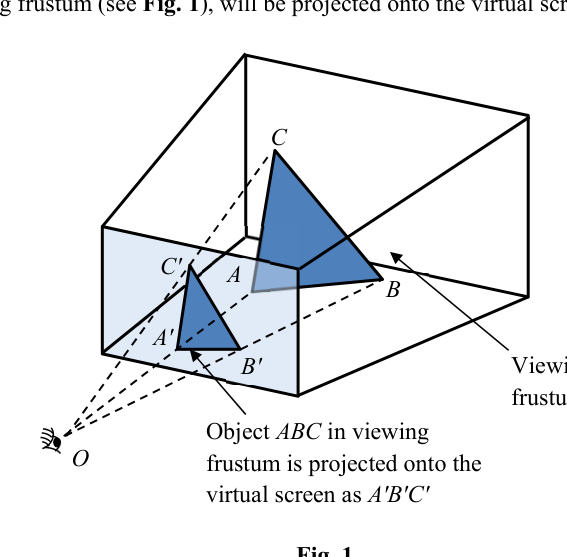
To build a Virtual Reality (VR) experience, a virtual world is created to contain geometric models. With reference to the origin OO, every point in the virtual world is represented as coordinates (x,y,z)(x, y, z). Perspective projection is a technique used to project points in the virtual world onto a virtual screen while respecting the scaling properties of objects at various distances. Getting this right in VR helps in the perception of depth and scale. In addition, only points that lie within a zone in front of the eye positioned at OO, known as the viewing frustum (see Fig. 1), will be projected onto the virtual screen. In Fig. 1, a triangular object ABCABC in the viewing frustum with A(36,36,12)A(36,36,12) and B(24,48,72)B(24,48,72) is projected onto the virtual screen to give an image of A′B′C′A'B'C'. It is given that the coordinates of A′A' are (3,3,1)(3,3,1) and the line that passes through A′A' and B′B' is parallel to the vector 2i+j−2k2\mathbf{i}+\mathbf{j}-2\mathbf{k}.

  1. (i)

    Show that the coordinates of B′B' are (1,2,3)(1,2,3).

  2. (ii)

    Given that the coordinates of C′C' are (1,4,2)(1,4,2), find the equation of the virtual screen in scalar product form.

  3. (iii)

    Find the exact area of triangle A′B′C′A'B'C'.

  4. (iv)

    If the length of projection of BC→\overrightarrow{BC} onto the normal of the virtual screen is 5729\tfrac{57}{29} units, find the possible position vector(s) of CC, leaving your answer(s) in exact form.

Work through it with AI →

It won't just hand you the answer — it asks where you're stuck.How the checker works

Worked solution

7(i)

1. Form the vector equation of the line passing through the origin $O$ and point $B$.

Since the projection is from OO, the image point B′B' must lie on the line passing through O(0,0,0)O(0, 0, 0) and B(24,48,72)B(24, 48, 72).
The direction vector of this line is OB→=(244872)\overrightarrow{OB} = \begin{pmatrix} 24 \\ 48 \\ 72 \end{pmatrix}, which is parallel to (123)\begin{pmatrix} 1 \\ 2 \\ 3 \end{pmatrix}.
The equation of line OBOB is:
lOB:r=μ(123)l_{OB}: \mathbf{r} = \mu \begin{pmatrix} 1 \\ 2 \\ 3 \end{pmatrix}

2. Form the vector equation of the line passing through $A'$ and $B'$.

We are given that A′A' has coordinates (3,3,1)(3, 3, 1) and the line A′B′A'B' is parallel to 2i+j−2k2\mathbf{i} + \mathbf{j} - 2\mathbf{k}.
The equation of line A′B′A'B' is:
lA′B′:r=(331)+λ(21−2)l_{A'B'}: \mathbf{r} = \begin{pmatrix} 3 \\ 3 \\ 1 \end{pmatrix} + \lambda \begin{pmatrix} 2 \\ 1 \\ -2 \end{pmatrix}

3. Equate the two line equations to find their point of intersection, $B'$.

Since B′B' lies on both lines, we equate their position vectors:
(μ2μ3μ)=(3+2λ3+λ1−2λ)\begin{pmatrix} \mu \\ 2\mu \\ 3\mu \end{pmatrix} = \begin{pmatrix} 3 + 2\lambda \\ 3 + \lambda \\ 1 - 2\lambda \end{pmatrix}
This gives a system of linear equations:
μ=3+2λ— (1)\mu = 3 + 2\lambda \quad \text{--- (1)}
2μ=3+λ— (2)2\mu = 3 + \lambda \quad \text{--- (2)}
3μ=1−2λ— (3)3\mu = 1 - 2\lambda \quad \text{--- (3)}

4. Solve the system of equations for the parameters $\lambda$ and $\mu$.

Substitute equation (1) into equation (2):
2(3+2λ)=3+λ2(3 + 2\lambda) = 3 + \lambda
6+4λ=3+λ6 + 4\lambda = 3 + \lambda
3λ=−3  ⟹  λ=−13\lambda = -3 \implies \lambda = -1
Substitute λ=−1\lambda = -1 into equation (1):
μ=3+2(−1)=1\mu = 3 + 2(-1) = 1
(Check for consistency with equation (3): 3(1)=33(1) = 3 and 1−2(−1)=31 - 2(-1) = 3. The lines intersect consistently.)

5. Determine the position vector and coordinates of $B'$.

Using μ=1\mu = 1, the position vector of B′B' is:
OB′→=1(123)=(123)\overrightarrow{OB'} = 1 \begin{pmatrix} 1 \\ 2 \\ 3 \end{pmatrix} = \begin{pmatrix} 1 \\ 2 \\ 3 \end{pmatrix}
Hence, the coordinates of B′B' are (1,2,3)(1, 2, 3).

Answer

The coordinates of B′B' are (1,2,3)(1, 2, 3).

7(ii)

1. Find two non-parallel direction vectors that lie on the virtual screen.

From part (i), the line through A′A' and B′B' is parallel to d1=(21−2)\mathbf{d}_1 = \begin{pmatrix} 2 \\ 1 \\ -2 \end{pmatrix}.

Using the coordinates of A′A' and C′C', we find another direction vector on the plane:
A′C′→=OC′→−OA′→=(142)−(331)=(−211)\overrightarrow{A'C'} = \overrightarrow{OC'} - \overrightarrow{OA'} = \begin{pmatrix} 1 \\ 4 \\ 2 \end{pmatrix} - \begin{pmatrix} 3 \\ 3 \\ 1 \end{pmatrix} = \begin{pmatrix} -2 \\ 1 \\ 1 \end{pmatrix}

2. Determine a normal vector to the virtual screen by taking the cross product of the two direction vectors.

n=d1×A′C′→=(21−2)×(−211)\mathbf{n} = \mathbf{d}_1 \times \overrightarrow{A'C'} = \begin{pmatrix} 2 \\ 1 \\ -2 \end{pmatrix} \times \begin{pmatrix} -2 \\ 1 \\ 1 \end{pmatrix}
n=((1)(1)−(−2)(1)(−2)(−2)−(2)(1)(2)(1)−(1)(−2))=(324)\mathbf{n} = \begin{pmatrix} (1)(1) - (-2)(1) \\ (-2)(-2) - (2)(1) \\ (2)(1) - (1)(-2) \end{pmatrix} = \begin{pmatrix} 3 \\ 2 \\ 4 \end{pmatrix}

3. Formulate the equation of the plane in scalar product form $\mathbf{r} \cdot \mathbf{n} = \mathbf{a} \cdot \mathbf{n}$.

r⋅n=OA′→⋅n\mathbf{r} \cdot \mathbf{n} = \overrightarrow{OA'} \cdot \mathbf{n}
r⋅(324)=(331)⋅(324)\mathbf{r} \cdot \begin{pmatrix} 3 \\ 2 \\ 4 \end{pmatrix} = \begin{pmatrix} 3 \\ 3 \\ 1 \end{pmatrix} \cdot \begin{pmatrix} 3 \\ 2 \\ 4 \end{pmatrix}
r⋅(324)=3(3)+3(2)+1(4)\mathbf{r} \cdot \begin{pmatrix} 3 \\ 2 \\ 4 \end{pmatrix} = 3(3) + 3(2) + 1(4)
r⋅(324)=19\mathbf{r} \cdot \begin{pmatrix} 3 \\ 2 \\ 4 \end{pmatrix} = 19

Answer

r⋅(324)=19\mathbf{r} \cdot \begin{pmatrix} 3 \\ 2 \\ 4 \end{pmatrix} = 19

7(iii)

1. Find the displacement vectors $\overrightarrow{A'B'}$ and $\overrightarrow{A'C'}$.

A′B′→=OB′→−OA′→=(123)−(331)=(−2−12)\overrightarrow{A'B'} = \overrightarrow{OB'} - \overrightarrow{OA'} = \begin{pmatrix} 1 \\ 2 \\ 3 \end{pmatrix} - \begin{pmatrix} 3 \\ 3 \\ 1 \end{pmatrix} = \begin{pmatrix} -2 \\ -1 \\ 2 \end{pmatrix}
A′C′→=OC′→−OA′→=(142)−(331)=(−211)\overrightarrow{A'C'} = \overrightarrow{OC'} - \overrightarrow{OA'} = \begin{pmatrix} 1 \\ 4 \\ 2 \end{pmatrix} - \begin{pmatrix} 3 \\ 3 \\ 1 \end{pmatrix} = \begin{pmatrix} -2 \\ 1 \\ 1 \end{pmatrix}

2. Evaluate the cross product of the two displacement vectors.

A′B′→×A′C′→=(−2−12)×(−211)=((−1)(1)−(2)(1)(2)(−2)−(−2)(1)(−2)(1)−(−1)(−2))=(−3−2−4)\overrightarrow{A'B'} \times \overrightarrow{A'C'} = \begin{pmatrix} -2 \\ -1 \\ 2 \end{pmatrix} \times \begin{pmatrix} -2 \\ 1 \\ 1 \end{pmatrix} = \begin{pmatrix} (-1)(1) - (2)(1) \\ (2)(-2) - (-2)(1) \\ (-2)(1) - (-1)(-2) \end{pmatrix} = \begin{pmatrix} -3 \\ -2 \\ -4 \end{pmatrix}
(Note: This cross product may have already been calculated in part (ii) to find the normal of the plane.)

3. Calculate the area of the triangle using the magnitude of the cross product.

Area of △A′B′C′=12∣A′B′→×A′C′→∣\text{Area of } \triangle A'B'C' = \frac{1}{2} |\overrightarrow{A'B'} \times \overrightarrow{A'C'}|
Area=12(−3)2+(−2)2+(−4)2\text{Area} = \frac{1}{2} \sqrt{(-3)^2 + (-2)^2 + (-4)^2}
Area=129+4+16=292 units2\text{Area} = \frac{1}{2} \sqrt{9 + 4 + 16} = \frac{\sqrt{29}}{2} \text{ units}^2

Answer

292\frac{\sqrt{29}}{2}

7(iv)

1. Express the position vector of $C$ in terms of an unknown scalar.

Since C′C' is the perspective projection of CC from the projection centre OO, the points OO, C′C', and CC must be collinear. Thus, OC→\overrightarrow{OC} is a scalar multiple of OC′→\overrightarrow{OC'}. Since CC lies in front of OO, we have OC→=kOC′→\overrightarrow{OC} = k \overrightarrow{OC'} for some scalar k>0k > 0.
OC→=k(142)=(k4k2k)\overrightarrow{OC} = k \begin{pmatrix} 1 \\ 4 \\ 2 \end{pmatrix} = \begin{pmatrix} k \\ 4k \\ 2k \end{pmatrix}

2. Formulate the vector $\overrightarrow{BC}$ in terms of $k$.

Using the position vector of BB, OB→=(244872)\overrightarrow{OB} = \begin{pmatrix} 24 \\ 48 \\ 72 \end{pmatrix}:
BC→=OC→−OB→=(k4k2k)−(244872)=(k−244k−482k−72)\overrightarrow{BC} = \overrightarrow{OC} - \overrightarrow{OB} = \begin{pmatrix} k \\ 4k \\ 2k \end{pmatrix} - \begin{pmatrix} 24 \\ 48 \\ 72 \end{pmatrix} = \begin{pmatrix} k - 24 \\ 4k - 48 \\ 2k - 72 \end{pmatrix}

3. Express the length of projection of $\overrightarrow{BC}$ onto the normal of the virtual screen.

From part (ii), the normal vector to the virtual screen is n=(324)\mathbf{n} = \begin{pmatrix} 3 \\ 2 \\ 4 \end{pmatrix}. Its magnitude is ∣n∣=32+22+42=29|\mathbf{n}| = \sqrt{3^2 + 2^2 + 4^2} = \sqrt{29}.
The length of projection of BC→\overrightarrow{BC} onto the normal is given by ∣BC→⋅n∣∣n∣\frac{|\overrightarrow{BC} \cdot \mathbf{n}|}{|\mathbf{n}|}:
BC→⋅n=3(k−24)+2(4k−48)+4(2k−72)\overrightarrow{BC} \cdot \mathbf{n} = 3(k - 24) + 2(4k - 48) + 4(2k - 72)
=3k−72+8k−96+8k−288=19k−456=19(k−24)= 3k - 72 + 8k - 96 + 8k - 288 = 19k - 456 = 19(k - 24)
Length of projection=∣19(k−24)∣29\text{Length of projection} = \frac{|19(k - 24)|}{\sqrt{29}}

4. Equate the projection length to the given value and solve for $k$.

19∣k−24∣29=5729\frac{19|k - 24|}{\sqrt{29}} = \frac{57}{29}
∣k−24∣=5729×2919=32929|k - 24| = \frac{57}{29} \times \frac{\sqrt{29}}{19} = \frac{3\sqrt{29}}{29}
k=24±32929k = 24 \pm \frac{3\sqrt{29}}{29}
Since both values of kk are positive, CC stays in front of the viewing frustum for both cases. Substituting these into OC→\overrightarrow{OC} yields the possible position vectors:
OC→=(24+32929)(142)and(24−32929)(142)\overrightarrow{OC} = \left( 24 + \frac{3\sqrt{29}}{29} \right) \begin{pmatrix} 1 \\ 4 \\ 2 \end{pmatrix} \quad \text{and} \quad \left( 24 - \frac{3\sqrt{29}}{29} \right) \begin{pmatrix} 1 \\ 4 \\ 2 \end{pmatrix}

Answer

(24+32929)(142)and(24−32929)(142)\left( 24 + \frac{3\sqrt{29}}{29} \right) \begin{pmatrix} 1 \\ 4 \\ 2 \end{pmatrix} \quad \text{and} \quad \left( 24 - \frac{3\sqrt{29}}{29} \right) \begin{pmatrix} 1 \\ 4 \\ 2 \end{pmatrix}

AI analysis — may contain mistakes.

Worked this one out on paper? Snap your steps and Gigle's AI math checker will circle the step where it went wrong.

More questions on this topic

  1. 1The lines l1l_1 and l2l_2 have equations r=(4110)+λ(1−1−6),λ∈R\mathbf{r} = \begin{pmatrix} 4 \\ 1 \\ 10 \end{pmatrix} + \lambda \begin{pmatrix} 1 \\ -1 \\ -6 \end{pmatrix}, \lambda \in \mathbb{R}…
  2. 2A drilling company plans to install a straight pipeline ABAB through a mountain. Points (x,y,z)(x, y, z) are defined relative…
  3. 3A plane Π1\Pi_1 has equation x+y+z=3x + y + z = 3. A line passes through the points PP and QQ with position vectors i+j+2k\mathbf{i} + \mathbf{j} + 2\mathbf{k}…
  4. 4The planes Π1\Pi_1 and Π2\Pi_2 have vector equations r=λ1(i+j−k)+μ1(2i−j+k)andr=λ2(i+2j+k)+μ2(3i+j−k)\mathbf{r} = \lambda_1(\mathbf{i} + \mathbf{j} - \mathbf{k}) + \mu_1(2\mathbf{i} - \mathbf{j} + \mathbf{k}) \quad \text{and} \quad \mathbf{r} = \lambda_2(\mathbf{i} + 2\mathbf{j} + \mathbf{k}) + \mu_2(3\mathbf{i} + \mathbf{j} - \mathbf{k})…
  5. 5A home interior designer is looking to design a pull-down wardrobe lift. To test his concept, the designer built a small…