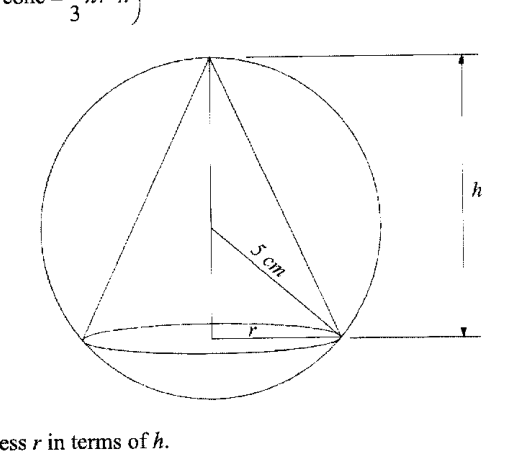
一个高为 hh、底面半径为 rr 的圆锥恰好内接于一个半径为 5 cm5\text{ cm} 的球体中,如下图所示。 (圆锥的体积=13πr2h)\left(\text{圆锥的体积} = \frac{1}{3}\pi r^2 h\right)

  1. (i)

    用 hh 表示 rr。

  2. (ii)

    证明圆锥的体积为 V=πh2(10−h)3V = \frac{\pi h^2 (10 - h)}{3}。

  3. (iii)

    求使 VV 取得驻值时 hh 的值。

  4. (iv)

    求在此 hh 值下圆锥的体积,并确定该体积是极大值还是极小值。

    阐明你的理由。

先不看答案,让 AI 诊断你卡在哪里?

它不会直接告诉你答案,而是问你卡在哪一步看看 AI 是怎么陪你一步步弄懂这道题的

完整解法

7(i)

1. Identify the right-angled triangle relating $r$, $h$, and the sphere's radius.

Let the center of the sphere be OO. The distance from OO to the base of the cone is h−5h - 5. The radius of the base is rr, and the radius of the sphere is 55. These form a right-angled triangle.

2. Apply Pythagoras' theorem to express $r$ in terms of $h$.

r2+(h−5)2=52r^2 + (h - 5)^2 = 5^2
r2+h2−10h+25=25r^2 + h^2 - 10h + 25 = 25
r2=10h−h2r^2 = 10h - h^2
r=10h−h2r = \sqrt{10h - h^2}

答案

r=10h−h2r = \sqrt{10h - h^2}

7(ii)

1. Recall or derive the expression for $r^2$ in terms of $h$ from part (i)

From part (i), using Pythagoras' theorem on the triangle formed by the sphere's centre, the cone's base centre, and the edge of the base:
r2+(h−5)2=52r^2 + (h - 5)^2 = 5^2
r2+h2−10h+25=25r^2 + h^2 - 10h + 25 = 25
r2=10h−h2r^2 = 10h - h^2

2. Substitute $r^2$ into the volume formula to show the given expression

V=13πr2hV = \frac{1}{3}\pi r^2 h
V=13π(10h−h2)hV = \frac{1}{3}\pi (10h - h^2) h
V=πh2(10−h)3V = \frac{\pi h^2 (10 - h)}{3} (Shown)

答案

Shown

7(iii)

1. Differentiate $V$ with respect to $h$

V=π3(10h2−h3)V = \frac{\pi}{3}(10h^2 - h^3)

dVdh=π3(20h−3h2)\frac{dV}{dh} = \frac{\pi}{3}(20h - 3h^2)

2. Set the derivative to zero to find stationary points

For stationary VV, dVdh=0\frac{dV}{dh} = 0

π3(20h−3h2)=0\frac{\pi}{3}(20h - 3h^2) = 0

h(20−3h)=0h(20 - 3h) = 0

3. Solve for $h$ and reject the invalid solution

h=0h = 0 or h=203h = \frac{20}{3}

Since h>0h > 0 for a cone, h=203h = \frac{20}{3}

答案

h=203h = \frac{20}{3}

7(iv)

1. Substitute the stationary value of $h$ into the volume equation

From part (iii), the stationary value is h=203h = \frac{20}{3}.
V=π(203)2(10−203)3V = \frac{\pi \left(\frac{20}{3}\right)^2 \left(10 - \frac{20}{3}\right)}{3}
V=π(4009)(103)3V = \frac{\pi \left(\frac{400}{9}\right) \left(\frac{10}{3}\right)}{3}
V=4000π81≈155.14 cm3V = \frac{4000\pi}{81} \approx 155.14 \text{ cm}^3

2. Find the second derivative of $V$ with respect to $h$

From part (iii), dVdh=20π3h−πh2\frac{\text{d}V}{\text{d}h} = \frac{20\pi}{3}h - \pi h^2.
d2Vdh2=20π3−2πh\frac{\text{d}^2V}{\text{d}h^2} = \frac{20\pi}{3} - 2\pi h

3. Evaluate the second derivative at $h = \frac{20}{3}$ to determine the nature of the stationary point

When h=203h = \frac{20}{3},
d2Vdh2=20π3−2π(203)=−20π3\frac{\text{d}^2V}{\text{d}h^2} = \frac{20\pi}{3} - 2\pi \left(\frac{20}{3}\right) = -\frac{20\pi}{3}
Since d2Vdh2<0\frac{\text{d}^2V}{\text{d}h^2} < 0, the volume is a maximum.

答案

V=4000π81 cm3V = \frac{4000\pi}{81}\text{ cm}^3 (or 155 cm3155\text{ cm}^3), Maximum

AI 分析,可能出错

用 AI 批改,圈出写错的那一步,并自动将你的薄弱点存入错题本,形成你的错因库。

同一知识点的其他题

  1. 1三角形 ABC 的面积为 16+7102 cm2\dfrac{16 + 7\sqrt{10}}{2}\ \text{cm}^2,AB 的长度为 (32+5) cm(3\sqrt{2} + \sqrt{5})\ \text{cm},且 AB 垂直于 BC。 求 BC 的长度…
  2. 2如果三角形的两条边分别为4和6,那么连结该三角形三边中点所得的周长可能是下列数据中的【 】 A. 6 B. 8 C. 10 D. 12
  3. 3在 ΔABC\Delta ABC 中,AC=12 cmAC = 12\text{ cm},∠ABC\angle ABC 为直角,∠ACB=π6\angle ACB = \frac{\pi}{6} 弧度,且 MM 是 BCBC 的中点。在不使用计算器的情况下,求整数 kk…
  4. 4图中展示了一个四边形 ABCDABCD,其顶点均落在圆周上。点 EE 位于 CDCD 的延长线上,使得 AEAE 是圆在点 AA 处的切线。CDCD 与 ABAB 为平行线。 解释为什么角 CBACBA = 角 EDAEDA。 证明三角形 DAEDAE…
  5. 5圆的方程为 x2+y2+8x−20y−53=0x^2 + y^2 + 8x - 20y - 53 = 0。 求圆的半径以及圆心的坐标。 求圆在点 P(1,−2)P(1, -2) 处的切线方程。 点 Q(9,10)Q(9, 10) 在该圆上。解释为什么圆在 QQ 点处的切线平行于 yy…