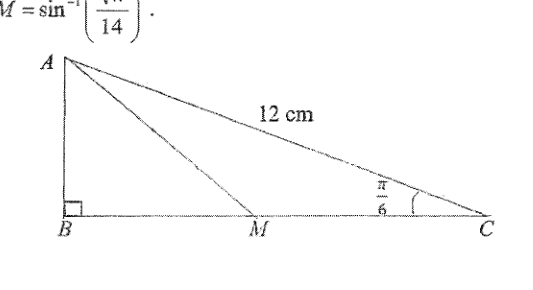
1. Find the lengths of AB and BC using exact trigonometric ratios
In ΔABC, ∠ABC=2π and ∠ACB=6π.
AB=ACsin(6π)=12×21=6 cm.
BC=ACcos(6π)=12×23=63 cm.
2. Find the length of CM and BM
Since M is the mid-point of BC,
CM=BM=21BC=21(63)=33 cm.
3. Find the length of AM using Pythagoras' theorem in triangle ABM
In right-angled ΔABM,
AM2=AB2+BM2
AM2=62+(33)2=36+27=63
AM=63=37 cm.
4. Use the sine rule in triangle ACM to find the sine of angle CAM
In ΔACM, using the sine rule:
CMsin(∠CAM)=AMsin(∠ACM)
33sin(∠CAM)=37sin(6π)
sin(∠CAM)=3733×21=273
5. Rationalise the denominator and find k
sin(∠CAM)=273×77=1421
Since ∠CAM=sin−1(14k), we have 14k=1421.
Therefore, k=21.