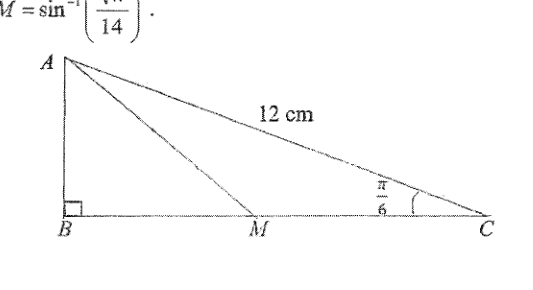
1. Find the lengths of AB and BC using exact trigonometric ratios
In Δ A B C \Delta ABC Δ A BC ∠ A B C = π 2 \angle ABC = \frac{\pi}{2} ∠ A BC = 2 π ∠ A C B = π 6 \angle ACB = \frac{\pi}{6} ∠ A CB = 6 π A B = A C sin ( π 6 ) = 12 × 1 2 = 6 cm AB = AC \sin\left(\frac{\pi}{6}\right) = 12 \times \frac{1}{2} = 6\text{ cm} A B = A C sin ( 6 π ) = 12 × 2 1 = 6 cm B C = A C cos ( π 6 ) = 12 × 3 2 = 6 3 cm BC = AC \cos\left(\frac{\pi}{6}\right) = 12 \times \frac{\sqrt{3}}{2} = 6\sqrt{3}\text{ cm} BC = A C cos ( 6 π ) = 12 × 2 3 = 6 3 cm
2. Find the length of CM and BM
Since M M M B C BC BC C M = B M = 1 2 B C = 1 2 ( 6 3 ) = 3 3 cm CM = BM = \frac{1}{2} BC = \frac{1}{2}(6\sqrt{3}) = 3\sqrt{3}\text{ cm} CM = BM = 2 1 BC = 2 1 ( 6 3 ) = 3 3 cm
3. Find the length of AM using Pythagoras' theorem in triangle ABM
In right-angled Δ A B M \Delta ABM Δ A BM A M 2 = A B 2 + B M 2 AM^2 = AB^2 + BM^2 A M 2 = A B 2 + B M 2 A M 2 = 6 2 + ( 3 3 ) 2 = 36 + 27 = 63 AM^2 = 6^2 + (3\sqrt{3})^2 = 36 + 27 = 63 A M 2 = 6 2 + ( 3 3 ) 2 = 36 + 27 = 63 A M = 63 = 3 7 cm AM = \sqrt{63} = 3\sqrt{7}\text{ cm} A M = 63 = 3 7 cm
4. Use the sine rule in triangle ACM to find the sine of angle CAM
In Δ A C M \Delta ACM Δ A CM sin ( ∠ C A M ) C M = sin ( ∠ A C M ) A M \frac{\sin(\angle CAM)}{CM} = \frac{\sin(\angle ACM)}{AM} CM s i n ( ∠ C A M ) = A M s i n ( ∠ A CM ) sin ( ∠ C A M ) 3 3 = sin ( π 6 ) 3 7 \frac{\sin(\angle CAM)}{3\sqrt{3}} = \frac{\sin(\frac{\pi}{6})}{3\sqrt{7}} 3 3 s i n ( ∠ C A M ) = 3 7 s i n ( 6 π ) sin ( ∠ C A M ) = 3 3 × 1 2 3 7 = 3 2 7 \sin(\angle CAM) = \frac{3\sqrt{3} \times \frac{1}{2}}{3\sqrt{7}} = \frac{\sqrt{3}}{2\sqrt{7}} sin ( ∠ C A M ) = 3 7 3 3 × 2 1 = 2 7 3
5. Rationalise the denominator and find k
sin ( ∠ C A M ) = 3 2 7 × 7 7 = 21 14 \sin(\angle CAM) = \frac{\sqrt{3}}{2\sqrt{7}} \times \frac{\sqrt{7}}{\sqrt{7}} = \frac{\sqrt{21}}{14} sin ( ∠ C A M ) = 2 7 3 × 7 7 = 14 21 ∠ C A M = sin − 1 ( k 14 ) \angle CAM = \sin^{-1}\left(\frac{\sqrt{k}}{14}\right) ∠ C A M = sin − 1 ( 14 k ) k 14 = 21 14 \frac{\sqrt{k}}{14} = \frac{\sqrt{21}}{14} 14 k = 14 21 k = 21 k = 21 k = 21