曲线 (如下图所示)的方程为 ,。
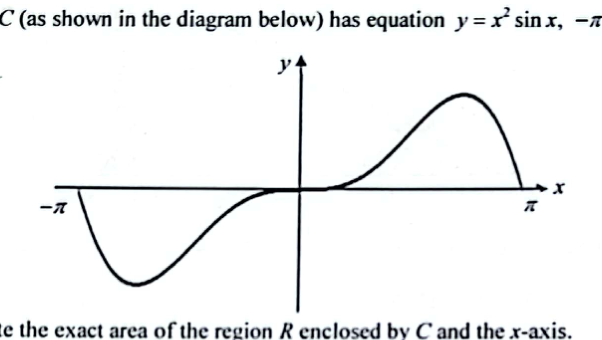
- (i)
计算由 和 轴所围成的区域 的精确面积。
- (ii)
画出方程为 的曲线草图,清晰地标出顶点的坐标以及所有渐近线的方程。
- (iii)
由此,求这两条曲线围成的区域绕 轴旋转一周所形成的旋转体的体积。
它不会直接告诉你答案,而是问你卡在哪一步看看 AI 是怎么陪你一步步弄懂这道题的
完整解法
8(i)
1. Formulate the definite integral for the total area of region $R$, utilising the symmetry of the curve.
Since for and for , the exact area is given by:
Because is an odd function (), the regions below and above the -axis are symmetric in area.
Thus, we can compute the area as:
2. Apply integration by parts for the first time on $x^2 \sin x$.
Using integration by parts, :
Let and .
Then and .
3. Apply integration by parts a second time to evaluate $\int x \cos x \,dx$.
For , let and .
Then and .
Substituting this back gives the integral:
4. Evaluate the definite integral using the limits from $0$ to $\pi$ to find the exact area.
Using , , and :
8(ii)
1. Identify the type of curve and its orientation from its equation.
The equation is , which can be rewritten as:
This is a hyperbola centred at that opens vertically (upwards and downwards).
2. Find the coordinates of the turning points (vertices).
The turning points lie on the vertical axis of symmetry, .
Substitute into the equation:
So, or .
The coordinates of the turning points are and .
3. Determine the equations of the asymptotes.
The equations of the asymptotes are found by setting the constant to 0:
For the positive case:
For the negative case:
The asymptotes are and .
4. Describe the features to be shown on the sketch.
Sketch the following features on the Cartesian axes:
- Centre at (not required to be explicitly marked, but guides the drawing).
- The two straight line asymptotes (drawn as dashed lines) and intersecting at the centre.
- The upper branch of the hyperbola with its minimum turning point at (which lies on the -axis).
- The lower branch of the hyperbola with its maximum turning point at .
- The curves approaching the asymptotes as .
Turning points: and
Asymptotes: and
(A valid sketch must show a two-branched hyperbola opening upwards and downwards, with the upper branch turning at and the lower branch turning at . The two dashed asymptotes and must intersect at the centre , and the branches must approach these lines as .)
8(iii)
1. Identify the relevant branch of the hyperbola and deduce the bounded region.
From the sketch in (ii), the hyperbola has an upper branch and a lower branch .
Since Curve () is strictly below the -axis for and the upper branch of the hyperbola does not intersect it to form a closed region, the bounded region must lie between Curve and the lower branch.
2. Find the $x$-coordinates of the intersection points using a graphing calculator.
Equating the two curves to find their points of intersection:
Using a graphing calculator, the -coordinates of the intersections are:
3. Set up the integral for the volume of the solid of revolution.
For , both curves lie below the -axis. Curve is further from the -axis (more negative) than the lower branch, making it the outer boundary. The outer radius is and the inner radius is .
The volume generated by rotating the region through 4 right angles () about the -axis is:
4. Evaluate the definite integral using a graphing calculator.
Evaluating the integral directly with a graphing calculator:
AI 分析,可能出错
用 AI 批改,圈出写错的那一步,并自动将你的薄弱点存入错题本,形成你的错因库。
同一知识点的其他题
- 1[剑桥/9709/2010] 图中显示了曲线 和 的部分图像以及它们的交点 和 。 和 的 坐标分别为 和 。 证…
- 2已知 展开式的前三项为 ,求 、 和 的值。 利用第 (i) 小题的答案,求由曲线 …
- 3曲线 C 的参数方程为 ,其中 为正常数。 曲线上的点 P 的参数为 ,曲线在点 P 处的切线与 轴交于点 S,与 轴交于点 T。点 M 是 ST 的中点。求当 …
- 4将方程为 的曲线先关于 y 轴进行反射,接着沿 x 轴负方向平移 1 个单位,最后在平行于 y 轴的方向上进行拉伸(缩放因子为 2)。所得曲线的方程由 给出,其中 …
- 5曲线 的方程为 ,其中 。 求 与 轴相交的点 处的切线方程。 画出 的草图,并用含 的式子给出渐近线方程、极值点…