The curve (as shown in the diagram below) has equation , .
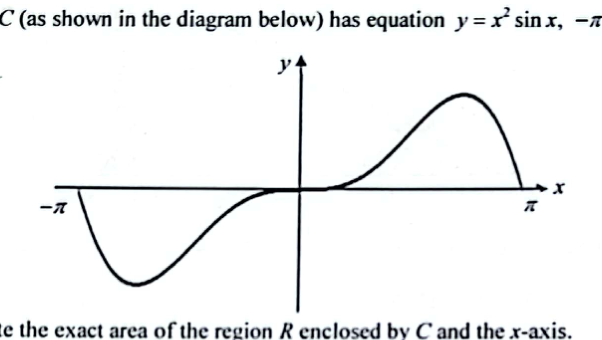
- (i)
Calculate the exact area of the region enclosed by and the -axis.
- (ii)
Sketch the curve with equation , showing clearly the coordinates of the turning points and the equation(s) of any asymptote(s).
- (iii)
Hence find the volume of the solid generated when the region bounded by the 2 curves is rotated through 4 right angles about the -axis.
It won't just hand you the answer — it asks where you're stuck.How the checker works
Worked solution
8(i)
1. Formulate the definite integral for the total area of region $R$, utilising the symmetry of the curve.
Since for and for , the exact area is given by:
Because is an odd function (), the regions below and above the -axis are symmetric in area.
Thus, we can compute the area as:
2. Apply integration by parts for the first time on $x^2 \sin x$.
Using integration by parts, :
Let and .
Then and .
3. Apply integration by parts a second time to evaluate $\int x \cos x \,dx$.
For , let and .
Then and .
Substituting this back gives the integral:
4. Evaluate the definite integral using the limits from $0$ to $\pi$ to find the exact area.
Using , , and :
8(ii)
1. Identify the type of curve and its orientation from its equation.
The equation is , which can be rewritten as:
This is a hyperbola centred at that opens vertically (upwards and downwards).
2. Find the coordinates of the turning points (vertices).
The turning points lie on the vertical axis of symmetry, .
Substitute into the equation:
So, or .
The coordinates of the turning points are and .
3. Determine the equations of the asymptotes.
The equations of the asymptotes are found by setting the constant to 0:
For the positive case:
For the negative case:
The asymptotes are and .
4. Describe the features to be shown on the sketch.
Sketch the following features on the Cartesian axes:
- Centre at (not required to be explicitly marked, but guides the drawing).
- The two straight line asymptotes (drawn as dashed lines) and intersecting at the centre.
- The upper branch of the hyperbola with its minimum turning point at (which lies on the -axis).
- The lower branch of the hyperbola with its maximum turning point at .
- The curves approaching the asymptotes as .
Turning points: and
Asymptotes: and
(A valid sketch must show a two-branched hyperbola opening upwards and downwards, with the upper branch turning at and the lower branch turning at . The two dashed asymptotes and must intersect at the centre , and the branches must approach these lines as .)
8(iii)
1. Identify the relevant branch of the hyperbola and deduce the bounded region.
From the sketch in (ii), the hyperbola has an upper branch and a lower branch .
Since Curve () is strictly below the -axis for and the upper branch of the hyperbola does not intersect it to form a closed region, the bounded region must lie between Curve and the lower branch.
2. Find the $x$-coordinates of the intersection points using a graphing calculator.
Equating the two curves to find their points of intersection:
Using a graphing calculator, the -coordinates of the intersections are:
3. Set up the integral for the volume of the solid of revolution.
For , both curves lie below the -axis. Curve is further from the -axis (more negative) than the lower branch, making it the outer boundary. The outer radius is and the inner radius is .
The volume generated by rotating the region through 4 right angles () about the -axis is:
4. Evaluate the definite integral using a graphing calculator.
Evaluating the integral directly with a graphing calculator:
AI analysis — may contain mistakes.
Worked this one out on paper? Snap your steps and Gigle's AI math checker will circle the step where it went wrong.
More questions on this topic
- 1[Cambridge/9709/2010] The diagram shows parts of the curves and and their points o…
- 2Given that the first three terms in the expansion of are , find the v…
- 3The parametric equations of a curve C are , where is a positive constant. The point P on the c…
- 4A curve with equation is transformed by a reflection in the y-axis, followed by a translation of 1 unit in the…
- 5The curve has equation , where . Find the equation of the tangent at the poin…