[Cambridge/9709/2010] The diagram shows parts of the curves and and their points of intersection and . The -coordinates of and are and respectively.
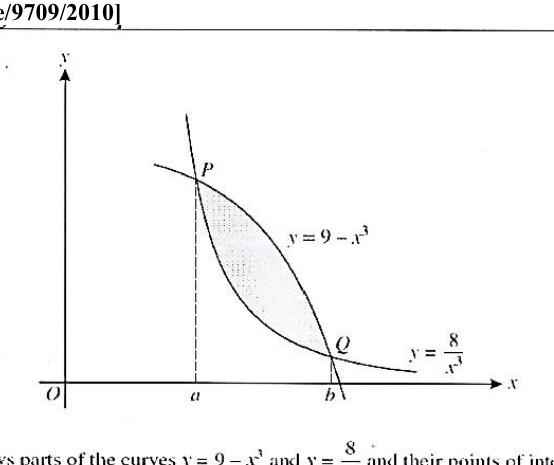
- (i)
Show that and are roots of the equation . Solve this equation and hence state the value of and the value of .
- (ii)
Find the area of the shaded region between the two curves.
- (iii)
The tangents to the two curves at (where ) are parallel to each other. Find the value of .
It won't just hand you the answer — it asks where you're stuck.How the checker works
Worked solution
Q5(i)
1. Set up the equation to find the points of intersection.
At the points of intersection, the -values of both curves are equal:
2. Rearrange the equation to show the required form.
Multiplying both sides by (since in the first quadrant):
Rearranging the terms to one side gives:
Since the intersection points and have -coordinates and , and must satisfy this equation and are therefore its roots.
3. Solve the polynomial equation by treating it as a quadratic in $x^3$.
Let . The equation becomes a quadratic in :
4. Solve for $x$ and assign the values to $a$ and $b$.
Substitute back :
From the given diagram, is to the left of , meaning .
Therefore, and .
Q5(ii)
1. Solve for the intersection points from part (i) to find the limits of integration.
Let . The intersection equation becomes .
.
Since is to the left of , and .
2. Set up the definite integral for the area between the two curves.
From the graph, the curve is above the curve for .
3. Integrate the function with respect to $x$.
4. Evaluate the definite integral to find the exact area.
Substitute and into the antiderivative:
Q5(iii)
1. Find the gradient functions for both curves by differentiating with respect to $x$.
Let and .
2. Set up the equation for parallel tangents at $x = c$.
Since the tangents to both curves at are parallel, their gradients at this point must be equal. Substituting into both derivatives and equating them:
3. Solve for $c$, considering the interval $a < c < b$.
From part (i), the roots of the intersection are and .
Since , we require .
Therefore, the only valid solution is:
AI analysis — may contain mistakes.
Worked this one out on paper? Snap your steps and Gigle's AI math checker will circle the step where it went wrong.
More questions on this topic
- 1[The volume of a cone of base radius and height is given by .] A manufacturer makes a…
- 2The sum of the first terms of a series is given by . Show that this series follows an arithmetic pr…
- 3A drilling company plans to install a straight pipeline through a mountain. Points are defined relative…
- 4The sum of the first terms of a series is given by . Show that this series follows an arithmetic pr…
- 5A curve has the equation where . Sketch , stating the coordinates of any points o…