[The volume of a cone of base radius and height is given by .]
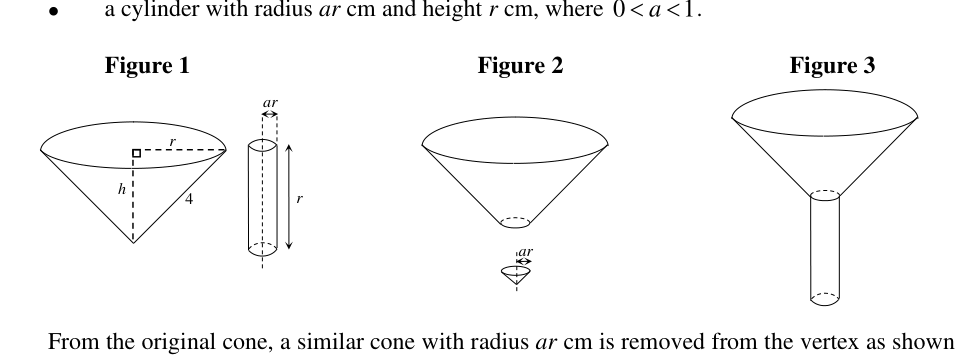
A manufacturer makes a funnel-shaped ornament from the same material which consists of two parts as shown in Figure 1.
- a right cone of radius cm, height cm and a slant height of 4 cm,
- a cylinder with radius cm and height cm, where .
From the original cone, a similar cone with radius cm is removed from the vertex as shown in Figure 2. The remaining part of the cone is joined to the cylinder to form the funnel as shown in Figure 3. It may be assumed that the thickness of the funnel is negligible.
Given that the volume of the ornament is , find in terms of and .
- (a)
For the remainder of this question, assume that .
The manufacturer wants to be a maximum. If gives the maximum value of , show that satisfies the equation .
- (b)
Show that one of the positive roots to the equation in part (a) does not give a stationary value of . Hence find the value of for which is stationary.
It won't just hand you the answer — it asks where you're stuck.How the checker works
Worked solution
5(a)
1. Express the total volume $V$ in terms of $r$ by evaluating the volumes of the frustum and cylinder.
From the given information, the slant height of the original cone is . Let its vertical height be . By Pythagoras' Theorem:
The similar cone removed from the vertex has radius and, by similarity, height .
Volume of the frustum =
Volume of the cylinder =
Total volume :
2. Substitute $a = 0.25$ to express $V$ solely in terms of $r$.
Given :
Substitute into :
3. Differentiate $V$ with respect to $r$ using the product and chain rules.
Applying the product rule on the first term:
4. Equate $\frac{dV}{dr}$ to 0 for a maximum value and substitute $r = r_1$.
For to be a maximum, . Let .
Since , divide the entire equation by :
Multiply through by to clear the denominator:
5. Square both sides to eliminate the square root and form the required equation.
Square both sides:
Rearranging the terms to one side:
(shown)
(shown)
5(b)
1. Solve the equation from part (a) to find the possible positive roots for $r$.
Let . Using the quadratic formula:
Evaluating these gives:
Taking the positive square roots (since radius ):
2. Test the first positive root in the original, un-squared condition for a stationary point to show it is extraneous.
From part (a), equating to zero leads to the condition before squaring:
Substitute () into both sides:
Since LHS RHS (they have opposite signs), is an extraneous root introduced by squaring and does not give a stationary value of .
3. Find the value of $h$ corresponding to the valid root.
The valid root for the stationary point must be the other one, .
Using the relationship between slant height, radius, and height from the original cone ():
Thus, cm (to 3 s.f.).
(to 3 s.f.)
AI analysis — may contain mistakes.
Worked this one out on paper? Snap your steps and Gigle's AI math checker will circle the step where it went wrong.
More questions on this topic
- 1A sector of angle radians and radius is used to form the curved surface of a right circular co…
- 2As part of an Art Project, a student designed a lantern in the shape of an octahedron as shown in the diagram. The frame…
- 3The following diagram shows the dimensions of a trapezoidal prism with fixed volume units, with varia…
- 4[The volume of a right circular cone of radius and height is .] A student makes a printer…
- 5Figure 1 shows an open cylindrical tank. Figure 2 shows the cross-sectional view of the tank. The external radius of the…