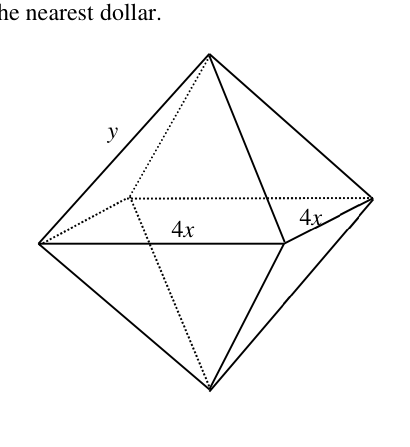
As part of an Art Project, a student designed a lantern in the shape of an octahedron as shown in the diagram. The frame of the lantern consists of twelve straight pieces of wire, joined at their ends to form two identical right pyramids with a square base of sides and slant edges of . The wire frame is covered tightly with coloured paper. The wire cost $8 per metre and the coloured paper cost $15 per square metre. The student is required to include the budget for his lantern in this project. Given that the total length of the wire used is , use differentiation to find the maximum amount for his budget, giving your answer to the nearest dollar.
It won't just hand you the answer — it asks where you're stuck.How the checker works
Worked solution
10
1. Express the slant edge $y$ in terms of $x$ using the total length of the wire.
The wire frame consists of the square base (4 edges of length ) and the slant edges of the two pyramids (8 edges of length ).
Total length of wire
Given that the total length of the wire used is :
2. Find an expression for the total surface area of the lantern in terms of $x$ and $y$.
The surface of the lantern is formed by 8 identical isosceles triangular faces.
For one triangular face with base and two slant edges , the height is given by Pythagoras' theorem:
Area of one triangular face
Total surface area
3. Substitute $y$ to express the total budget $C$ entirely in terms of $x$.
Substitute into :
The total budget is the sum of the wire cost and the paper cost.
Cost of wire
Cost of paper
4. Differentiate $C$ with respect to $x$ and equate to $0$ to find the stationary point.
Using the product rule and chain rule to find :
To maximize the budget, let :
Multiply through by :
5. Verify that this value of $x$ gives a maximum budget using the First Derivative Test.
Testing the sign of around :
- When ,
- When ,
Since the gradient changes from positive to negative, yields a maximum point.
6. Calculate the maximum budget and round it to the nearest dollar.
Substitute into the budget equation:
Rounding to the nearest dollar, the maximum budget is .
$29
AI analysis — may contain mistakes.
Worked this one out on paper? Snap your steps and Gigle's AI math checker will circle the step where it went wrong.
More questions on this topic
- 1[The volume of a cone of base radius and height is given by .] A manufacturer makes a…
- 2A sector of angle radians and radius is used to form the curved surface of a right circular co…
- 3The following diagram shows the dimensions of a trapezoidal prism with fixed volume units, with varia…
- 4[The volume of a right circular cone of radius and height is .] A student makes a printer…
- 5Figure 1 shows an open cylindrical tank. Figure 2 shows the cross-sectional view of the tank. The external radius of the…