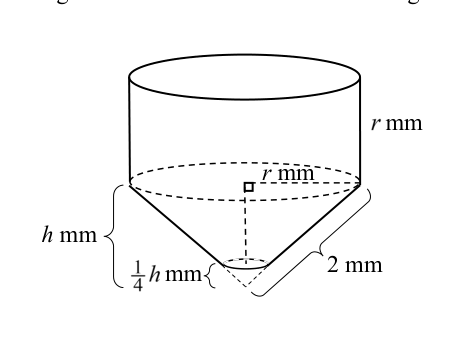
[The volume of a right circular cone of radius and height is .] A student makes a printer nozzle for his self-built 3D printer. The printer nozzle consists of a hollow inverted right circular cone of negligible thickness with radius mm where , height mm and slanted edge 2 mm joined to a hollow cylinder of negligible thickness with radius mm and height mm. A height of mm is cut off from the vertex of the cone for the nozzle opening (see diagram). The volume of the printer nozzle is .
- (a)
Show that .
- (b)
The student wants to be a maximum.
It is given that gives the maximum value of . Show that satisfies the equation .
- (c)
Show that one of the positive roots of the equation in part (b) does not give a stationary value of . Suggest a reason why this value is a solution to the equation in part (b) even though it does not give a stationary value of .
- (d)
Given that is the largest positive root of the equation in part (b), state the value of and find the corresponding value of . (You need not show that your answer gives a maximum.)
- (e)
With reference to the value of found in part (d), comment on the practicality of having a maximum volume for the printer nozzle.
It won't just hand you the answer — it asks where you're stuck.How the checker works
Worked solution
11(a)
1. Express the volume of the cylindrical part.
The volume of the cylinder is given by:
2. Express the height of the cone, $h$, in terms of $r$.
Using Pythagoras' theorem on the original right circular cone:
3. Find the volume of the truncated cone.
The cut-off cone and the original cone are similar. The ratio of their heights is .
The ratio of their volumes is .
The volume of the truncated cone (frustum) is therefore of the original cone's volume.
4. Combine the volumes to obtain the final expression.
Substitute into and add to the cylinder's volume:
11(b)
1. Differentiate $V$ with respect to $r$ using the product and chain rules.
Given ,
Make the terms in the bracket a single fraction:
2. Set the derivative to zero and simplify by factoring out $r_1$.
For a stationary point, . Since the maximum occurs at :
Since , we can divide the entire equation by :
Multiply through by :
3. Rearrange and square both sides to eliminate the square root and obtain the required polynomial equation.
Square both sides:
Rearranging all terms to one side yields:
11(c)
1. Solve the biquadratic equation from part (b) to find the possible positive roots for $r$.
Let . The equation is .
Using the quadratic formula:
Since , the positive roots are:
2. Determine the condition for a stationary point and show that the smaller positive root fails this condition.
To find stationary points, we set :
Dividing by (since ) and rearranging gives the condition before squaring:
Test the smaller positive root (where ):
- Left-Hand Side (LHS): Since , .
- Right-Hand Side (RHS): .
Since a positive LHS cannot equal a negative RHS, for . Therefore, this root does not give a stationary value of .
3. Suggest the mathematical reason for the existence of this solution.
During the derivation of the polynomial equation in part (b), the algebraic step of squaring both sides of the equation (to eliminate the square root) was required. Squaring both sides of an equation introduces extraneous roots.
The root does not satisfy the original condition , thus it does not give a stationary value.
Reason: Squaring both sides of the equation during the derivation in part (b) introduced an extraneous root.
11(d)
1. Solve the given equation for the roots of $r^2$.
Let . The given equation is .
Using the quadratic formula (or a calculator's polynomial solver):
2. Find the largest positive root $r_1$.
Since is the largest positive root, we take the larger value of :
3. Calculate the corresponding value of $h$ using the geometry of the cone.
From the right circular cone's dimensions (radius , height , and slanted edge ), we use Pythagoras' theorem:
Substituting the exact value of :
,
11(e)
1. Comment on the shape of the nozzle using the dimensions from part (d).
From part (d), and . Since the height is significantly smaller than the radius , the conical part of the nozzle is extremely shallow (almost a flat disc). This geometric shape is impractical for effectively directing and extruding material in a 3D printer, meaning the mathematical maximum volume does not yield a practical design.
From part (d), and . Since the height is much smaller than the radius , the conical part of the nozzle is almost flat (or too shallow), making it impractical for use as a 3D printer nozzle.
AI analysis — may contain mistakes.
Worked this one out on paper? Snap your steps and Gigle's AI math checker will circle the step where it went wrong.
More questions on this topic
- 1[The volume of a cone of base radius and height is given by .] A manufacturer makes a…
- 2A sector of angle radians and radius is used to form the curved surface of a right circular co…
- 3As part of an Art Project, a student designed a lantern in the shape of an octahedron as shown in the diagram. The frame…
- 4The following diagram shows the dimensions of a trapezoidal prism with fixed volume units, with varia…
- 5Figure 1 shows an open cylindrical tank. Figure 2 shows the cross-sectional view of the tank. The external radius of the…