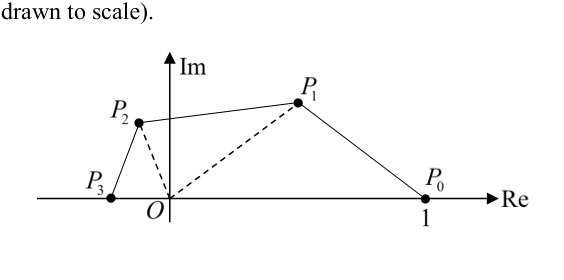
一个复数 zz 由 z=reiπnz = r \mathrm{e}^{\mathrm{i}\frac{\pi}{n}} 给出,其中 0<r<10 < r < 1 且 nn 为满足 n≥3n \ge 3 的正整数。数 11,zz,z2z^2,...,znz^n 可分别由阿尔冈图中的点 P0P_0,P1P_1,P2P_2,...,PnP_n 表示。由点 P0P_0,P1P_1,P2P_2,...,PnP_n 构成的 (n+1)(n+1) 边形称为由 zz 生成的 (n+1)(n+1) 边形。下方的阿尔冈图(未按比例绘制)示出了一个由 zz 生成的 (3+1)(3+1) 边形示例。 对于部分 (a) 至 (c),设 z=14(1+3i)z = \frac{1}{4}(1 + \sqrt{3}\mathrm{i})。

  1. (a)

    将 zz 表示为 reiθr\mathrm{e}^{\mathrm{i}\theta} 的形式,其中 r>0r > 0 且 0<θ≤π0 < \theta \le \pi。

  2. (b)

    由此,以类似的形式写出 z2z^2 和 z3z^3。

  3. (c)

    求三角形 OP0P1OP_0P_1 的精确面积,其中 OO 是原点。由此,求由 zz 生成的 (3+1)(3+1) 边形的精确面积。

  4. (d)

    对于第 (d) 问,设 z=12eiπnz = \frac{1}{2}\mathrm{e}^{\mathrm{i}\frac{\pi}{n}}。

    用 nn 表示由 zz 生成的 (n+1)(n+1) 边形的面积,并将你的答案表示为 a(1−bn)sin⁡πna(1-b^n)\sin\frac{\pi}{n} 的形式,其中 aa 和 bb 是待确定的实数。

先不看答案,让 AI 诊断你卡在哪里?

它不会直接告诉你答案,而是问你卡在哪一步看看 AI 是怎么陪你一步步弄懂这道题的

完整解法

10(a)

1. Calculate the modulus $r$ and the argument $\theta$ of $z$.

r=∣z∣=(14)2+(34)2=116+316=12r = |z| = \sqrt{\left(\frac{1}{4}\right)^2 + \left(\frac{\sqrt{3}}{4}\right)^2} = \sqrt{\frac{1}{16} + \frac{3}{16}} = \frac{1}{2}

Since zz is in the first quadrant, its argument is:
θ=arg⁡(z)=tan⁡−1(3/41/4)=tan⁡−1(3)=π3\theta = \arg(z) = \tan^{-1}\left(\frac{\sqrt{3}/4}{1/4}\right) = \tan^{-1}(\sqrt{3}) = \frac{\pi}{3}

2. Express $z$ in exponential form.

z=12eiπ3z = \frac{1}{2}\mathrm{e}^{\mathrm{i}\frac{\pi}{3}}

答案

z=12eiπ3z = \frac{1}{2}\mathrm{e}^{\mathrm{i}\frac{\pi}{3}}

10(b)

1. State the exponential form of $z$ from part (a) and compute $z^2$.

From part (a), z=12eiπ3z = \frac{1}{2}\mathrm{e}^{\mathrm{i}\frac{\pi}{3}}.

z2=(12eiπ3)2z^2 = \left(\frac{1}{2}\mathrm{e}^{\mathrm{i}\frac{\pi}{3}}\right)^2
z2=(12)2ei(π3×2)z^2 = \left(\frac{1}{2}\right)^2 \mathrm{e}^{\mathrm{i}\left(\frac{\pi}{3} \times 2\right)}
z2=14ei2π3z^2 = \frac{1}{4}\mathrm{e}^{\mathrm{i}\frac{2\pi}{3}}

2. Compute $z^3$ using the same index laws.

z3=(12eiπ3)3z^3 = \left(\frac{1}{2}\mathrm{e}^{\mathrm{i}\frac{\pi}{3}}\right)^3
z3=(12)3ei(π3×3)z^3 = \left(\frac{1}{2}\right)^3 \mathrm{e}^{\mathrm{i}\left(\frac{\pi}{3} \times 3\right)}
z3=18eiπz^3 = \frac{1}{8}\mathrm{e}^{\mathrm{i}\pi}

答案

z2=14ei2π3z^2 = \frac{1}{4}\mathrm{e}^{\mathrm{i}\frac{2\pi}{3}}, z3=18eiπz^3 = \frac{1}{8}\mathrm{e}^{\mathrm{i}\pi}

10(c)

1. Find the area of triangle $OP_0P_1$ using the modulus and argument of $z$.

From part (a), z=12eiπ3z = \frac{1}{2}\mathrm{e}^{\mathrm{i}\frac{\pi}{3}}.
In the Argand diagram, P0P_0 corresponds to z0=1z^0 = 1 and P1P_1 corresponds to zz.
Thus, the lengths OP0=1OP_0 = 1 and OP1=∣z∣=12OP_1 = |z| = \frac{1}{2}.
The angle between OP0OP_0 and OP1OP_1 is arg⁡(z)=π3\arg(z) = \frac{\pi}{3}.
Area of △OP0P1=12(OP0)(OP1)sin⁡(π3)\text{Area of } \triangle OP_0P_1 = \frac{1}{2}(OP_0)(OP_1)\sin\left(\frac{\pi}{3}\right)
=12(1)(12)(32)=38= \frac{1}{2}(1)\left(\frac{1}{2}\right)\left(\frac{\sqrt{3}}{2}\right) = \frac{\sqrt{3}}{8}

2. Deduce that the area of the polygon is the sum of the areas of three triangles meeting at the origin.

The (3+1)(3+1)-polygon is a quadrilateral with vertices P0,P1,P2,P3P_0, P_1, P_2, P_3.
From part (b), P3P_3 corresponds to z3=18eiπz^3 = \frac{1}{8}\mathrm{e}^{\mathrm{i}\pi}, which lies on the negative real axis.
Since P0P_0 lies on the positive real axis, the origin OO lies exactly on the line segment connecting P3P_3 and P0P_0.
Therefore, the total area of the polygon is simply the sum of the areas of the constituent triangles: △OP0P1\triangle OP_0P_1, △OP1P2\triangle OP_1P_2, and △OP2P3\triangle OP_2P_3.

3. Calculate the areas of the remaining triangles and sum them up to find the exact area of the polygon.

For △OP1P2\triangle OP_1P_2:
OP1=12OP_1 = \frac{1}{2}, OP2=∣z2∣=14OP_2 = |z^2| = \frac{1}{4}, and ∠P1OP2=arg⁡(z2)−arg⁡(z)=π3\angle P_1OP_2 = \arg(z^2) - \arg(z) = \frac{\pi}{3}.
Area of △OP1P2=12(12)(14)sin⁡(π3)=332\text{Area of } \triangle OP_1P_2 = \frac{1}{2}\left(\frac{1}{2}\right)\left(\frac{1}{4}\right)\sin\left(\frac{\pi}{3}\right) = \frac{\sqrt{3}}{32}

For △OP2P3\triangle OP_2P_3:
OP2=14OP_2 = \frac{1}{4}, OP3=∣z3∣=18OP_3 = |z^3| = \frac{1}{8}, and ∠P2OP3=arg⁡(z3)−arg⁡(z2)=π3\angle P_2OP_3 = \arg(z^3) - \arg(z^2) = \frac{\pi}{3}.
Area of △OP2P3=12(14)(18)sin⁡(π3)=3128\text{Area of } \triangle OP_2P_3 = \frac{1}{2}\left(\frac{1}{4}\right)\left(\frac{1}{8}\right)\sin\left(\frac{\pi}{3}\right) = \frac{\sqrt{3}}{128}

Exact Area=38+332+3128\text{Exact Area} = \frac{\sqrt{3}}{8} + \frac{\sqrt{3}}{32} + \frac{\sqrt{3}}{128}
=163+43+3128=213128= \frac{16\sqrt{3} + 4\sqrt{3} + \sqrt{3}}{128} = \frac{21\sqrt{3}}{128}

答案

Exact area of triangle OP0P1=38OP_0P_1 = \frac{\sqrt{3}}{8}
Exact area of the polygon =213128= \frac{21\sqrt{3}}{128}

10(d)

1. Determine the area of the $k$-th triangle $OP_{k-1}P_k$.

Let the vertices of the (n+1)(n+1)-polygon be P0,P1,…,PnP_0, P_1, \dots, P_n. The point PkP_k represents the complex number:
zk=(12eiπn)k=(12)keikπnz^k = \left(\frac{1}{2} \mathrm{e}^{\mathrm{i}\frac{\pi}{n}}\right)^k = \left(\frac{1}{2}\right)^k \mathrm{e}^{\mathrm{i}\frac{k\pi}{n}}
The distance from the origin OO to PkP_k is OPk=∣zk∣=(12)kOP_k = |z^k| = \left(\frac{1}{2}\right)^k.
The angle between the segments OPk−1OP_{k-1} and OPkOP_k is the difference in their arguments:
arg⁡(zk)−arg⁡(zk−1)=kπn−(k−1)πn=πn\arg(z^k) - \arg(z^{k-1}) = \frac{k\pi}{n} - \frac{(k-1)\pi}{n} = \frac{\pi}{n}
The area of triangle OPk−1PkOP_{k-1}P_k is:
Area=12(OPk−1)(OPk)sin⁡(πn)=12(12)k−1(12)ksin⁡(πn)=(14)ksin⁡(πn)\text{Area} = \frac{1}{2} (OP_{k-1})(OP_k) \sin\left(\frac{\pi}{n}\right) = \frac{1}{2} \left(\frac{1}{2}\right)^{k-1} \left(\frac{1}{2}\right)^k \sin\left(\frac{\pi}{n}\right) = \left(\frac{1}{4}\right)^k \sin\left(\frac{\pi}{n}\right)

2. Express the total area of the polygon as a sum of the triangular areas.

The point P0=1P_0 = 1 lies on the positive real axis, and Pn=zn=(12)neiπ=−(12)nP_n = z^n = \left(\frac{1}{2}\right)^n \mathrm{e}^{\mathrm{i}\pi} = -\left(\frac{1}{2}\right)^n lies on the negative real axis.
Since the line segment connecting PnP_n and P0P_0 passes along the real axis directly through the origin OO, the (n+1)(n+1)-polygon is exactly partitioned into the nn triangles OP0P1,OP1P2,…,OPn−1PnOP_0P_1, OP_1P_2, \dots, OP_{n-1}P_n.
The total area of the polygon is the sum of the areas of these nn triangles:
Total Area=∑k=1n(14)ksin⁡(πn)=sin⁡(πn)[14+(14)2+⋯+(14)n]\text{Total Area} = \sum_{k=1}^n \left(\frac{1}{4}\right)^k \sin\left(\frac{\pi}{n}\right) = \sin\left(\frac{\pi}{n}\right) \left[ \frac{1}{4} + \left(\frac{1}{4}\right)^2 + \dots + \left(\frac{1}{4}\right)^n \right]

3. Evaluate the geometric series to obtain the final expression and determine the constants $a$ and $b$.

The terms inside the square bracket form a finite geometric series with nn terms, a first term of u1=14u_1 = \frac{1}{4}, and a common ratio of r=14r = \frac{1}{4}.
Using the formula for the sum of a finite geometric series:
∑k=1n(14)k=14(1−(14)n)1−14=14(1−(14)n)34=13(1−(14)n)\sum_{k=1}^n \left(\frac{1}{4}\right)^k = \frac{\frac{1}{4}\left(1 - \left(\frac{1}{4}\right)^n\right)}{1 - \frac{1}{4}} = \frac{\frac{1}{4}\left(1 - \left(\frac{1}{4}\right)^n\right)}{\frac{3}{4}} = \frac{1}{3}\left(1 - \left(\frac{1}{4}\right)^n\right)
Substituting this back, the total area of the polygon is:
13(1−(14)n)sin⁡(πn)\frac{1}{3}\left(1 - \left(\frac{1}{4}\right)^n\right) \sin\left(\frac{\pi}{n}\right)
Comparing this to the required form a(1−bn)sin⁡πna(1 - b^n)\sin\frac{\pi}{n}, we determine that a=13a = \frac{1}{3} and b=14b = \frac{1}{4}.

答案

13(1−(14)n)sin⁡πn\frac{1}{3} \left(1 - \left(\frac{1}{4}\right)^n\right) \sin\frac{\pi}{n}, where a=13a = \frac{1}{3} and b=14b = \frac{1}{4}

AI 分析,可能出错

用 AI 批改,圈出写错的那一步,并自动将你的薄弱点存入错题本,形成你的错因库。

同一知识点的其他题

  1. 1解方程 z4=−4−4√3iz^4 = -4 - 4√3\mathrm{i},将你的答案表示为 reiθr\mathrm{e}^{\mathrm{i}\theta} 的形式,其中 r>0r > 0 且 −π<θ≤π-\pi < \theta \le \pi。(不需要列出…
  2. 2已知复数z1=1−3iz_{1}=1-3i,z2=3+iz_{2}=3+i,则()(\quad) A. ∣z1+z2∣=6  |z_{1}+z_{2}|=6\:\: B. z‾1−z2=−2+2i{\overline{z}}_{1}-{z}_{2}=-2+2i C. z1z2=6−8iz_{1}z_{2}=6-8i …
  3. 3解方程 iz5=−32i z^5 = -32,将根写成 reiθre^{i\theta} 的形式,其中 r>0r>0 且 −π<θ≤π-\pi<\theta\le\pi。在阿甘特图上描绘出代表这些根的点 P1,P2,P3,P4P_1, P_2, P_3, P_4 和 P5P_5,其…
  4. 4证明对于任何复数 z=eiθz = e^{i\theta}, zn+1zn=2cos⁡nθ.z^{n} + \dfrac{1}{z^{n}} = 2\cos n\theta . 通过令 n=1n = 1,证明 cos⁡3θ=18(z3+3z+3z+1z3).\cos^{3}\theta = \tfrac{1}{8}\left(z^{3} + 3z + \tfrac{3}{z} + \tfrac{1}{z^{3}}\right).…
  5. 5已知复数z=x+yi(x,y∈R)z=x+yi(x,y\in R),则()(\quad) A. z2⩾0z^{2}\geqslant 0 B. zz的虚部是yiyi C. 若z=1+2iz=1+2i,则x=1x=1,y=2y=2 D. ∣z∣=x2+y2|z|=\sqrt{x^{2}+y^{2}}…