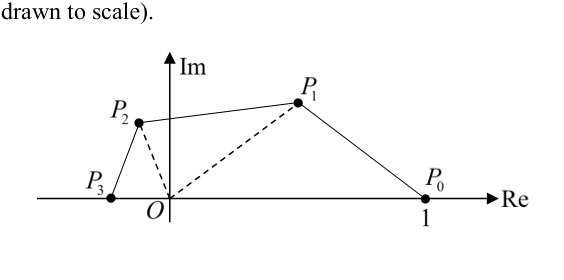
A complex number is given by , where and is a positive integer with . The numbers , , , ..., can be represented by the points , , , ..., respectively in an Argand diagram. The -sided polygon formed by using , , , ..., is called the -polygon generated by . An example of a -polygon generated by is shown in the following Argand diagram (not drawn to scale). Let for parts (a) to (c).
- (a)
Express in the form , where and .
- (b)
Hence write down and in similar form.
- (c)
Find the exact area of triangle , where is the origin. Hence find the exact area of the -polygon generated by .
- (d)
Let for part (d).
Find the area of an -polygon generated by in terms of , leaving your answer in the form , where and are real numbers to be determined.
It won't just hand you the answer — it asks where you're stuck.How the checker works
Worked solution
10(a)
1. Calculate the modulus $r$ and the argument $\theta$ of $z$.
Since is in the first quadrant, its argument is:
2. Express $z$ in exponential form.
10(b)
1. State the exponential form of $z$ from part (a) and compute $z^2$.
From part (a), .
2. Compute $z^3$ using the same index laws.
,
10(c)
1. Find the area of triangle $OP_0P_1$ using the modulus and argument of $z$.
From part (a), .
In the Argand diagram, corresponds to and corresponds to .
Thus, the lengths and .
The angle between and is .
2. Deduce that the area of the polygon is the sum of the areas of three triangles meeting at the origin.
The -polygon is a quadrilateral with vertices .
From part (b), corresponds to , which lies on the negative real axis.
Since lies on the positive real axis, the origin lies exactly on the line segment connecting and .
Therefore, the total area of the polygon is simply the sum of the areas of the constituent triangles: , , and .
3. Calculate the areas of the remaining triangles and sum them up to find the exact area of the polygon.
For :
, , and .
For :
, , and .
Exact area of triangle
Exact area of the polygon
10(d)
1. Determine the area of the $k$-th triangle $OP_{k-1}P_k$.
Let the vertices of the -polygon be . The point represents the complex number:
The distance from the origin to is .
The angle between the segments and is the difference in their arguments:
The area of triangle is:
2. Express the total area of the polygon as a sum of the triangular areas.
The point lies on the positive real axis, and lies on the negative real axis.
Since the line segment connecting and passes along the real axis directly through the origin , the -polygon is exactly partitioned into the triangles .
The total area of the polygon is the sum of the areas of these triangles:
3. Evaluate the geometric series to obtain the final expression and determine the constants $a$ and $b$.
The terms inside the square bracket form a finite geometric series with terms, a first term of , and a common ratio of .
Using the formula for the sum of a finite geometric series:
Substituting this back, the total area of the polygon is:
Comparing this to the required form , we determine that and .
, where and
AI analysis — may contain mistakes.
Worked this one out on paper? Snap your steps and Gigle's AI math checker will circle the step where it went wrong.