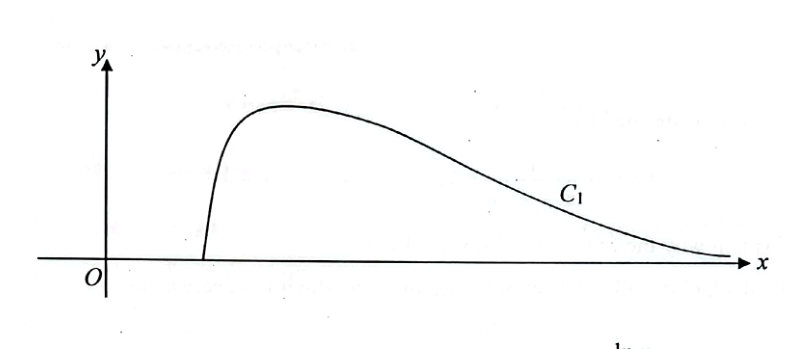
上图显示了方程为 y=ln⁡xx2y = \frac{\ln x}{x^2} 的曲线 C1C_1,其中 x≥1x \ge 1。

  1. (i)

    证明 C1C_1 上的极值点的精确坐标为 (e,12e)\left(\sqrt{\text{e}}, \frac{1}{2\text{e}}\right)。

  2. (ii)

    曲线 C2C_2 的方程为 (x−e)2+(2y)2=1\left(x - \sqrt{\text{e}}\right)^2 + (2y)^2 = 1,其中 y≥0y \ge 0。在同一坐标系中草绘 C1C_1 和 C2C_2,并写出它们与坐标轴的所有交点的精确坐标。

  3. (iii)

    写出一个表示由两条曲线 C1C_1 和 C2C_2 以及 xx 轴围成的较小区域面积的积分。利用数值方法计算该积分。

先不看答案,让 AI 诊断你卡在哪里?

它不会直接告诉你答案,而是问你卡在哪一步看看 AI 是怎么陪你一步步弄懂这道题的

完整解法

11(i)

1. Find the first derivative of $y$ with respect to $x$ using the quotient rule.

y=ln⁡xx2y = \frac{\ln x}{x^2}
Using the quotient rule:
dydx=x2(1x)−(ln⁡x)(2x)(x2)2\frac{\text{d}y}{\text{d}x} = \frac{x^2 \left(\frac{1}{x}\right) - (\ln x)(2x)}{(x^2)^2}
dydx=x−2xln⁡xx4\frac{\text{d}y}{\text{d}x} = \frac{x - 2x \ln x}{x^4}
dydx=1−2ln⁡xx3\frac{\text{d}y}{\text{d}x} = \frac{1 - 2\ln x}{x^3}

2. Equate the derivative to zero to find the $x$-coordinate of the turning point.

At a turning point, dydx=0\frac{\text{d}y}{\text{d}x} = 0:
1−2ln⁡xx3=0\frac{1 - 2\ln x}{x^3} = 0
Since x≥1x \ge 1, x3≠0x^3 \neq 0, so the numerator must be zero:
1−2ln⁡x=01 - 2\ln x = 0
2ln⁡x=12\ln x = 1
ln⁡x=12\ln x = \frac{1}{2}
x=e12=ex = \text{e}^{\frac{1}{2}} = \sqrt{\text{e}}

3. Substitute the $x$-coordinate back into the original equation to obtain the corresponding $y$-coordinate.

Substitute x=e12x = \text{e}^{\frac{1}{2}} into the original equation for yy:
y=ln⁡(e12)(e12)2y = \frac{\ln\left(\text{e}^{\frac{1}{2}}\right)}{\left(\text{e}^{\frac{1}{2}}\right)^2}
y=12e=12ey = \frac{\frac{1}{2}}{\text{e}} = \frac{1}{2\text{e}}
Thus, the exact coordinates of the turning point are (e,12e)\left(\sqrt{\text{e}}, \frac{1}{2\text{e}}\right) (shown).

答案

\left(\sqrt{\text{e}}, \frac{1}{2\text{e}}\right)

11(ii)

1. Find the point(s) of intersection of $C_1$ with the coordinate axes.

For C1C_1: y=ln⁡xx2y = \frac{\ln x}{x^2}, defined for x≥1x \ge 1.
Let y=0y = 0:
ln⁡xx2=0\frac{\ln x}{x^2} = 0
ln⁡x=0  ⟹  x=1\ln x = 0 \implies x = 1
The xx-intercept for C1C_1 is (1,0)(1, 0).
Since the domain is x≥1x \ge 1, xx cannot be 00, so there are no yy-intercepts.

2. Find the point(s) of intersection of $C_2$ with the coordinate axes.

For C2C_2: (x−e)2+(2y)2=1\left(x - \sqrt{\mathrm{e}}\right)^2 + (2y)^2 = 1, where y≥0y \ge 0.
Let y=0y = 0:
(x−e)2=1\left(x - \sqrt{\mathrm{e}}\right)^2 = 1
x−e=±1  ⟹  x=e−1 or x=e+1x - \sqrt{\mathrm{e}} = \pm 1 \implies x = \sqrt{\mathrm{e}} - 1 \text{ or } x = \sqrt{\mathrm{e}} + 1
The xx-intercepts for C2C_2 are (e−1,0)(\sqrt{\mathrm{e}} - 1, 0) and (e+1,0)(\sqrt{\mathrm{e}} + 1, 0).
Let x=0x = 0:
(−e)2+4y2=1\left(-\sqrt{\mathrm{e}}\right)^2 + 4y^2 = 1
e+4y2=1  ⟹  4y2=1−e\mathrm{e} + 4y^2 = 1 \implies 4y^2 = 1 - \mathrm{e}
Since 1−e<01 - \mathrm{e} < 0, there are no real solutions for yy, so C2C_2 does not intersect the yy-axis.

3. Identify the shapes to accurately sketch both curves.

C1C_1 starts at (1,0)(1, 0), climbs to its turning point (e,12e)\left(\sqrt{\mathrm{e}}, \frac{1}{2\mathrm{e}}\right) found in part (i), and asymptotically approaches the xx-axis.

C2C_2 can be rewritten as:
(x−e)212+y2(1/2)2=1\frac{(x - \sqrt{\mathrm{e}})^2}{1^2} + \frac{y^2}{(1/2)^2} = 1
This represents the upper half (y≥0y \ge 0) of an ellipse centered at (e,0)(\sqrt{\mathrm{e}}, 0), with a horizontal semi-axis of 11 and a vertical semi-axis of 12\frac{1}{2}. Its peak is at (e,12)(\sqrt{\mathrm{e}}, \frac{1}{2}).

Note that e−1≈0.649<1\sqrt{\mathrm{e}} - 1 \approx 0.649 < 1, so C2C_2 starts to the left of C1C_1.
Also, 12e≈0.184<0.5\frac{1}{2\mathrm{e}} \approx 0.184 < 0.5, so the peak of C2C_2 is much higher than the peak of C1C_1.

答案

Intersections with axes:

  • C1C_1: (1,0)(1, 0)
  • C2C_2: (e−1,0)(\sqrt{\mathrm{e}} - 1, 0) and (e+1,0)(\sqrt{\mathrm{e}} + 1, 0)

(Self-drawn sketch should feature:)

  • C1C_1 starting at (1,0)(1, 0), rising to a peak at (e,12e)(\sqrt{\mathrm{e}}, \frac{1}{2\mathrm{e}}), and approaching y=0y=0 as an asymptote.
  • C2C_2 as an upper semi-ellipse starting from (e−1,0)(\sqrt{\mathrm{e}} - 1, 0) to (e+1,0)(\sqrt{\mathrm{e}} + 1, 0), with a local maximum at (e,0.5)(\sqrt{\mathrm{e}}, 0.5). It forms an arch over the turning point of C1C_1.

11(iii)

1. Find the point of intersection between $C_1$ and $C_2$ using a graphing calculator.

From part (ii), C1C_1 intersects the xx-axis at x=1x=1, and C2C_2 intersects the xx-axis at x=e+1x=\sqrt{\text{e}}+1.
Let y1=ln⁡xx2y_1 = \frac{\ln x}{x^2} and y2=121−(x−e)2y_2 = \frac{1}{2}\sqrt{1 - (x - \sqrt{\text{e}})^2} (since y≥0y \ge 0).
Using a graphing calculator to solve y1=y2y_1 = y_2:
x≈2.6079x \approx 2.6079

2. Set up the integral for the smaller region bounded by $C_1$, $C_2$, and the $x$-axis.

From the sketch in (ii), the curves enclose two bounded regions with the xx-axis. The smaller region lies on the right, between x=1x=1 and x=e+1x=\sqrt{\text{e}}+1.
It is bounded above by C1C_1 for x∈[1,2.6079]x \in [1, 2.6079] and by C2C_2 for x∈[2.6079,e+1]x \in [2.6079, \sqrt{\text{e}}+1].

Area=∫12.6079ln⁡xx2 dx+∫2.6079e+1121−(x−e)2 dx\text{Area} = \int_{1}^{2.6079} \frac{\ln x}{x^2} \,\mathrm{d}x + \int_{2.6079}^{\sqrt{\text{e}}+1} \frac{1}{2}\sqrt{1 - (x - \sqrt{\text{e}})^2} \,\mathrm{d}x

3. Evaluate the integral numerically using a graphing calculator.

Evaluating the integrals using the GC:
Area≈0.24900+0.00359=0.25259\text{Area} \approx 0.24900 + 0.00359 = 0.25259
Area=0.253 (to 3 s.f.)\text{Area} = 0.253 \text{ (to 3 s.f.)}

答案

∫12.608ln⁡xx2 dx+∫2.608e+1121−(x−e)2 dx\int_{1}^{2.608} \frac{\ln x}{x^2} \,\mathrm{d}x + \int_{2.608}^{\sqrt{\text{e}}+1} \frac{1}{2}\sqrt{1 - (x - \sqrt{\text{e}})^2} \,\mathrm{d}x
Area ≈0.253\approx 0.253

AI 分析,可能出错

用 AI 批改,圈出写错的那一步,并自动将你的薄弱点存入错题本,形成你的错因库。

同一知识点的其他题

  1. 1[底面半径为 rr、高为 hh 的圆锥体积由 V=13πr2hV = \frac{1}{3}\pi r^2 h 给出。] 某制造商用同一种材料制作了一个漏斗状的装饰品,它由两部分组成,如图 1所示。 * 一个半径为 rr cm、高为 hh…
  2. 2曲线 C 的方程为 x+y=(x−y)2x + y = (x - y)^2。 已知 C 只有一个转向点。 证明 1−dydx=21+2x−2y1 - \frac{dy}{dx} = \frac{2}{1 + 2x - 2y}。 由此,或用其他方法,证明 d2ydx2=(1−dydx)3\displaystyle \frac{d^2 y}{dx^2} = \left(1 - \frac{dy}{dx}\right)^3…
  3. 3曲线 C 的方程为 x+y=(x−y)2.x + y = (x - y)^2. 已知 C 只有一个驻点。 证明 1−dydx=21+2x−2y1 - \dfrac{dy}{dx} = \dfrac{2}{1 + 2x - 2y}。 由此或用其他方法,证明 d2ydx2=(1−dydx)3.\dfrac{d^2y}{dx^2} = \left(1 - \dfrac{dy}{dx}\right)^3.…
  4. 4曲线 C1C_1 的方程为 p2x2−y2=p2p^2x^2 - y^2 = p^2,其中 p>1p > 1。 画出 C1C_1 的草图,用 pp 表示出其与坐标轴的所有交点坐标、所有驻点坐标以及所有渐近线方程。 C1C_1 经过单一变换得到 C2C_2。…
  5. 5一个圆心角为 θ\theta 弧度、半径为 4π cm4\pi\text{ cm} 的扇形被用来围成一个直圆锥的侧面,且没有重叠。证明该圆锥的体积为 8π34π2θ4−θ6 cm3.\hfill[3]\frac{8\pi}{3}\sqrt{4\pi^2\theta^4 - \theta^6}\text{ cm}^3. \hfill [3]…