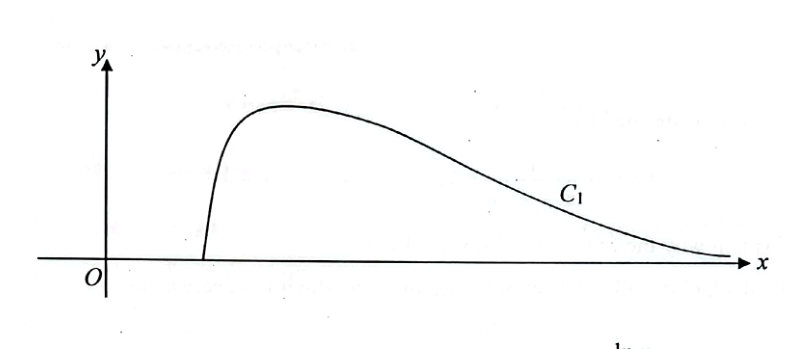
The diagram above shows the curve C1C_1 with equation y=ln⁡xx2y = \frac{\ln x}{x^2}, where x≥1x \ge 1.

  1. (i)

    Show that the exact coordinates of the turning point on C1C_1 are (e,12e)\left(\sqrt{\text{e}}, \frac{1}{2\text{e}}\right).

  2. (ii)

    The curve C2C_2 has equation (x−e)2+(2y)2=1\left(x - \sqrt{\text{e}}\right)^2 + (2y)^2 = 1, where y≥0y \ge 0. Sketch C1C_1 and C2C_2 on the same diagram, stating the exact coordinates of any points of intersection with the axes.

  3. (iii)

    Write down an integral that gives the area of the smaller region bounded by the two curves, C1C_1 and C2C_2, and the xx-axis. Evaluate this integral numerically.

Work through it with AI →

It won't just hand you the answer — it asks where you're stuck.How the checker works

Worked solution

11(i)

1. Find the first derivative of $y$ with respect to $x$ using the quotient rule.

y=ln⁡xx2y = \frac{\ln x}{x^2}
Using the quotient rule:
dydx=x2(1x)−(ln⁡x)(2x)(x2)2\frac{\text{d}y}{\text{d}x} = \frac{x^2 \left(\frac{1}{x}\right) - (\ln x)(2x)}{(x^2)^2}
dydx=x−2xln⁡xx4\frac{\text{d}y}{\text{d}x} = \frac{x - 2x \ln x}{x^4}
dydx=1−2ln⁡xx3\frac{\text{d}y}{\text{d}x} = \frac{1 - 2\ln x}{x^3}

2. Equate the derivative to zero to find the $x$-coordinate of the turning point.

At a turning point, dydx=0\frac{\text{d}y}{\text{d}x} = 0:
1−2ln⁡xx3=0\frac{1 - 2\ln x}{x^3} = 0
Since x≥1x \ge 1, x3≠0x^3 \neq 0, so the numerator must be zero:
1−2ln⁡x=01 - 2\ln x = 0
2ln⁡x=12\ln x = 1
ln⁡x=12\ln x = \frac{1}{2}
x=e12=ex = \text{e}^{\frac{1}{2}} = \sqrt{\text{e}}

3. Substitute the $x$-coordinate back into the original equation to obtain the corresponding $y$-coordinate.

Substitute x=e12x = \text{e}^{\frac{1}{2}} into the original equation for yy:
y=ln⁡(e12)(e12)2y = \frac{\ln\left(\text{e}^{\frac{1}{2}}\right)}{\left(\text{e}^{\frac{1}{2}}\right)^2}
y=12e=12ey = \frac{\frac{1}{2}}{\text{e}} = \frac{1}{2\text{e}}
Thus, the exact coordinates of the turning point are (e,12e)\left(\sqrt{\text{e}}, \frac{1}{2\text{e}}\right) (shown).

Answer

\left(\sqrt{\text{e}}, \frac{1}{2\text{e}}\right)

11(ii)

1. Find the point(s) of intersection of $C_1$ with the coordinate axes.

For C1C_1: y=ln⁡xx2y = \frac{\ln x}{x^2}, defined for x≥1x \ge 1.
Let y=0y = 0:
ln⁡xx2=0\frac{\ln x}{x^2} = 0
ln⁡x=0  ⟹  x=1\ln x = 0 \implies x = 1
The xx-intercept for C1C_1 is (1,0)(1, 0).
Since the domain is x≥1x \ge 1, xx cannot be 00, so there are no yy-intercepts.

2. Find the point(s) of intersection of $C_2$ with the coordinate axes.

For C2C_2: (x−e)2+(2y)2=1\left(x - \sqrt{\mathrm{e}}\right)^2 + (2y)^2 = 1, where y≥0y \ge 0.
Let y=0y = 0:
(x−e)2=1\left(x - \sqrt{\mathrm{e}}\right)^2 = 1
x−e=±1  ⟹  x=e−1 or x=e+1x - \sqrt{\mathrm{e}} = \pm 1 \implies x = \sqrt{\mathrm{e}} - 1 \text{ or } x = \sqrt{\mathrm{e}} + 1
The xx-intercepts for C2C_2 are (e−1,0)(\sqrt{\mathrm{e}} - 1, 0) and (e+1,0)(\sqrt{\mathrm{e}} + 1, 0).
Let x=0x = 0:
(−e)2+4y2=1\left(-\sqrt{\mathrm{e}}\right)^2 + 4y^2 = 1
e+4y2=1  ⟹  4y2=1−e\mathrm{e} + 4y^2 = 1 \implies 4y^2 = 1 - \mathrm{e}
Since 1−e<01 - \mathrm{e} < 0, there are no real solutions for yy, so C2C_2 does not intersect the yy-axis.

3. Identify the shapes to accurately sketch both curves.

C1C_1 starts at (1,0)(1, 0), climbs to its turning point (e,12e)\left(\sqrt{\mathrm{e}}, \frac{1}{2\mathrm{e}}\right) found in part (i), and asymptotically approaches the xx-axis.

C2C_2 can be rewritten as:
(x−e)212+y2(1/2)2=1\frac{(x - \sqrt{\mathrm{e}})^2}{1^2} + \frac{y^2}{(1/2)^2} = 1
This represents the upper half (y≥0y \ge 0) of an ellipse centered at (e,0)(\sqrt{\mathrm{e}}, 0), with a horizontal semi-axis of 11 and a vertical semi-axis of 12\frac{1}{2}. Its peak is at (e,12)(\sqrt{\mathrm{e}}, \frac{1}{2}).

Note that e−1≈0.649<1\sqrt{\mathrm{e}} - 1 \approx 0.649 < 1, so C2C_2 starts to the left of C1C_1.
Also, 12e≈0.184<0.5\frac{1}{2\mathrm{e}} \approx 0.184 < 0.5, so the peak of C2C_2 is much higher than the peak of C1C_1.

Answer

Intersections with axes:

  • C1C_1: (1,0)(1, 0)
  • C2C_2: (e−1,0)(\sqrt{\mathrm{e}} - 1, 0) and (e+1,0)(\sqrt{\mathrm{e}} + 1, 0)

(Self-drawn sketch should feature:)

  • C1C_1 starting at (1,0)(1, 0), rising to a peak at (e,12e)(\sqrt{\mathrm{e}}, \frac{1}{2\mathrm{e}}), and approaching y=0y=0 as an asymptote.
  • C2C_2 as an upper semi-ellipse starting from (e−1,0)(\sqrt{\mathrm{e}} - 1, 0) to (e+1,0)(\sqrt{\mathrm{e}} + 1, 0), with a local maximum at (e,0.5)(\sqrt{\mathrm{e}}, 0.5). It forms an arch over the turning point of C1C_1.

11(iii)

1. Find the point of intersection between $C_1$ and $C_2$ using a graphing calculator.

From part (ii), C1C_1 intersects the xx-axis at x=1x=1, and C2C_2 intersects the xx-axis at x=e+1x=\sqrt{\text{e}}+1.
Let y1=ln⁡xx2y_1 = \frac{\ln x}{x^2} and y2=121−(x−e)2y_2 = \frac{1}{2}\sqrt{1 - (x - \sqrt{\text{e}})^2} (since y≥0y \ge 0).
Using a graphing calculator to solve y1=y2y_1 = y_2:
x≈2.6079x \approx 2.6079

2. Set up the integral for the smaller region bounded by $C_1$, $C_2$, and the $x$-axis.

From the sketch in (ii), the curves enclose two bounded regions with the xx-axis. The smaller region lies on the right, between x=1x=1 and x=e+1x=\sqrt{\text{e}}+1.
It is bounded above by C1C_1 for x∈[1,2.6079]x \in [1, 2.6079] and by C2C_2 for x∈[2.6079,e+1]x \in [2.6079, \sqrt{\text{e}}+1].

Area=∫12.6079ln⁡xx2 dx+∫2.6079e+1121−(x−e)2 dx\text{Area} = \int_{1}^{2.6079} \frac{\ln x}{x^2} \,\mathrm{d}x + \int_{2.6079}^{\sqrt{\text{e}}+1} \frac{1}{2}\sqrt{1 - (x - \sqrt{\text{e}})^2} \,\mathrm{d}x

3. Evaluate the integral numerically using a graphing calculator.

Evaluating the integrals using the GC:
Area≈0.24900+0.00359=0.25259\text{Area} \approx 0.24900 + 0.00359 = 0.25259
Area=0.253 (to 3 s.f.)\text{Area} = 0.253 \text{ (to 3 s.f.)}

Answer

∫12.608ln⁡xx2 dx+∫2.608e+1121−(x−e)2 dx\int_{1}^{2.608} \frac{\ln x}{x^2} \,\mathrm{d}x + \int_{2.608}^{\sqrt{\text{e}}+1} \frac{1}{2}\sqrt{1 - (x - \sqrt{\text{e}})^2} \,\mathrm{d}x
Area ≈0.253\approx 0.253

AI analysis — may contain mistakes.

Worked this one out on paper? Snap your steps and Gigle's AI math checker will circle the step where it went wrong.

More questions on this topic

  1. 1[The volume of a cone of base radius rr and height hh is given by V=13πr2hV = \frac{1}{3}\pi r^2 h.] A manufacturer makes a…
  2. 2The curve C has equation x+y=(x−y)2x + y = (x - y)^2. It is given that C has only one turning point. Show that 1−dydx=21+2x−2y1 - \frac{dy}{dx} = \frac{2}{1 + 2x - 2y}…
  3. 3The curve C has equation x+y=(x−y)2.x + y = (x - y)^2. It is given that C has only one turning point. Show that 1−dydx=21+2x−2y1 - \dfrac{dy}{dx} = \dfrac{2}{1 + 2x - 2y}…
  4. 4A curve C1C_1 has the equation p2x2−y2=p2p^2x^2 - y^2 = p^2 where p>1p > 1. Sketch C1C_1, stating the coordinates of any points o…
  5. 5A sector of angle θ\theta radians and radius 4π cm4\pi\text{ cm} is used to form the curved surface of a right circular co…