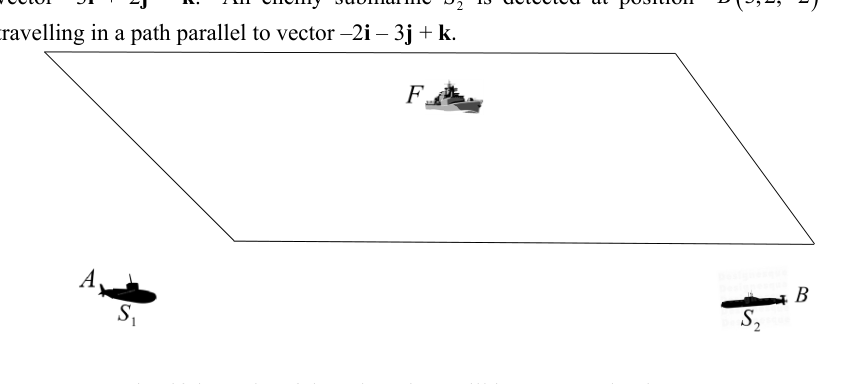
一艘护卫舰停泊在位置 F(1,2,0)F(1, 2, 0)。两艘潜艇 S1S_1 和 S2S_2 位于海面以下。潜艇 S1S_1 处于位置 A(−2,−1,−1)A(-2, -1, -1),并沿着平行于向量 −3i+2j−k-3\mathbf{i} + 2\mathbf{j} - \mathbf{k} 的路径航行。一艘敌方潜艇 S2S_2 在位置 B(3,2,−2)B(3, 2, -2) 被发现,并沿着平行于向量 −2i−3j+k-2\mathbf{i} - 3\mathbf{j} + \mathbf{k} 的路径航行。

  1. (i)

    判断这两艘潜艇的航线是否会相交。

  2. (ii)

    当敌方潜艇 S2S_2 处于其航线上最接近 FF 的点 PP 时,它将向护卫舰发射一枚鱼雷。求点 PP 的坐标。

  3. (iii)

    求包含 FF 和 S2S_2 的运动路径的平面 π\pi 的直角坐标方程。

    计算 π\pi 与 xx-yy 平面之间的锐角。

  4. (iv)

    深水炸弹是一种用于对付潜艇的反制武器。护卫舰释放了一枚深水炸弹,它下沉到位置 Q(1,2,−k)Q(1, 2, -k) 以针对 S2S_2。当 QQ 到 PP 的距离达到最小时,该深水炸弹被引爆。求 kk 的值。

    引爆时,深水炸弹将在半径为 0.1 个单位的范围内造成破坏。解释说明 S2S_2 是否会受到该深水炸弹的破坏。

先不看答案,让 AI 诊断你卡在哪里?

它不会直接告诉你答案,而是问你卡在哪一步看看 AI 是怎么陪你一步步弄懂这道题的

完整解法

6(i)

1. Write down the vector equations for the paths of $S_1$ and $S_2$.

Let the paths be l1l_1 and l2l_2.
l1:r1=(−2−1−1)+λ(−32−1)l_1: \mathbf{r}_1 = \begin{pmatrix} -2 \\ -1 \\ -1 \end{pmatrix} + \lambda \begin{pmatrix} -3 \\ 2 \\ -1 \end{pmatrix}, λ∈R\lambda \in \mathbb{R}
l2:r2=(32−2)+μ(−2−31)l_2: \mathbf{r}_2 = \begin{pmatrix} 3 \\ 2 \\ -2 \end{pmatrix} + \mu \begin{pmatrix} -2 \\ -3 \\ 1 \end{pmatrix}, μ∈R\mu \in \mathbb{R}

2. Set up a system of equations by assuming the lines intersect.

Equating r1\mathbf{r}_1 and r2\mathbf{r}_2, we get:
−2−3λ=3−2μ  ⟹  3λ−2μ=−5-2 - 3\lambda = 3 - 2\mu \implies 3\lambda - 2\mu = -5 --- (1)
−1+2λ=2−3μ  ⟹  2λ+3μ=3-1 + 2\lambda = 2 - 3\mu \implies 2\lambda + 3\mu = 3 --- (2)
−1−λ=−2+μ  ⟹  λ+μ=1-1 - \lambda = -2 + \mu \implies \lambda + \mu = 1 --- (3)

3. Solve for the parameters and check for consistency.

From (3), μ=1−λ\mu = 1 - \lambda.
Substitute into (2):
2λ+3(1−λ)=32\lambda + 3(1 - \lambda) = 3
2λ+3−3λ=3  ⟹  λ=02\lambda + 3 - 3\lambda = 3 \implies \lambda = 0
Thus, μ=1−0=1\mu = 1 - 0 = 1.
Substitute λ=0\lambda = 0 and μ=1\mu = 1 into the LHS of (1):
3(0)−2(1)=−23(0) - 2(1) = -2
Since the LHS (−2-2) ≠\neq RHS (−5-5), the system of equations is inconsistent.
Therefore, the paths of the submarines do not intersect.

答案

The paths of the submarines do not intersect.

6(ii)

1. Formulate the vector equation for the path of $S_2$ and express the vector $\vec{FP}$ to a general point on this line.

Let l2l_2 be the line representing the path of S2S_2. The equation of l2l_2 is r=(32−2)+μ(−2−31)\mathbf{r} = \begin{pmatrix} 3 \\ 2 \\ -2 \end{pmatrix} + \mu \begin{pmatrix} -2 \\ -3 \\ 1 \end{pmatrix}, where μ∈R\mu \in \mathbb{R}.

The position vector of a general point PP on l2l_2 is OP⃗=(3−2μ2−3μ−2+μ)\vec{OP} = \begin{pmatrix} 3 - 2\mu \\ 2 - 3\mu \\ -2 + \mu \end{pmatrix}.

Given the position of the frigate OF⃗=(120)\vec{OF} = \begin{pmatrix} 1 \\ 2 \\ 0 \end{pmatrix}, the vector FP⃗\vec{FP} is:
FP⃗=OP⃗−OF⃗=(3−2μ2−3μ−2+μ)−(120)=(2−2μ−3μ−2+μ)\vec{FP} = \vec{OP} - \vec{OF} = \begin{pmatrix} 3 - 2\mu \\ 2 - 3\mu \\ -2 + \mu \end{pmatrix} - \begin{pmatrix} 1 \\ 2 \\ 0 \end{pmatrix} = \begin{pmatrix} 2 - 2\mu \\ -3\mu \\ -2 + \mu \end{pmatrix}

2. Apply the shortest distance condition using the dot product, since $\vec{FP}$ must be perpendicular to the path of $S_2$.

For PP to be the closest point to FF, the vector FP⃗\vec{FP} must be perpendicular to the direction vector of l2l_2, which is d2=(−2−31)\mathbf{d}_2 = \begin{pmatrix} -2 \\ -3 \\ 1 \end{pmatrix}.

Therefore, their scalar (dot) product must be zero: FP⃗⋅d2=0\vec{FP} \cdot \mathbf{d}_2 = 0.
(2−2μ−3μ−2+μ)⋅(−2−31)=0\begin{pmatrix} 2 - 2\mu \\ -3\mu \\ -2 + \mu \end{pmatrix} \cdot \begin{pmatrix} -2 \\ -3 \\ 1 \end{pmatrix} = 0

3. Evaluate the scalar product and solve for the parameter $\mu$.

−2(2−2μ)−3(−3μ)+1(−2+μ)=0-2(2 - 2\mu) - 3(-3\mu) + 1(-2 + \mu) = 0
−4+4μ+9μ−2+μ=0-4 + 4\mu + 9\mu - 2 + \mu = 0
14μ−6=014\mu - 6 = 0
14μ=6  ⟹  μ=614=3714\mu = 6 \implies \mu = \frac{6}{14} = \frac{3}{7}

4. Substitute $\mu$ back into $\vec{OP}$ to find the coordinates of $P$.

OP⃗=(32−2)+37(−2−31)=(3−672−97−2+37)=(15/75/7−11/7)\vec{OP} = \begin{pmatrix} 3 \\ 2 \\ -2 \end{pmatrix} + \frac{3}{7} \begin{pmatrix} -2 \\ -3 \\ 1 \end{pmatrix} = \begin{pmatrix} 3 - \frac{6}{7} \\ 2 - \frac{9}{7} \\ -2 + \frac{3}{7} \end{pmatrix} = \begin{pmatrix} 15/7 \\ 5/7 \\ -11/7 \end{pmatrix}

The coordinates of point PP are (157,57,−117)\left(\frac{15}{7}, \frac{5}{7}, -\frac{11}{7}\right).

答案

P(157,57,−117)P\left(\frac{15}{7}, \frac{5}{7}, -\frac{11}{7}\right)

6(iii)

1. Find two non-parallel vectors that lie on or are parallel to the plane $\pi$.

The plane π\pi contains the point F(1,2,0)F(1, 2, 0) and the path of S2S_2, which passes through B(3,2,−2)B(3, 2, -2) with direction d2=(−2−31)\mathbf{d_2} = \begin{pmatrix} -2 \\ -3 \\ 1 \end{pmatrix}.

A vector on the plane connecting FF and BB is:
FB⃗=OB⃗−OF⃗=(32−2)−(120)=(20−2)\vec{FB} = \vec{OB} - \vec{OF} = \begin{pmatrix} 3 \\ 2 \\ -2 \end{pmatrix} - \begin{pmatrix} 1 \\ 2 \\ 0 \end{pmatrix} = \begin{pmatrix} 2 \\ 0 \\ -2 \end{pmatrix}

2. Calculate a normal vector to the plane using the cross product.

The normal vector n\mathbf{n} is orthogonal to both FB⃗\vec{FB} and d2\mathbf{d_2}:
n=FB⃗×d2=(20−2)×(−2−31)=(0(1)−(−2)(−3)(−2)(−2)−2(1)2(−3)−0(−2))=(−62−6)\mathbf{n} = \vec{FB} \times \mathbf{d_2} = \begin{pmatrix} 2 \\ 0 \\ -2 \end{pmatrix} \times \begin{pmatrix} -2 \\ -3 \\ 1 \end{pmatrix} = \begin{pmatrix} 0(1) - (-2)(-3) \\ (-2)(-2) - 2(1) \\ 2(-3) - 0(-2) \end{pmatrix} = \begin{pmatrix} -6 \\ 2 \\ -6 \end{pmatrix}

A simpler parallel normal vector is n1=(3−13)\mathbf{n_1} = \begin{pmatrix} 3 \\ -1 \\ 3 \end{pmatrix}.

3. Determine the cartesian equation of the plane.

Using the point F(1,2,0)F(1, 2, 0) and the scalar product equation r⋅n1=OF⃗⋅n1\mathbf{r} \cdot \mathbf{n_1} = \vec{OF} \cdot \mathbf{n_1}:
r⋅(3−13)=(120)⋅(3−13)\mathbf{r} \cdot \begin{pmatrix} 3 \\ -1 \\ 3 \end{pmatrix} = \begin{pmatrix} 1 \\ 2 \\ 0 \end{pmatrix} \cdot \begin{pmatrix} 3 \\ -1 \\ 3 \end{pmatrix}
r⋅(3−13)=3(1)+(−1)(2)+3(0)=1\mathbf{r} \cdot \begin{pmatrix} 3 \\ -1 \\ 3 \end{pmatrix} = 3(1) + (-1)(2) + 3(0) = 1

The cartesian equation is:
3x−y+3z=13x - y + 3z = 1

4. Calculate the acute angle between the plane $\pi$ and the $x$-$y$ plane.

The normal vector to the xx-yy plane is k=(001)\mathbf{k} = \begin{pmatrix} 0 \\ 0 \\ 1 \end{pmatrix}.
Let θ\theta be the acute angle between the two planes.
cos⁡θ=∣n1⋅k∣∣n1∣∣k∣\cos \theta = \frac{|\mathbf{n_1} \cdot \mathbf{k}|}{|\mathbf{n_1}| |\mathbf{k}|}
cos⁡θ=∣(3−13)⋅(001)∣32+(−1)2+3212\cos \theta = \frac{\left| \begin{pmatrix} 3 \\ -1 \\ 3 \end{pmatrix} \cdot \begin{pmatrix} 0 \\ 0 \\ 1 \end{pmatrix} \right|}{\sqrt{3^2 + (-1)^2 + 3^2} \sqrt{1^2}}
cos⁡θ=319\cos \theta = \frac{3}{\sqrt{19}}
θ=cos⁡−1(319)≈46.5∘ (to 1 d.p.)\theta = \cos^{-1}\left(\frac{3}{\sqrt{19}}\right) \approx 46.5^\circ \text{ (to 1 d.p.)}

答案

Cartesian equation: 3x−y+3z=13x - y + 3z = 1
Acute angle: 46.5∘46.5^\circ

6(iv)

1. Retrieve or calculate the position vector of point $P$ from part (ii).

Let the path of S2S_2 be r=(32−2)+μ(−2−31)\mathbf{r} = \begin{pmatrix} 3 \\ 2 \\ -2 \end{pmatrix} + \mu \begin{pmatrix} -2 \\ -3 \\ 1 \end{pmatrix}.
The vector FP⃗\vec{FP} from F(1,2,0)F(1, 2, 0) is (2−2μ−3μ−2+μ)\begin{pmatrix} 2 - 2\mu \\ -3\mu \\ -2 + \mu \end{pmatrix}.
Since PP is the closest point to FF, FP⃗⋅(−2−31)=0\vec{FP} \cdot \begin{pmatrix} -2 \\ -3 \\ 1 \end{pmatrix} = 0.
−2(2−2μ)−3(−3μ)+1(−2+μ)=0  ⟹  14μ−6=0  ⟹  μ=37-2(2 - 2\mu) - 3(-3\mu) + 1(-2 + \mu) = 0 \implies 14\mu - 6 = 0 \implies \mu = \frac{3}{7}.
Substituting μ=37\mu = \frac{3}{7} gives the position vector OP⃗=(15/75/7−11/7)\vec{OP} = \begin{pmatrix} 15/7 \\ 5/7 \\ -11/7 \end{pmatrix}.

2. Find the value of $k$ that minimizes the distance between $Q$ and $P$.

The position of QQ is given by OQ⃗=(12−k)\vec{OQ} = \begin{pmatrix} 1 \\ 2 \\ -k \end{pmatrix}.
QP⃗=OP⃗−OQ⃗=(15/7−15/7−2−11/7−(−k))=(8/7−9/7k−11/7)\vec{QP} = \vec{OP} - \vec{OQ} = \begin{pmatrix} 15/7 - 1 \\ 5/7 - 2 \\ -11/7 - (-k) \end{pmatrix} = \begin{pmatrix} 8/7 \\ -9/7 \\ k - 11/7 \end{pmatrix}.
The square of the distance is QP2=(87)2+(−97)2+(k−117)2=14549+(k−117)2QP^2 = \left(\frac{8}{7}\right)^2 + \left(-\frac{9}{7}\right)^2 + \left(k - \frac{11}{7}\right)^2 = \frac{145}{49} + \left(k - \frac{11}{7}\right)^2.
For QPQP to be at a minimum, the squared term must be zero:
k−117=0  ⟹  k=117k - \frac{11}{7} = 0 \implies k = \frac{11}{7}.

3. Calculate the minimum distance and determine if $S_2$ will be damaged.

Substitute k=117k = \frac{11}{7} into the distance formula:
Minimum distance QP=14549=1457≈1.72QP = \sqrt{\frac{145}{49}} = \frac{\sqrt{145}}{7} \approx 1.72 units.
Since the minimum distance of 1.721.72 units is greater than the damage radius of 0.10.1 units, S2S_2 will not be damaged by the depth charge.

答案

k=117k = \frac{11}{7}; S2S_2 will not be damaged as the minimum distance is approximately 1.721.72 units, which is greater than 0.10.1 units.

AI 分析,可能出错

用 AI 批改,圈出写错的那一步,并自动将你的薄弱点存入错题本,形成你的错因库。

同一知识点的其他题

  1. 1直线 l1l_1 和 l2l_2 的方程分别为 r=(4110)+λ(1−1−6),λ∈R\mathbf{r} = \begin{pmatrix} 4 \\ 1 \\ 10 \end{pmatrix} + \lambda \begin{pmatrix} 1 \\ -1 \\ -6 \end{pmatrix}, \lambda \in \mathbb{R}…
  2. 2一家钻探公司计划在山中铺设一条直管道 ABAB。点 (x,y,z)(x, y, z) 是相对于山脚下坐标为 (0,0,0)(0, 0, 0) 的主控制中心定义的,其中单位为米。xx 轴指向东,yy 轴指向北,zz 轴垂直向上。点 AA 的坐标为 (−200,150,10)(-200, 150, 10)…
  3. 3平面 Π1\Pi_1 的方程为 x+y+z=3x + y + z = 3。一条直线穿过点 PP 和 QQ,它们的位置向量分别为 i+j+2k\mathbf{i} + \mathbf{j} + 2\mathbf{k} 和 4i+2j−k4\mathbf{i} + 2\mathbf{j} - \mathbf{k}…
  4. 4平面 Π1\Pi_1 和 Π2\Pi_2 的向量方程分别为 r=λ1(i+j−k)+μ1(2i−j+k)andr=λ2(i+2j+k)+μ2(3i+j−k)\mathbf{r} = \lambda_1(\mathbf{i} + \mathbf{j} - \mathbf{k}) + \mu_1(2\mathbf{i} - \mathbf{j} + \mathbf{k}) \quad \text{and} \quad \mathbf{r} = \lambda_2(\mathbf{i} + 2\mathbf{j} + \mathbf{k}) + \mu_2(3\mathbf{i} + \mathbf{j} - \mathbf{k})…
  5. 5一位室内设计师正计划设计一个下拉式衣柜升降机。为了测试他的设想,设计师制作了一个它的微缩模型。在这个模型中,点 (x,y,z)(x, y, z) 是相对于模型的一个拐角 O(0,0,0)O(0, 0, 0) 来定义的。模型中使用的杆可以用直线方程来建模。 主杆可…