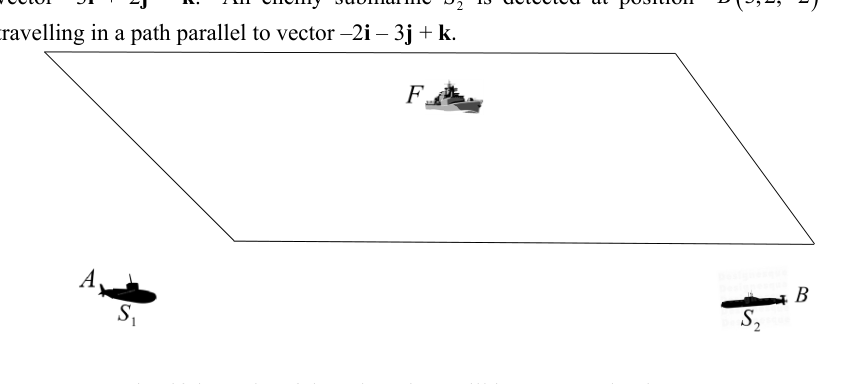
A frigate is stationed at position F(1,2,0)F(1, 2, 0). Two submarines S1S_1 and S2S_2 are under the sea surface. Submarine S1S_1 is at position A(−2,−1,−1)A(-2, -1, -1) and travelling in a path parallel to vector −3i+2j−k-3\mathbf{i} + 2\mathbf{j} - \mathbf{k}. An enemy submarine S2S_2 is detected at position B(3,2,−2)B(3, 2, -2) travelling in a path parallel to vector −2i−3j+k-2\mathbf{i} - 3\mathbf{j} + \mathbf{k}.

  1. (i)

    Determine if the paths of the submarines will intersect each other.

  2. (ii)

    The enemy submarine S2S_2 will launch a torpedo at the frigate when it is at a point PP in its path that is closest to FF. Find the co-ordinates of PP.

  3. (iii)

    Find a cartesian equation of the plane π\pi that contains FF and the path of S2S_2.

    Calculate the acute angle between π\pi and the xx-yy plane.

  4. (iv)

    A depth charge is a countermeasure used against submarines. The frigate releases a depth charge which descends to the position Q(1,2,−k)Q(1, 2, -k) to target S2S_2. The depth charge is detonated when the distance from QQ to PP is at a minimum. Find the value of kk.

    When detonated the depth charge will cause damage within a 0.1 unit radius. Explain whether S2S_2 will be damaged by the depth charge.

Work through it with AI →

It won't just hand you the answer — it asks where you're stuck.How the checker works

Worked solution

6(i)

1. Write down the vector equations for the paths of $S_1$ and $S_2$.

Let the paths be l1l_1 and l2l_2.
l1:r1=(−2−1−1)+λ(−32−1)l_1: \mathbf{r}_1 = \begin{pmatrix} -2 \\ -1 \\ -1 \end{pmatrix} + \lambda \begin{pmatrix} -3 \\ 2 \\ -1 \end{pmatrix}, λ∈R\lambda \in \mathbb{R}
l2:r2=(32−2)+μ(−2−31)l_2: \mathbf{r}_2 = \begin{pmatrix} 3 \\ 2 \\ -2 \end{pmatrix} + \mu \begin{pmatrix} -2 \\ -3 \\ 1 \end{pmatrix}, μ∈R\mu \in \mathbb{R}

2. Set up a system of equations by assuming the lines intersect.

Equating r1\mathbf{r}_1 and r2\mathbf{r}_2, we get:
−2−3λ=3−2μ  ⟹  3λ−2μ=−5-2 - 3\lambda = 3 - 2\mu \implies 3\lambda - 2\mu = -5 --- (1)
−1+2λ=2−3μ  ⟹  2λ+3μ=3-1 + 2\lambda = 2 - 3\mu \implies 2\lambda + 3\mu = 3 --- (2)
−1−λ=−2+μ  ⟹  λ+μ=1-1 - \lambda = -2 + \mu \implies \lambda + \mu = 1 --- (3)

3. Solve for the parameters and check for consistency.

From (3), μ=1−λ\mu = 1 - \lambda.
Substitute into (2):
2λ+3(1−λ)=32\lambda + 3(1 - \lambda) = 3
2λ+3−3λ=3  ⟹  λ=02\lambda + 3 - 3\lambda = 3 \implies \lambda = 0
Thus, μ=1−0=1\mu = 1 - 0 = 1.
Substitute λ=0\lambda = 0 and μ=1\mu = 1 into the LHS of (1):
3(0)−2(1)=−23(0) - 2(1) = -2
Since the LHS (−2-2) ≠\neq RHS (−5-5), the system of equations is inconsistent.
Therefore, the paths of the submarines do not intersect.

Answer

The paths of the submarines do not intersect.

6(ii)

1. Formulate the vector equation for the path of $S_2$ and express the vector $\vec{FP}$ to a general point on this line.

Let l2l_2 be the line representing the path of S2S_2. The equation of l2l_2 is r=(32−2)+μ(−2−31)\mathbf{r} = \begin{pmatrix} 3 \\ 2 \\ -2 \end{pmatrix} + \mu \begin{pmatrix} -2 \\ -3 \\ 1 \end{pmatrix}, where μ∈R\mu \in \mathbb{R}.

The position vector of a general point PP on l2l_2 is OP⃗=(3−2μ2−3μ−2+μ)\vec{OP} = \begin{pmatrix} 3 - 2\mu \\ 2 - 3\mu \\ -2 + \mu \end{pmatrix}.

Given the position of the frigate OF⃗=(120)\vec{OF} = \begin{pmatrix} 1 \\ 2 \\ 0 \end{pmatrix}, the vector FP⃗\vec{FP} is:
FP⃗=OP⃗−OF⃗=(3−2μ2−3μ−2+μ)−(120)=(2−2μ−3μ−2+μ)\vec{FP} = \vec{OP} - \vec{OF} = \begin{pmatrix} 3 - 2\mu \\ 2 - 3\mu \\ -2 + \mu \end{pmatrix} - \begin{pmatrix} 1 \\ 2 \\ 0 \end{pmatrix} = \begin{pmatrix} 2 - 2\mu \\ -3\mu \\ -2 + \mu \end{pmatrix}

2. Apply the shortest distance condition using the dot product, since $\vec{FP}$ must be perpendicular to the path of $S_2$.

For PP to be the closest point to FF, the vector FP⃗\vec{FP} must be perpendicular to the direction vector of l2l_2, which is d2=(−2−31)\mathbf{d}_2 = \begin{pmatrix} -2 \\ -3 \\ 1 \end{pmatrix}.

Therefore, their scalar (dot) product must be zero: FP⃗⋅d2=0\vec{FP} \cdot \mathbf{d}_2 = 0.
(2−2μ−3μ−2+μ)⋅(−2−31)=0\begin{pmatrix} 2 - 2\mu \\ -3\mu \\ -2 + \mu \end{pmatrix} \cdot \begin{pmatrix} -2 \\ -3 \\ 1 \end{pmatrix} = 0

3. Evaluate the scalar product and solve for the parameter $\mu$.

−2(2−2μ)−3(−3μ)+1(−2+μ)=0-2(2 - 2\mu) - 3(-3\mu) + 1(-2 + \mu) = 0
−4+4μ+9μ−2+μ=0-4 + 4\mu + 9\mu - 2 + \mu = 0
14μ−6=014\mu - 6 = 0
14μ=6  ⟹  μ=614=3714\mu = 6 \implies \mu = \frac{6}{14} = \frac{3}{7}

4. Substitute $\mu$ back into $\vec{OP}$ to find the coordinates of $P$.

OP⃗=(32−2)+37(−2−31)=(3−672−97−2+37)=(15/75/7−11/7)\vec{OP} = \begin{pmatrix} 3 \\ 2 \\ -2 \end{pmatrix} + \frac{3}{7} \begin{pmatrix} -2 \\ -3 \\ 1 \end{pmatrix} = \begin{pmatrix} 3 - \frac{6}{7} \\ 2 - \frac{9}{7} \\ -2 + \frac{3}{7} \end{pmatrix} = \begin{pmatrix} 15/7 \\ 5/7 \\ -11/7 \end{pmatrix}

The coordinates of point PP are (157,57,−117)\left(\frac{15}{7}, \frac{5}{7}, -\frac{11}{7}\right).

Answer

P(157,57,−117)P\left(\frac{15}{7}, \frac{5}{7}, -\frac{11}{7}\right)

6(iii)

1. Find two non-parallel vectors that lie on or are parallel to the plane $\pi$.

The plane π\pi contains the point F(1,2,0)F(1, 2, 0) and the path of S2S_2, which passes through B(3,2,−2)B(3, 2, -2) with direction d2=(−2−31)\mathbf{d_2} = \begin{pmatrix} -2 \\ -3 \\ 1 \end{pmatrix}.

A vector on the plane connecting FF and BB is:
FB⃗=OB⃗−OF⃗=(32−2)−(120)=(20−2)\vec{FB} = \vec{OB} - \vec{OF} = \begin{pmatrix} 3 \\ 2 \\ -2 \end{pmatrix} - \begin{pmatrix} 1 \\ 2 \\ 0 \end{pmatrix} = \begin{pmatrix} 2 \\ 0 \\ -2 \end{pmatrix}

2. Calculate a normal vector to the plane using the cross product.

The normal vector n\mathbf{n} is orthogonal to both FB⃗\vec{FB} and d2\mathbf{d_2}:
n=FB⃗×d2=(20−2)×(−2−31)=(0(1)−(−2)(−3)(−2)(−2)−2(1)2(−3)−0(−2))=(−62−6)\mathbf{n} = \vec{FB} \times \mathbf{d_2} = \begin{pmatrix} 2 \\ 0 \\ -2 \end{pmatrix} \times \begin{pmatrix} -2 \\ -3 \\ 1 \end{pmatrix} = \begin{pmatrix} 0(1) - (-2)(-3) \\ (-2)(-2) - 2(1) \\ 2(-3) - 0(-2) \end{pmatrix} = \begin{pmatrix} -6 \\ 2 \\ -6 \end{pmatrix}

A simpler parallel normal vector is n1=(3−13)\mathbf{n_1} = \begin{pmatrix} 3 \\ -1 \\ 3 \end{pmatrix}.

3. Determine the cartesian equation of the plane.

Using the point F(1,2,0)F(1, 2, 0) and the scalar product equation r⋅n1=OF⃗⋅n1\mathbf{r} \cdot \mathbf{n_1} = \vec{OF} \cdot \mathbf{n_1}:
r⋅(3−13)=(120)⋅(3−13)\mathbf{r} \cdot \begin{pmatrix} 3 \\ -1 \\ 3 \end{pmatrix} = \begin{pmatrix} 1 \\ 2 \\ 0 \end{pmatrix} \cdot \begin{pmatrix} 3 \\ -1 \\ 3 \end{pmatrix}
r⋅(3−13)=3(1)+(−1)(2)+3(0)=1\mathbf{r} \cdot \begin{pmatrix} 3 \\ -1 \\ 3 \end{pmatrix} = 3(1) + (-1)(2) + 3(0) = 1

The cartesian equation is:
3x−y+3z=13x - y + 3z = 1

4. Calculate the acute angle between the plane $\pi$ and the $x$-$y$ plane.

The normal vector to the xx-yy plane is k=(001)\mathbf{k} = \begin{pmatrix} 0 \\ 0 \\ 1 \end{pmatrix}.
Let θ\theta be the acute angle between the two planes.
cos⁡θ=∣n1⋅k∣∣n1∣∣k∣\cos \theta = \frac{|\mathbf{n_1} \cdot \mathbf{k}|}{|\mathbf{n_1}| |\mathbf{k}|}
cos⁡θ=∣(3−13)⋅(001)∣32+(−1)2+3212\cos \theta = \frac{\left| \begin{pmatrix} 3 \\ -1 \\ 3 \end{pmatrix} \cdot \begin{pmatrix} 0 \\ 0 \\ 1 \end{pmatrix} \right|}{\sqrt{3^2 + (-1)^2 + 3^2} \sqrt{1^2}}
cos⁡θ=319\cos \theta = \frac{3}{\sqrt{19}}
θ=cos⁡−1(319)≈46.5∘ (to 1 d.p.)\theta = \cos^{-1}\left(\frac{3}{\sqrt{19}}\right) \approx 46.5^\circ \text{ (to 1 d.p.)}

Answer

Cartesian equation: 3x−y+3z=13x - y + 3z = 1
Acute angle: 46.5∘46.5^\circ

6(iv)

1. Retrieve or calculate the position vector of point $P$ from part (ii).

Let the path of S2S_2 be r=(32−2)+μ(−2−31)\mathbf{r} = \begin{pmatrix} 3 \\ 2 \\ -2 \end{pmatrix} + \mu \begin{pmatrix} -2 \\ -3 \\ 1 \end{pmatrix}.
The vector FP⃗\vec{FP} from F(1,2,0)F(1, 2, 0) is (2−2μ−3μ−2+μ)\begin{pmatrix} 2 - 2\mu \\ -3\mu \\ -2 + \mu \end{pmatrix}.
Since PP is the closest point to FF, FP⃗⋅(−2−31)=0\vec{FP} \cdot \begin{pmatrix} -2 \\ -3 \\ 1 \end{pmatrix} = 0.
−2(2−2μ)−3(−3μ)+1(−2+μ)=0  ⟹  14μ−6=0  ⟹  μ=37-2(2 - 2\mu) - 3(-3\mu) + 1(-2 + \mu) = 0 \implies 14\mu - 6 = 0 \implies \mu = \frac{3}{7}.
Substituting μ=37\mu = \frac{3}{7} gives the position vector OP⃗=(15/75/7−11/7)\vec{OP} = \begin{pmatrix} 15/7 \\ 5/7 \\ -11/7 \end{pmatrix}.

2. Find the value of $k$ that minimizes the distance between $Q$ and $P$.

The position of QQ is given by OQ⃗=(12−k)\vec{OQ} = \begin{pmatrix} 1 \\ 2 \\ -k \end{pmatrix}.
QP⃗=OP⃗−OQ⃗=(15/7−15/7−2−11/7−(−k))=(8/7−9/7k−11/7)\vec{QP} = \vec{OP} - \vec{OQ} = \begin{pmatrix} 15/7 - 1 \\ 5/7 - 2 \\ -11/7 - (-k) \end{pmatrix} = \begin{pmatrix} 8/7 \\ -9/7 \\ k - 11/7 \end{pmatrix}.
The square of the distance is QP2=(87)2+(−97)2+(k−117)2=14549+(k−117)2QP^2 = \left(\frac{8}{7}\right)^2 + \left(-\frac{9}{7}\right)^2 + \left(k - \frac{11}{7}\right)^2 = \frac{145}{49} + \left(k - \frac{11}{7}\right)^2.
For QPQP to be at a minimum, the squared term must be zero:
k−117=0  ⟹  k=117k - \frac{11}{7} = 0 \implies k = \frac{11}{7}.

3. Calculate the minimum distance and determine if $S_2$ will be damaged.

Substitute k=117k = \frac{11}{7} into the distance formula:
Minimum distance QP=14549=1457≈1.72QP = \sqrt{\frac{145}{49}} = \frac{\sqrt{145}}{7} \approx 1.72 units.
Since the minimum distance of 1.721.72 units is greater than the damage radius of 0.10.1 units, S2S_2 will not be damaged by the depth charge.

Answer

k=117k = \frac{11}{7}; S2S_2 will not be damaged as the minimum distance is approximately 1.721.72 units, which is greater than 0.10.1 units.

AI analysis — may contain mistakes.

Worked this one out on paper? Snap your steps and Gigle's AI math checker will circle the step where it went wrong.

More questions on this topic

  1. 1The lines l1l_1 and l2l_2 have equations r=(4110)+λ(1−1−6),λ∈R\mathbf{r} = \begin{pmatrix} 4 \\ 1 \\ 10 \end{pmatrix} + \lambda \begin{pmatrix} 1 \\ -1 \\ -6 \end{pmatrix}, \lambda \in \mathbb{R}…
  2. 2A drilling company plans to install a straight pipeline ABAB through a mountain. Points (x,y,z)(x, y, z) are defined relative…
  3. 3A plane Π1\Pi_1 has equation x+y+z=3x + y + z = 3. A line passes through the points PP and QQ with position vectors i+j+2k\mathbf{i} + \mathbf{j} + 2\mathbf{k}…
  4. 4The planes Π1\Pi_1 and Π2\Pi_2 have vector equations r=λ1(i+j−k)+μ1(2i−j+k)andr=λ2(i+2j+k)+μ2(3i+j−k)\mathbf{r} = \lambda_1(\mathbf{i} + \mathbf{j} - \mathbf{k}) + \mu_1(2\mathbf{i} - \mathbf{j} + \mathbf{k}) \quad \text{and} \quad \mathbf{r} = \lambda_2(\mathbf{i} + 2\mathbf{j} + \mathbf{k}) + \mu_2(3\mathbf{i} + \mathbf{j} - \mathbf{k})…
  5. 5A home interior designer is looking to design a pull-down wardrobe lift. To test his concept, the designer built a small…