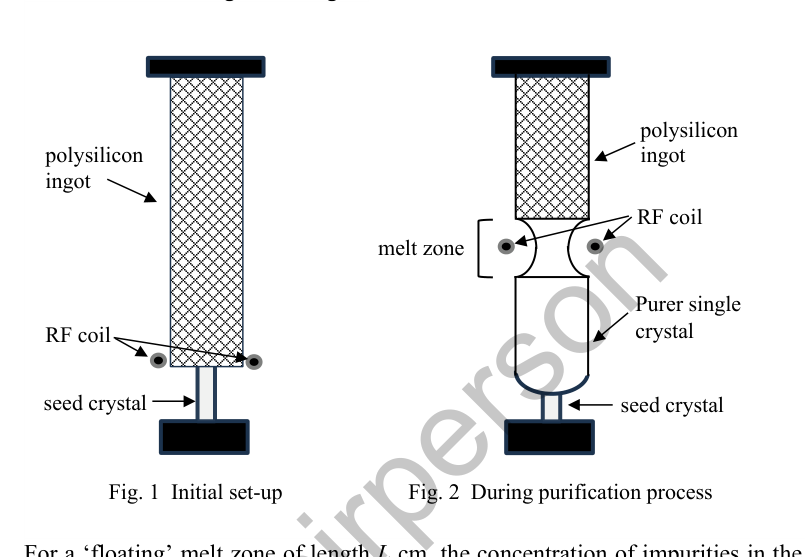
一家晶圆制造公司使用悬浮区熔法来提纯多晶硅锭,每个硅锭具有均匀的横截面积,长度为 200 cm。该方法包括将杂质浓度为 atoms/ 的多晶硅锭放置在单个籽晶的顶部。然后通过射频(RF)线圈对多晶硅锭进行外部加热,从而使硅锭局部熔化。杂质更倾向于留在熔融态而非固态中,因此随着线圈和熔区向上移动,一个更纯的单晶在籽晶顶部凝固。该方法的原理示意图如图 1 和图 2 所示。
对于长度为 cm 的“悬浮”熔区,熔区中的杂质浓度 atoms/ 与射频线圈移动的距离 cm 满足以下微分方程:
其中 是一个常数,满足 。
该公司采用的“悬浮”熔区长度 cm 为 2 cm,且 。已知当 时,。
- (a)
求解该微分方程,得到用 、 和 表示 的表达式。
- (b)
画出 关于 的图像。
- (c)
假设 ,且射频线圈以每小时 8 mm 的恒定速度向上移动。求熔区内杂质浓度达到 所需的时间,以及在这一时刻,杂质浓度的变化率(用 表示)。
- (d)
该公司决定改变“漂浮”熔融区的长度。
请解释并给出理由,说明较短的长度是否比较长的长度更可取。
它不会直接告诉你答案,而是问你卡在哪一步看看 AI 是怎么陪你一步步弄懂这道题的
完整解法
11(a)
1. Substitute the given value of $L$ into the differential equation and separate the variables.
Given , the differential equation becomes:
Separating the variables and :
2. Integrate both sides to find the general solution.
3. Apply the initial condition to find the constant of integration, $A$.
Given that when , :
Since and , we have . Therefore:
Substituting back into the equation:
4. Rearrange the equation to make $C$ the subject.
Multiply the entire equation by :
Since is positive initially and continuous, we can drop the absolute value:
11(b)
1. Identify the initial point and horizontal asymptote from the solution for $C$.
From part (a), the solution is .
When , .
As , (since ).
Thus, . The horizontal asymptote is .
2. Determine the shape of the curve based on the first derivative.
From the given differential equation, .
Since and starts at , the initial gradient is .
As increases towards , the term remains positive but decreases towards .
Therefore, the gradient is positive but strictly decreasing, meaning the curve is increasing and concave downwards.
3. Sketch the graph incorporating the valid domain.
Draw the horizontal -axis and vertical -axis.
Plot the -intercept at .
Draw a horizontal dotted line at (note that since ).
Draw a smooth, increasing, concave down curve from the intercept, approaching the asymptote.
Terminate the graph at , matching the domain given in the context.
A sketched curve on and axes with the following features:
- -intercept: Point .
- Shape: An increasing, concave downwards curve.
- Asymptote: A horizontal dotted line at that the curve approaches from below.
- Domain: The curve should be drawn for .
11(c)
1. Briefly solve the differential equation from part (a) to express $C$ in terms of $x$, as the result is required.
As required from part (a), we first find the expression for by separating variables and integrating:
Using the initial condition when :
2. Substitute $C = 2C_0$ and $k = 0.3$ to find the distance $x$ moved.
3. Convert the speed to consistent units and calculate the time taken $t$.
The distance is in cm, so the upward speed must be in cm/h:
So the time taken is approximately hours.
4. Set up the relationship for the rate of change of $C$ with respect to time using the chain rule.
We know and the differential equation gives .
5. Evaluate the rate of change of concentration at the instant when $C = 2C_0$.
At the instant when and :
Time taken: hours (or hours)
Rate of change: atoms/cm per hour
11(d)
1. Concisely solve the differential equation from part (a) to find the expression for $C$.
Separating variables for the given differential equation:
Using the initial condition when :
2. Analyze the effect of a shorter melt zone length $L$ on the impurity concentration $C$.
From the expression for , for a shorter length , the value of is larger, making smaller.
Since , the term becomes larger.
Therefore, a shorter length results in a larger for any given .
(Alternatively, directly from , a smaller yields a larger positive , meaning increases more rapidly.)
3. Relate the higher concentration $C$ to the purity of the solidifying crystal to draw a conclusion.
A larger means a higher concentration of impurities in the melt zone.
Because the newly formed single crystal draws its material from this melt zone, a higher impurity concentration in the melt leads to a higher concentration of impurities solidifying into the crystal.
As this makes the single crystal less pure, a shorter length is not preferable.
A shorter length is not preferable, because it leads to a higher rate of increase in impurity concentration in the melt zone, which causes the solidifying single crystal to be less pure.
AI 分析,可能出错
用 AI 批改,圈出写错的那一步,并自动将你的薄弱点存入错题本,形成你的错因库。
同一知识点的其他题
- 1曲线上的点 满足方程 和 其中 为参数,。 已知当 …
- 2在一个大城镇中,首次发现某种病毒 天后感染该病毒的人数为 。假设感染率与 成正比。起初有 5 人感染该病毒,而在首次发现病毒 30 天后,有 5120 人感染该病毒。 在发现病毒 30 天后,人们发现了该病毒的治疗方法…
- 3考虑二阶微分方程 where and are non-zero constants and …
- 4一杯刚泡好的茶,初始温度为 ,被放在一间室温为 的房间里冷却。20分钟后,茶的温度为 。已知茶温的变化率与茶温与室温之差成正比。…
- 5在一个大城镇中,在首次发现某种病毒 天后,感染该病毒的人数为 。假设感染率与 成正比。起初有 5 人感染该病毒,在首次发现该病毒 30 天后,有 5120 人感染。 证明 …