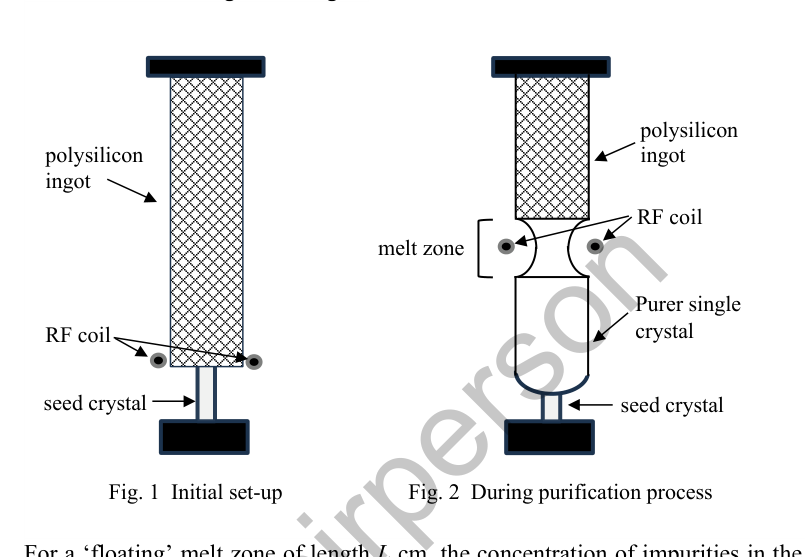
A wafer fabrication company uses the floating-zone method to purify polysilicon ingots, each having a uniform cross-sectional area and a length of 200 cm. The method involves placing a polysilicon ingot with impurity concentration atoms/ on top of a single seed crystal. The polysilicon ingot is then heated externally by an RF coil, which locally melts the ingot. The impurities prefer to stay in the molten state than in the solid state and thus as the coil and the melt zone move upwards, a single crystal, that is purer, solidifies on top of the seed crystal. A schematic illustration of the method is shown below in Fig. 1 and Fig. 2.
For a 'floating' melt zone of length cm, the concentration of impurities in the melt zone, atoms/, and the distance moved by the RF coil, cm, are related by the differential equation
where is a constant such that .
The length of the "floating" melt zone, cm, adopted by the company is 2 cm and . It is also given that when , .
- (a)
Solve the differential equation to find an expression for in terms of , and .
- (b)
Sketch the graph of against .
- (c)
Assume that and that the RF coil moves upwards at a constant speed of 8 mm per hour. Find the time taken for the concentration of impurities in the melt zone to reach and the rate of change of the concentration of impurities, in terms of at this instant.
- (d)
The company decides to change the length of the "floating" melt zone.
Explain, with a reason, whether a shorter length is preferable over a longer one.
It won't just hand you the answer — it asks where you're stuck.How the checker works
Worked solution
11(a)
1. Substitute the given value of $L$ into the differential equation and separate the variables.
Given , the differential equation becomes:
Separating the variables and :
2. Integrate both sides to find the general solution.
3. Apply the initial condition to find the constant of integration, $A$.
Given that when , :
Since and , we have . Therefore:
Substituting back into the equation:
4. Rearrange the equation to make $C$ the subject.
Multiply the entire equation by :
Since is positive initially and continuous, we can drop the absolute value:
11(b)
1. Identify the initial point and horizontal asymptote from the solution for $C$.
From part (a), the solution is .
When , .
As , (since ).
Thus, . The horizontal asymptote is .
2. Determine the shape of the curve based on the first derivative.
From the given differential equation, .
Since and starts at , the initial gradient is .
As increases towards , the term remains positive but decreases towards .
Therefore, the gradient is positive but strictly decreasing, meaning the curve is increasing and concave downwards.
3. Sketch the graph incorporating the valid domain.
Draw the horizontal -axis and vertical -axis.
Plot the -intercept at .
Draw a horizontal dotted line at (note that since ).
Draw a smooth, increasing, concave down curve from the intercept, approaching the asymptote.
Terminate the graph at , matching the domain given in the context.
A sketched curve on and axes with the following features:
- -intercept: Point .
- Shape: An increasing, concave downwards curve.
- Asymptote: A horizontal dotted line at that the curve approaches from below.
- Domain: The curve should be drawn for .
11(c)
1. Briefly solve the differential equation from part (a) to express $C$ in terms of $x$, as the result is required.
As required from part (a), we first find the expression for by separating variables and integrating:
Using the initial condition when :
2. Substitute $C = 2C_0$ and $k = 0.3$ to find the distance $x$ moved.
3. Convert the speed to consistent units and calculate the time taken $t$.
The distance is in cm, so the upward speed must be in cm/h:
So the time taken is approximately hours.
4. Set up the relationship for the rate of change of $C$ with respect to time using the chain rule.
We know and the differential equation gives .
5. Evaluate the rate of change of concentration at the instant when $C = 2C_0$.
At the instant when and :
Time taken: hours (or hours)
Rate of change: atoms/cm per hour
11(d)
1. Concisely solve the differential equation from part (a) to find the expression for $C$.
Separating variables for the given differential equation:
Using the initial condition when :
2. Analyze the effect of a shorter melt zone length $L$ on the impurity concentration $C$.
From the expression for , for a shorter length , the value of is larger, making smaller.
Since , the term becomes larger.
Therefore, a shorter length results in a larger for any given .
(Alternatively, directly from , a smaller yields a larger positive , meaning increases more rapidly.)
3. Relate the higher concentration $C$ to the purity of the solidifying crystal to draw a conclusion.
A larger means a higher concentration of impurities in the melt zone.
Because the newly formed single crystal draws its material from this melt zone, a higher impurity concentration in the melt leads to a higher concentration of impurities solidifying into the crystal.
As this makes the single crystal less pure, a shorter length is not preferable.
A shorter length is not preferable, because it leads to a higher rate of increase in impurity concentration in the melt zone, which causes the solidifying single crystal to be less pure.
AI analysis — may contain mistakes.
Worked this one out on paper? Snap your steps and Gigle's AI math checker will circle the step where it went wrong.
More questions on this topic
- 1The points on a curve satisfy the equations and …
- 2In a large town, the number of people infected by a particular virus days after the virus was first discovered is …
- 3Consider the second order differential equation where and are no…
- 4A freshly brewed cup of tea, initially at a temperature of , is left out to cool in a room with a room…
- 5In a large town, the number of people infected by a particular virus days after the virus was first discovered is …