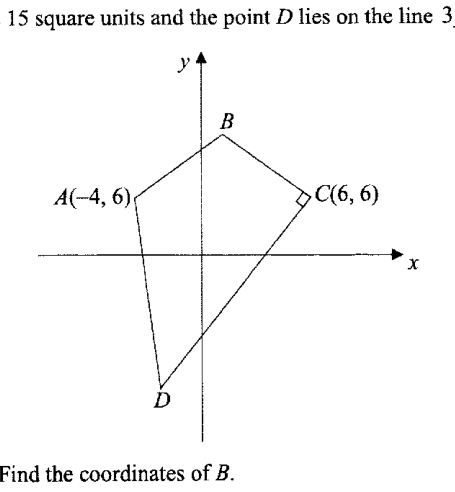
图中(未按比例绘制)显示了一个四边形 ABCDABCD,满足 AB=BCAB = BC 且角 BCD=90∘BCD = 90^\circ。点 AA 为 (−4,6)(-4, 6),点 CC 为 (6,6)(6, 6)。已知三角形 ABCABC 的面积为 15 平方单位,且点 DD 在直线 3y+5x+42=03y + 5x + 42 = 0 上。

  1. (i)

    求 BB 的坐标。

  2. (ii)

    求 DD 的坐标。

  3. (iii)

    求四边形 ABCDABCD 的面积。

  4. (iv)

    点 XX 在直线 ABAB 的延长线上,使得 AB:BX=2:3AB : BX = 2 : 3。求 XX 的坐标。

先不看答案,让 AI 诊断你卡在哪里?

它不会直接告诉你答案,而是问你卡在哪一步看看 AI 是怎么陪你一步步弄懂这道题的

完整解法

9(i)

1. Find the length of the base $AC$.

Since A(−4,6)A(-4, 6) and C(6,6)C(6, 6) have the same yy-coordinate, the line segment ACAC is horizontal.
Length of AC=6−(−4)=10AC = 6 - (-4) = 10 units.

2. Use the area of the triangle to find the perpendicular height of $B$ from $AC$.

Let the perpendicular height of BB from ACAC be hh.
Area of △ABC=12×AC×h\text{Area of } \triangle ABC = \frac{1}{2} \times AC \times h
15=12×10×h15 = \frac{1}{2} \times 10 \times h
15=5h  ⟹  h=315 = 5h \implies h = 3

3. Determine the coordinates of $B$ using the properties of the isosceles triangle.

Since AB=BCAB = BC, riangleABC riangle ABC is an isosceles triangle. The xx-coordinate of BB must lie exactly halfway between AA and CC.
xx-coordinate of B=−4+62=1B = \frac{-4 + 6}{2} = 1
Since BB is in the first quadrant and forms a simple quadrilateral with DD (which is in the third quadrant), BB must be above ACAC.
yy-coordinate of B=6+3=9B = 6 + 3 = 9
Therefore, BB is (1,9)(1, 9).

答案

(1,9)(1, 9)

9(ii)

1. Find the coordinates of $B$ (from part i) to calculate the gradient of $BC$.

From part (i), BB is (1,9)(1, 9).
Gradient of BC=6−96−1=−35BC = \frac{6 - 9}{6 - 1} = -\frac{3}{5}

2. Find the gradient of $CD$ using the perpendicular property.

Since angle BCD=90∘BCD = 90^\circ, CDCD is perpendicular to BCBC.
Gradient of CD=−1−35=53CD = \frac{-1}{-\frac{3}{5}} = \frac{5}{3}

3. Find the equation of the line $CD$.

Using point C(6,6)C(6, 6) and gradient 53\frac{5}{3}:
y−6=53(x−6)y - 6 = \frac{5}{3}(x - 6)
3y−18=5x−303y - 18 = 5x - 30
3y=5x−123y = 5x - 12

4. Solve simultaneously with the given line equation to find $D$.

The point DD lies on 3y+5x+42=03y + 5x + 42 = 0, so 3y=−5x−423y = -5x - 42.
Substitute 3y=5x−123y = 5x - 12 into this equation:
5x−12=−5x−425x - 12 = -5x - 42
10x=−30  ⟹  x=−310x = -30 \implies x = -3
Substitute x=−3x = -3 into 3y=5x−123y = 5x - 12:
3y=5(−3)−12=−27  ⟹  y=−93y = 5(-3) - 12 = -27 \implies y = -9
The coordinates of DD are (−3,−9)(-3, -9).

答案

(−3,−9)(-3, -9)

9(iii)

1. Find the coordinates of $B$ and $D$ (from earlier parts).

Since A(−4,6)A(-4, 6) and C(6,6)C(6, 6) have the same yy-coordinate, the length of AC=6−(−4)=10AC = 6 - (-4) = 10.
Given Area of △ABC=15\triangle ABC = 15, 12(10)(h)=15  ⟹  h=3\frac{1}{2}(10)(h) = 15 \implies h = 3.
Since AB=BCAB = BC, BB lies on the perpendicular bisector of ACAC (x=1x = 1). As BB is above the xx-axis, BB is (1,6+3)=(1,9)(1, 6+3) = (1, 9).
Gradient of BC=9−61−6=−35BC = \frac{9-6}{1-6} = -\frac{3}{5}.
Since ∠BCD=90∘\angle BCD = 90^\circ, gradient of CD=53CD = \frac{5}{3}.
Equation of CDCD: y−6=53(x−6)  ⟹  5x−3y−12=0y - 6 = \frac{5}{3}(x - 6) \implies 5x - 3y - 12 = 0.
Solving simultaneously with 3y+5x+42=03y + 5x + 42 = 0 gives 10x+30=0  ⟹  x=−310x + 30 = 0 \implies x = -3, and y=−9y = -9. Thus, DD is (−3,−9)(-3, -9).

2. Calculate the area of quadrilateral $ABCD$ using the shoelace formula.

Using the vertices in counter-clockwise order: A(−4,6)A(-4, 6), D(−3,−9)D(-3, -9), C(6,6)C(6, 6), B(1,9)B(1, 9):
Area=12∣−4−361−46−9696∣\text{Area} = \frac{1}{2} \left| \begin{matrix} -4 & -3 & 6 & 1 & -4 \\ 6 & -9 & 6 & 9 & 6 \end{matrix} \right|
Area=12∣[(−4)(−9)+(−3)(6)+(6)(9)+(1)(6)]−[(6)(−3)+(−9)(6)+(6)(1)+(9)(−4)]∣\text{Area} = \frac{1}{2} | [(-4)(-9) + (-3)(6) + (6)(9) + (1)(6)] - [(6)(-3) + (-9)(6) + (6)(1) + (9)(-4)] |
Area=12∣(36−18+54+6)−(−18−54+6−36)∣\text{Area} = \frac{1}{2} | (36 - 18 + 54 + 6) - (-18 - 54 + 6 - 36) |
Area=12∣78−(−102)∣=12(180)=90\text{Area} = \frac{1}{2} | 78 - (-102) | = \frac{1}{2} (180) = 90

答案

9090 square units

9(iv)

1. State the coordinates of $A$ and $B$ (from part i) and set up the ratio

From part (i), BB is (1,9)(1, 9). We are given A(−4,6)A(-4, 6).
Since XX lies on ABAB produced, the points are in the order A,B,XA, B, X.
The ratio of the lengths is AB:BX=2:3AB : BX = 2 : 3.

2. Use vectors or coordinate differences to find $X$

Let the coordinates of XX be (x,y)(x, y).
Using the ratio theorem or similar triangles, the horizontal and vertical changes from BB to XX are 32\frac{3}{2} of the changes from AA to BB.
x−1=32(1−(−4))  ⟹  x−1=32(5)=7.5  ⟹  x=8.5x - 1 = \frac{3}{2}(1 - (-4)) \implies x - 1 = \frac{3}{2}(5) = 7.5 \implies x = 8.5
y−9=32(9−6)  ⟹  y−9=32(3)=4.5  ⟹  y=13.5y - 9 = \frac{3}{2}(9 - 6) \implies y - 9 = \frac{3}{2}(3) = 4.5 \implies y = 13.5
Thus, X=(8.5,13.5)X = (8.5, 13.5).

答案

(8.5,13.5)(8.5, 13.5)

AI 分析,可能出错

用 AI 批改,圈出写错的那一步,并自动将你的薄弱点存入错题本,形成你的错因库。

同一知识点的其他题

  1. 1曲线 y=2tan⁡3x−1y = 2\tan 3x - 1 在点 P(π3,−1)P\left(\frac{\pi}{3}, -1\right) 处的法线交 yy 轴于点 AA,交 xx 轴于点 BB。求三角形 AOBAOB 的精确面积。
  2. 2点 PP 在曲线 y=ln⁡(x+1x−1)y = \ln\left(\frac{x+1}{x-1}\right)(x>1x > 1)上。该曲线在点 PP 处的法线平行于直线 2y=3x+22y = 3x + 2。曲线在点 PP 处的切线交 yy 轴于点 QQ。求…
  3. 3图中显示了曲线 y=g(x)y = g(x) 的一部分。(2,8)(2, 8) 和 (6,1)(6, 1) 是曲线上的两个点。 已知 ∫26y dx=32\int_{2}^{6} y \text{ } dx = 32,求 ∫18x dy\int_{1}^{8} x \text{ } dy…
  4. 4图示为曲线 y=3e−12x−6y = 3e^{-\frac{1}{2}x} - 6 的一部分,该曲线与 xx 轴相交于点 PP,与 yy 轴相交于点 QQ。曲线在点 QQ 处的法线与 xx 轴交于点 RR。求 法线的方程, 阴影区域的面积。
  5. 5三角形 ABC 的面积为 16+7102 cm2\dfrac{16 + 7\sqrt{10}}{2}\ \text{cm}^2,AB 的长度为 (32+5) cm(3\sqrt{2} + \sqrt{5})\ \text{cm},且 AB 垂直于 BC。 求 BC 的长度…