The diagram (not drawn to scale) shows a quadrilateral such that and angle . The point is and the point is . Given that the area of triangle is 15 square units and the point lies on the line .
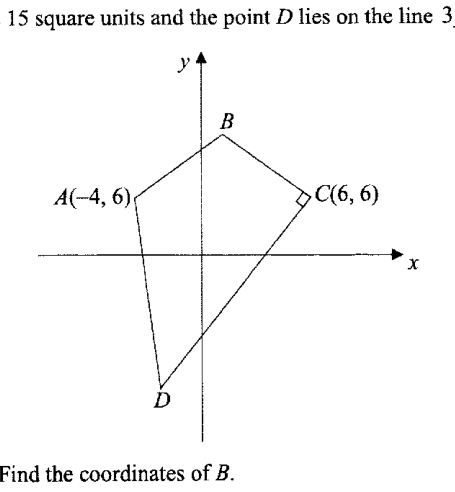
- (i)
Find the coordinates of .
- (ii)
Find the coordinates of .
- (iii)
Find the area of the quadrilateral .
- (iv)
The point lies on the line produced such that is 2 : 3. Find the coordinates of .
It won't just hand you the answer — it asks where you're stuck.How the checker works
Worked solution
9(i)
1. Find the length of the base $AC$.
Since and have the same -coordinate, the line segment is horizontal.
Length of units.
2. Use the area of the triangle to find the perpendicular height of $B$ from $AC$.
Let the perpendicular height of from be .
3. Determine the coordinates of $B$ using the properties of the isosceles triangle.
Since , is an isosceles triangle. The -coordinate of must lie exactly halfway between and .
-coordinate of
Since is in the first quadrant and forms a simple quadrilateral with (which is in the third quadrant), must be above .
-coordinate of
Therefore, is .
9(ii)
1. Find the coordinates of $B$ (from part i) to calculate the gradient of $BC$.
From part (i), is .
Gradient of
2. Find the gradient of $CD$ using the perpendicular property.
Since angle , is perpendicular to .
Gradient of
3. Find the equation of the line $CD$.
Using point and gradient :
4. Solve simultaneously with the given line equation to find $D$.
The point lies on , so .
Substitute into this equation:
Substitute into :
The coordinates of are .
9(iii)
1. Find the coordinates of $B$ and $D$ (from earlier parts).
Since and have the same -coordinate, the length of .
Given Area of , .
Since , lies on the perpendicular bisector of (). As is above the -axis, is .
Gradient of .
Since , gradient of .
Equation of : .
Solving simultaneously with gives , and . Thus, is .
2. Calculate the area of quadrilateral $ABCD$ using the shoelace formula.
Using the vertices in counter-clockwise order: , , , :
square units
9(iv)
1. State the coordinates of $A$ and $B$ (from part i) and set up the ratio
From part (i), is . We are given .
Since lies on produced, the points are in the order .
The ratio of the lengths is .
2. Use vectors or coordinate differences to find $X$
Let the coordinates of be .
Using the ratio theorem or similar triangles, the horizontal and vertical changes from to are of the changes from to .
Thus, .
AI analysis — may contain mistakes.
Worked this one out on paper? Snap your steps and Gigle's AI math checker will circle the step where it went wrong.
More questions on this topic
- 1The normal to the curve at point crosses the -axis at point …
- 2The point lies on the curve for . The normal to the curve at is par…
- 3The figure shows part of the curve . and are two points on the curve. Given that …
- 4The diagram shows part of the curve which crosses the -axis at and the -axis at …
- 5The triangle ABC is such that its area is , the length of AB is …