复数 aa 和 bb 由 a=−(1+3i)a = -(1 + \sqrt{3}\text{i}) and b=12(1−i)b = \frac{1}{2}(1 - \text{i}) 给出。

  1. (i)

    不使用计算器,求出形如 x+iyx + \text{i}y 的 a2ba^2b 的值。

  2. (ii)

    通过使用 aa 和 bb 的模与辐角,求出 a2ba^2b 的模与辐角。

  3. (iii)

    利用你在第 (i) 和 (ii) 部分的答案,证明 sin⁡5π12=3+122\sin\frac{5\pi}{12} = \frac{\sqrt{3} + 1}{2\sqrt{2}}。

  4. (iv)

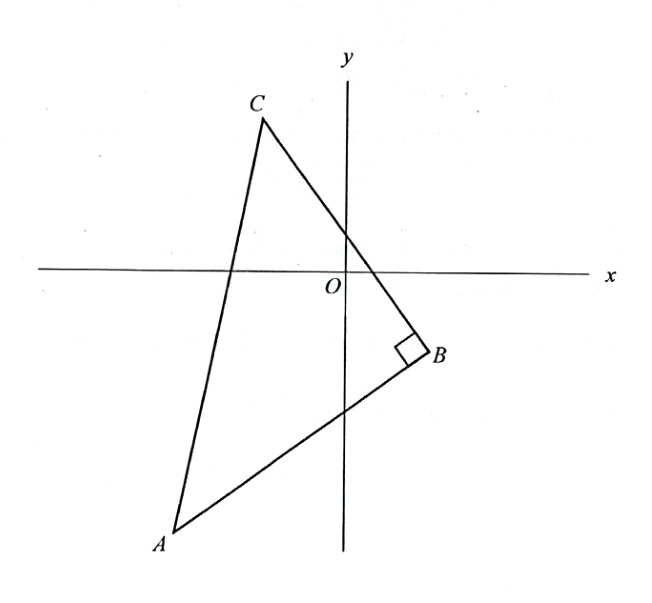
    下图显示了一个等腰直角三角形 ABCABC,其中点 AA、BB 和 CC 分别代表复数 aa、bb 和 cc。求 cc 的精确值。

先不看答案,让 AI 诊断你卡在哪里?

它不会直接告诉你答案,而是问你卡在哪一步看看 AI 是怎么陪你一步步弄懂这道题的

完整解法

4(i)

1. Calculate the value of $a^2$.

a2=(−(1+3i))2a^2 = \left( -(1 + \sqrt{3}\text{i}) \right)^2
=(1+3i)2= (1 + \sqrt{3}\text{i})^2
=12+2(3i)+(3i)2= 1^2 + 2(\sqrt{3}\text{i}) + (\sqrt{3}\text{i})^2
=1+23i−3= 1 + 2\sqrt{3}\text{i} - 3
=−2+23i= -2 + 2\sqrt{3}\text{i}

2. Multiply $a^2$ by $b$ and simplify into the form $x + \text{i}y$.

a2b=(−2+23i)[12(1−i)]a^2b = (-2 + 2\sqrt{3}\text{i}) \left[ \frac{1}{2}(1 - \text{i}) \right]
=(−1+3i)(1−i)= (-1 + \sqrt{3}\text{i})(1 - \text{i})
=−1+i+3i−3i2= -1 + \text{i} + \sqrt{3}\text{i} - \sqrt{3}\text{i}^2
=−1+i+3i−3(−1)= -1 + \text{i} + \sqrt{3}\text{i} - \sqrt{3}(-1)
=(3−1)+(3+1)i= (\sqrt{3} - 1) + (\sqrt{3} + 1)\text{i}

答案

(3−1)+(3+1)i(\sqrt{3} - 1) + (\sqrt{3} + 1)\text{i}

4(ii)

1. Find the modulus and argument of $a$.

∣a∣=(−1)2+(−3)2=2|a| = \sqrt{(-1)^2 + (-\sqrt{3})^2} = 2

Since a=−1−3ia = -1 - \sqrt{3}\text{i} is in the third quadrant:
arg⁡(a)=−π+tan⁡−1(31)=−π+π3=−2π3\arg(a) = -\pi + \tan^{-1}\left(\frac{\sqrt{3}}{1}\right) = -\pi + \frac{\pi}{3} = -\frac{2\pi}{3}

2. Find the modulus and argument of $b$.

∣b∣=(12)2+(−12)2=14+14=12|b| = \sqrt{\left(\frac{1}{2}\right)^2 + \left(-\frac{1}{2}\right)^2} = \sqrt{\frac{1}{4} + \frac{1}{4}} = \frac{1}{\sqrt{2}}

Since b=12−12ib = \frac{1}{2} - \frac{1}{2}\text{i} is in the fourth quadrant:
arg⁡(b)=tan⁡−1(−1/21/2)=tan⁡−1(−1)=−π4\arg(b) = \tan^{-1}\left(\frac{-1/2}{1/2}\right) = \tan^{-1}(-1) = -\frac{\pi}{4}

3. Calculate the modulus of $a^2b$.

Using the property ∣z1z2∣=∣z1∣∣z2∣|z_1 z_2| = |z_1| |z_2| and ∣zn∣=∣z∣n|z^n| = |z|^n:
∣a2b∣=∣a∣2∣b∣=22×12=42=22|a^2b| = |a|^2|b| = 2^2 \times \frac{1}{\sqrt{2}} = \frac{4}{\sqrt{2}} = 2\sqrt{2}

4. Calculate the argument of $a^2b$.

Using the property arg⁡(z1z2)=arg⁡(z1)+arg⁡(z2)\arg(z_1 z_2) = \arg(z_1) + \arg(z_2) and arg⁡(zn)=narg⁡(z)\arg(z^n) = n\arg(z):
arg⁡(a2b)=2arg⁡(a)+arg⁡(b)\arg(a^2b) = 2\arg(a) + \arg(b)
=2(−2π3)+(−π4)= 2\left(-\frac{2\pi}{3}\right) + \left(-\frac{\pi}{4}\right)
=−4π3−π4= -\frac{4\pi}{3} - \frac{\pi}{4}
=−16π12−3π12=−19π12= -\frac{16\pi}{12} - \frac{3\pi}{12} = -\frac{19\pi}{12}

Adjusting to the principal argument range (−π,π](-\pi, \pi]:
arg⁡(a2b)=−19π12+2π=5π12\arg(a^2b) = -\frac{19\pi}{12} + 2\pi = \frac{5\pi}{12}

答案

Modulus = 222\sqrt{2}, Argument = 5π12\frac{5\pi}{12}

4(iii)

1. Concisely evaluate $a^2b$ in both Cartesian form (from part i) and modulus-argument form (from part ii) as they are required to solve this part.

From part (i):
a2b=(−(1+3i))2(12(1−i))a^2b = \left( -(1 + \sqrt{3}\text{i}) \right)^2 \left( \frac{1}{2}(1 - \text{i}) \right)
=(−2+23i)(12−12i)= (-2 + 2\sqrt{3}\text{i}) \left( \frac{1}{2} - \frac{1}{2}\text{i} \right)
=−1+i+3i+3= -1 + \text{i} + \sqrt{3}\text{i} + \sqrt{3}
=(3−1)+(3+1)i= (\sqrt{3} - 1) + (\sqrt{3} + 1)\text{i}

From part (ii):
∣a∣=2|a| = 2, arg⁡(a)=−2π3\arg(a) = -\frac{2\pi}{3}
∣b∣=12|b| = \frac{1}{\sqrt{2}}, arg⁡(b)=−π4\arg(b) = -\frac{\pi}{4}
∣a2b∣=∣a∣2∣b∣=22(12)=22|a^2b| = |a|^2 |b| = 2^2 \left( \frac{1}{\sqrt{2}} \right) = 2\sqrt{2}
arg⁡(a2b)=2arg⁡(a)+arg⁡(b)=2(−2π3)−π4=−19π12\arg(a^2b) = 2\arg(a) + \arg(b) = 2\left(-\frac{2\pi}{3}\right) - \frac{\pi}{4} = -\frac{19\pi}{12}
Principal argument =−19π12+2π=5π12= -\frac{19\pi}{12} + 2\pi = \frac{5\pi}{12}

2. Express $a^2b$ using its modulus and principal argument, and equate the imaginary parts.

Using the modulus and argument, a2ba^2b can be written in trigonometric form:
a2b=22(cos⁡5π12+isin⁡5π12)a^2b = 2\sqrt{2}\left(\cos\frac{5\pi}{12} + \text{i}\sin\frac{5\pi}{12}\right)

Equating the imaginary part of this polar form to the imaginary part of the Cartesian form from part (i):
22sin⁡5π12=3+12\sqrt{2}\sin\frac{5\pi}{12} = \sqrt{3} + 1

Dividing both sides by 222\sqrt{2}:
sin⁡5π12=3+122\sin\frac{5\pi}{12} = \frac{\sqrt{3} + 1}{2\sqrt{2}}

答案

\sin\frac{5\pi}{12} = \frac{\sqrt{3} + 1}{2\sqrt{2}} \text{ (shown)}

4(iv)

1. Set up an equation relating $a$, $b$, and $c$ using the geometric properties of the isosceles right-angled triangle.

Since △ABC\triangle ABC is an isosceles right-angled triangle with AB=BCAB = BC and a right angle at BB, the vector BC→\overrightarrow{BC} is obtained by rotating the vector BA→\overrightarrow{BA} by exactly 90∘90^\circ (or π2\frac{\pi}{2} radians) either clockwise or anticlockwise about point BB.

In the Argand diagram, multiplying a complex number by i\text{i} results in an anticlockwise rotation of 90∘90^\circ, and multiplying by −i-\text{i} results in a clockwise rotation. Therefore, we can write the relationship as:
c−b=±i(a−b)c - b = \pm \text{i}(a - b)

2. Evaluate the two possible complex numbers for $c$ by substituting the given values of $a$ and $b$.

Substitute a=−1−3ia = -1 - \sqrt{3}\text{i} and b=12(1−i)b = \frac{1}{2}(1 - \text{i}) into the rotation equations:

Case 1: Anticlockwise rotation (+i+\text{i})
c−b=i(a−b)  ⟹  c=b(1−i)+aic - b = \text{i}(a - b) \implies c = b(1 - \text{i}) + a\text{i}
c=12(1−i)2+i(−1−3i)c = \frac{1}{2}(1 - \text{i})^2 + \text{i}(-1 - \sqrt{3}\text{i})
c=12(1−2i−1)−i−3(i2)c = \frac{1}{2}(1 - 2\text{i} - 1) - \text{i} - \sqrt{3}(\text{i}^2)
c=−i−i+3=3−2ic = -\text{i} - \text{i} + \sqrt{3} = \sqrt{3} - 2\text{i}

Case 2: Clockwise rotation (−i-\text{i})
c−b=−i(a−b)  ⟹  c=b(1+i)−aic - b = -\text{i}(a - b) \implies c = b(1 + \text{i}) - a\text{i}
c=12(1−i)(1+i)−i(−1−3i)c = \frac{1}{2}(1 - \text{i})(1 + \text{i}) - \text{i}(-1 - \sqrt{3}\text{i})
c=12(12−i2)+i+3(i2)c = \frac{1}{2}(1^2 - \text{i}^2) + \text{i} + \sqrt{3}(\text{i}^2)
c=12(2)+i−3=1−3+ic = \frac{1}{2}(2) + \text{i} - \sqrt{3} = 1 - \sqrt{3} + \text{i}

3. Determine the correct value for $c$ using the quadrant placement shown in the given diagram.

The diagram indicates that point CC lies in the second quadrant, meaning its real part must be negative and its imaginary part positive.

For Case 1, c=3−2ic = \sqrt{3} - 2\text{i} has a positive real part (≈1.732\approx 1.732) and a negative imaginary part (−2-2), which would place it in the fourth quadrant. Thus, we reject this case.

For Case 2, c=1−3+ic = 1 - \sqrt{3} + \text{i} has a negative real part (1−3≈−0.7321 - \sqrt{3} \approx -0.732) and a positive imaginary part (11), correctly placing it in the second quadrant.

Therefore, the exact value is:
c=1−3+ic = 1 - \sqrt{3} + \text{i}

答案

1 - \sqrt{3} + \text{i}

AI 分析,可能出错

用 AI 批改,圈出写错的那一步,并自动将你的薄弱点存入错题本,形成你的错因库。

同一知识点的其他题

  1. 1解方程 z4=−4−4√3iz^4 = -4 - 4√3\mathrm{i},将你的答案表示为 reiθr\mathrm{e}^{\mathrm{i}\theta} 的形式,其中 r>0r > 0 且 −π<θ≤π-\pi < \theta \le \pi。(不需要列出…
  2. 2已知复数z1=1−3iz_{1}=1-3i,z2=3+iz_{2}=3+i,则()(\quad) A. ∣z1+z2∣=6  |z_{1}+z_{2}|=6\:\: B. z‾1−z2=−2+2i{\overline{z}}_{1}-{z}_{2}=-2+2i C. z1z2=6−8iz_{1}z_{2}=6-8i …
  3. 3解方程 iz5=−32i z^5 = -32,将根写成 reiθre^{i\theta} 的形式,其中 r>0r>0 且 −π<θ≤π-\pi<\theta\le\pi。在阿甘特图上描绘出代表这些根的点 P1,P2,P3,P4P_1, P_2, P_3, P_4 和 P5P_5,其…
  4. 4已知 z=2−iz = 2 - \text{i} 是方程 4z4−12z3+17z2+pz+q=04z^4 - 12z^3 + 17z^2 + pz + q = 0 的一个根,其中 pp 和 qq 是实数,求 pp 和 qq 的值。 利用所求得的 pp 和 qq 的值,…
  5. 5证明对于任何复数 z=eiθz = e^{i\theta}, zn+1zn=2cos⁡nθ.z^{n} + \dfrac{1}{z^{n}} = 2\cos n\theta . 通过令 n=1n = 1,证明 cos⁡3θ=18(z3+3z+3z+1z3).\cos^{3}\theta = \tfrac{1}{8}\left(z^{3} + 3z + \tfrac{3}{z} + \tfrac{1}{z^{3}}\right).…