The complex numbers aa and bb are given by a=−(1+3i)a = -(1 + \sqrt{3}\text{i}) and b=12(1−i)b = \frac{1}{2}(1 - \text{i}).

  1. (i)

    Without using a calculator, find the value of a2ba^2b in the form x+iyx + \text{i}y.

  2. (ii)

    By using the moduli and arguments of aa and bb, find the modulus and argument of a2ba^2b.

  3. (iii)

    Use your answers to parts (i) and (ii) to show that sin⁡5π12=3+122\sin\frac{5\pi}{12} = \frac{\sqrt{3} + 1}{2\sqrt{2}}.

  4. (iv)

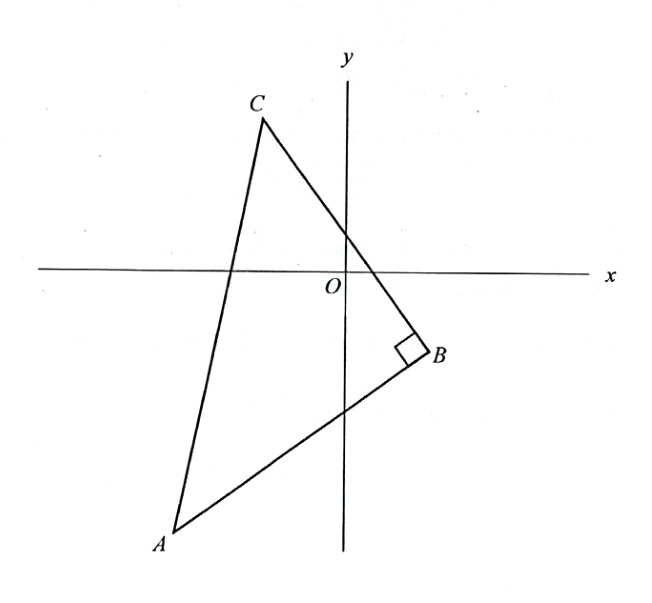
    The diagram below shows an isosceles right triangle ABCABC, where the points AA, BB and CC represent the complex numbers aa, bb and cc respectively. Find the exact value of cc.

Work through it with AI →

It won't just hand you the answer — it asks where you're stuck.How the checker works

Worked solution

4(i)

1. Calculate the value of $a^2$.

a2=(−(1+3i))2a^2 = \left( -(1 + \sqrt{3}\text{i}) \right)^2
=(1+3i)2= (1 + \sqrt{3}\text{i})^2
=12+2(3i)+(3i)2= 1^2 + 2(\sqrt{3}\text{i}) + (\sqrt{3}\text{i})^2
=1+23i−3= 1 + 2\sqrt{3}\text{i} - 3
=−2+23i= -2 + 2\sqrt{3}\text{i}

2. Multiply $a^2$ by $b$ and simplify into the form $x + \text{i}y$.

a2b=(−2+23i)[12(1−i)]a^2b = (-2 + 2\sqrt{3}\text{i}) \left[ \frac{1}{2}(1 - \text{i}) \right]
=(−1+3i)(1−i)= (-1 + \sqrt{3}\text{i})(1 - \text{i})
=−1+i+3i−3i2= -1 + \text{i} + \sqrt{3}\text{i} - \sqrt{3}\text{i}^2
=−1+i+3i−3(−1)= -1 + \text{i} + \sqrt{3}\text{i} - \sqrt{3}(-1)
=(3−1)+(3+1)i= (\sqrt{3} - 1) + (\sqrt{3} + 1)\text{i}

Answer

(3−1)+(3+1)i(\sqrt{3} - 1) + (\sqrt{3} + 1)\text{i}

4(ii)

1. Find the modulus and argument of $a$.

∣a∣=(−1)2+(−3)2=2|a| = \sqrt{(-1)^2 + (-\sqrt{3})^2} = 2

Since a=−1−3ia = -1 - \sqrt{3}\text{i} is in the third quadrant:
arg⁡(a)=−π+tan⁡−1(31)=−π+π3=−2π3\arg(a) = -\pi + \tan^{-1}\left(\frac{\sqrt{3}}{1}\right) = -\pi + \frac{\pi}{3} = -\frac{2\pi}{3}

2. Find the modulus and argument of $b$.

∣b∣=(12)2+(−12)2=14+14=12|b| = \sqrt{\left(\frac{1}{2}\right)^2 + \left(-\frac{1}{2}\right)^2} = \sqrt{\frac{1}{4} + \frac{1}{4}} = \frac{1}{\sqrt{2}}

Since b=12−12ib = \frac{1}{2} - \frac{1}{2}\text{i} is in the fourth quadrant:
arg⁡(b)=tan⁡−1(−1/21/2)=tan⁡−1(−1)=−π4\arg(b) = \tan^{-1}\left(\frac{-1/2}{1/2}\right) = \tan^{-1}(-1) = -\frac{\pi}{4}

3. Calculate the modulus of $a^2b$.

Using the property ∣z1z2∣=∣z1∣∣z2∣|z_1 z_2| = |z_1| |z_2| and ∣zn∣=∣z∣n|z^n| = |z|^n:
∣a2b∣=∣a∣2∣b∣=22×12=42=22|a^2b| = |a|^2|b| = 2^2 \times \frac{1}{\sqrt{2}} = \frac{4}{\sqrt{2}} = 2\sqrt{2}

4. Calculate the argument of $a^2b$.

Using the property arg⁡(z1z2)=arg⁡(z1)+arg⁡(z2)\arg(z_1 z_2) = \arg(z_1) + \arg(z_2) and arg⁡(zn)=narg⁡(z)\arg(z^n) = n\arg(z):
arg⁡(a2b)=2arg⁡(a)+arg⁡(b)\arg(a^2b) = 2\arg(a) + \arg(b)
=2(−2π3)+(−π4)= 2\left(-\frac{2\pi}{3}\right) + \left(-\frac{\pi}{4}\right)
=−4π3−π4= -\frac{4\pi}{3} - \frac{\pi}{4}
=−16π12−3π12=−19π12= -\frac{16\pi}{12} - \frac{3\pi}{12} = -\frac{19\pi}{12}

Adjusting to the principal argument range (−π,π](-\pi, \pi]:
arg⁡(a2b)=−19π12+2π=5π12\arg(a^2b) = -\frac{19\pi}{12} + 2\pi = \frac{5\pi}{12}

Answer

Modulus = 222\sqrt{2}, Argument = 5π12\frac{5\pi}{12}

4(iii)

1. Concisely evaluate $a^2b$ in both Cartesian form (from part i) and modulus-argument form (from part ii) as they are required to solve this part.

From part (i):
a2b=(−(1+3i))2(12(1−i))a^2b = \left( -(1 + \sqrt{3}\text{i}) \right)^2 \left( \frac{1}{2}(1 - \text{i}) \right)
=(−2+23i)(12−12i)= (-2 + 2\sqrt{3}\text{i}) \left( \frac{1}{2} - \frac{1}{2}\text{i} \right)
=−1+i+3i+3= -1 + \text{i} + \sqrt{3}\text{i} + \sqrt{3}
=(3−1)+(3+1)i= (\sqrt{3} - 1) + (\sqrt{3} + 1)\text{i}

From part (ii):
∣a∣=2|a| = 2, arg⁡(a)=−2π3\arg(a) = -\frac{2\pi}{3}
∣b∣=12|b| = \frac{1}{\sqrt{2}}, arg⁡(b)=−π4\arg(b) = -\frac{\pi}{4}
∣a2b∣=∣a∣2∣b∣=22(12)=22|a^2b| = |a|^2 |b| = 2^2 \left( \frac{1}{\sqrt{2}} \right) = 2\sqrt{2}
arg⁡(a2b)=2arg⁡(a)+arg⁡(b)=2(−2π3)−π4=−19π12\arg(a^2b) = 2\arg(a) + \arg(b) = 2\left(-\frac{2\pi}{3}\right) - \frac{\pi}{4} = -\frac{19\pi}{12}
Principal argument =−19π12+2π=5π12= -\frac{19\pi}{12} + 2\pi = \frac{5\pi}{12}

2. Express $a^2b$ using its modulus and principal argument, and equate the imaginary parts.

Using the modulus and argument, a2ba^2b can be written in trigonometric form:
a2b=22(cos⁡5π12+isin⁡5π12)a^2b = 2\sqrt{2}\left(\cos\frac{5\pi}{12} + \text{i}\sin\frac{5\pi}{12}\right)

Equating the imaginary part of this polar form to the imaginary part of the Cartesian form from part (i):
22sin⁡5π12=3+12\sqrt{2}\sin\frac{5\pi}{12} = \sqrt{3} + 1

Dividing both sides by 222\sqrt{2}:
sin⁡5π12=3+122\sin\frac{5\pi}{12} = \frac{\sqrt{3} + 1}{2\sqrt{2}}

Answer

\sin\frac{5\pi}{12} = \frac{\sqrt{3} + 1}{2\sqrt{2}} \text{ (shown)}

4(iv)

1. Set up an equation relating $a$, $b$, and $c$ using the geometric properties of the isosceles right-angled triangle.

Since △ABC\triangle ABC is an isosceles right-angled triangle with AB=BCAB = BC and a right angle at BB, the vector BC→\overrightarrow{BC} is obtained by rotating the vector BA→\overrightarrow{BA} by exactly 90∘90^\circ (or π2\frac{\pi}{2} radians) either clockwise or anticlockwise about point BB.

In the Argand diagram, multiplying a complex number by i\text{i} results in an anticlockwise rotation of 90∘90^\circ, and multiplying by −i-\text{i} results in a clockwise rotation. Therefore, we can write the relationship as:
c−b=±i(a−b)c - b = \pm \text{i}(a - b)

2. Evaluate the two possible complex numbers for $c$ by substituting the given values of $a$ and $b$.

Substitute a=−1−3ia = -1 - \sqrt{3}\text{i} and b=12(1−i)b = \frac{1}{2}(1 - \text{i}) into the rotation equations:

Case 1: Anticlockwise rotation (+i+\text{i})
c−b=i(a−b)  ⟹  c=b(1−i)+aic - b = \text{i}(a - b) \implies c = b(1 - \text{i}) + a\text{i}
c=12(1−i)2+i(−1−3i)c = \frac{1}{2}(1 - \text{i})^2 + \text{i}(-1 - \sqrt{3}\text{i})
c=12(1−2i−1)−i−3(i2)c = \frac{1}{2}(1 - 2\text{i} - 1) - \text{i} - \sqrt{3}(\text{i}^2)
c=−i−i+3=3−2ic = -\text{i} - \text{i} + \sqrt{3} = \sqrt{3} - 2\text{i}

Case 2: Clockwise rotation (−i-\text{i})
c−b=−i(a−b)  ⟹  c=b(1+i)−aic - b = -\text{i}(a - b) \implies c = b(1 + \text{i}) - a\text{i}
c=12(1−i)(1+i)−i(−1−3i)c = \frac{1}{2}(1 - \text{i})(1 + \text{i}) - \text{i}(-1 - \sqrt{3}\text{i})
c=12(12−i2)+i+3(i2)c = \frac{1}{2}(1^2 - \text{i}^2) + \text{i} + \sqrt{3}(\text{i}^2)
c=12(2)+i−3=1−3+ic = \frac{1}{2}(2) + \text{i} - \sqrt{3} = 1 - \sqrt{3} + \text{i}

3. Determine the correct value for $c$ using the quadrant placement shown in the given diagram.

The diagram indicates that point CC lies in the second quadrant, meaning its real part must be negative and its imaginary part positive.

For Case 1, c=3−2ic = \sqrt{3} - 2\text{i} has a positive real part (≈1.732\approx 1.732) and a negative imaginary part (−2-2), which would place it in the fourth quadrant. Thus, we reject this case.

For Case 2, c=1−3+ic = 1 - \sqrt{3} + \text{i} has a negative real part (1−3≈−0.7321 - \sqrt{3} \approx -0.732) and a positive imaginary part (11), correctly placing it in the second quadrant.

Therefore, the exact value is:
c=1−3+ic = 1 - \sqrt{3} + \text{i}

Answer

1 - \sqrt{3} + \text{i}

AI analysis — may contain mistakes.

Worked this one out on paper? Snap your steps and Gigle's AI math checker will circle the step where it went wrong.

More questions on this topic

  1. 1Solve z4=−4−4√3iz^4 = -4 - 4√3\mathrm{i}, expressing your answers in the form reiθr\mathrm{e}^{\mathrm{i}\theta}, where r>0r > 0 an…
  2. 2已知复数z1=1−3iz_{1}=1-3i,z2=3+iz_{2}=3+i,则()(\quad) A. ∣z1+z2∣=6  |z_{1}+z_{2}|=6\:\: B. z‾1−z2=−2+2i{\overline{z}}_{1}-{z}_{2}=-2+2i C. z1z2=6−8iz_{1}z_{2}=6-8i …
  3. 3Solve the equation iz5=−32i z^5 = -32, giving your roots in the form reiθre^{i\theta}, where r>0r>0 and −π<θ≤π-\pi<\theta\le\pi. Ske…
  4. 4Given that z=2−iz = 2 - \text{i} is a root of the equation 4z4−12z3+17z2+pz+q=04z^4 - 12z^3 + 17z^2 + pz + q = 0, where pp and qq are real,…
  5. 5Show that for any complex number z=eiθz = e^{i\theta}, zn+1zn=2cos⁡nθ.z^{n} + \dfrac{1}{z^{n}} = 2\cos n\theta . By taking n=1n = 1, sh…