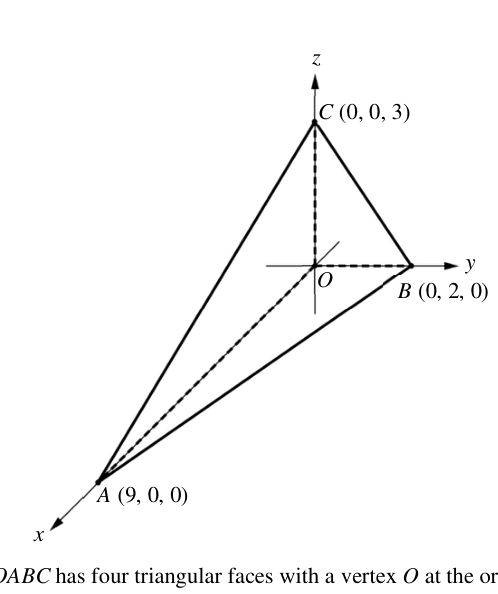
四面体 OABCOABC 具有四个三角形面,顶点 OO 位于原点。AA、BB 和 CC 的坐标分别为 (9,0,0)(9, 0, 0)、(0,2,0)(0, 2, 0) 和 (0,0,3)(0, 0, 3)(见图)。

  1. (a)

    求面 ABCABC 的笛卡尔方程。

  2. (b)

    求面 ABCABC 与 zz 轴之间的锐角。

  3. (c)

    求从 OO 到面 ABCABC 的垂足坐标。

  4. (d)

    直线 ss 穿过 OO 和 ACAC 的中点。证明直线 ss 关于面 ABCABC 的反射直线的向量方程为 r=(92032)+μ(a−216−23)\mathbf{r} = \begin{pmatrix} \frac{9}{2} \\ 0 \\ \frac{3}{2} \end{pmatrix} + \mu \begin{pmatrix} a \\ -216 \\ -23 \end{pmatrix},其中 aa 是一个待确定的常数。

先不看答案,让 AI 诊断你卡在哪里?

它不会直接告诉你答案,而是问你卡在哪一步看看 AI 是怎么陪你一步步弄懂这道题的

完整解法

8(a)

1. Find two non-parallel direction vectors lying on the plane.

AB⃗=OB⃗−OA⃗=(020)−(900)=(−920)\vec{AB} = \vec{OB} - \vec{OA} = \begin{pmatrix} 0 \\ 2 \\ 0 \end{pmatrix} - \begin{pmatrix} 9 \\ 0 \\ 0 \end{pmatrix} = \begin{pmatrix} -9 \\ 2 \\ 0 \end{pmatrix}

AC⃗=OC⃗−OA⃗=(003)−(900)=(−903)\vec{AC} = \vec{OC} - \vec{OA} = \begin{pmatrix} 0 \\ 0 \\ 3 \end{pmatrix} - \begin{pmatrix} 9 \\ 0 \\ 0 \end{pmatrix} = \begin{pmatrix} -9 \\ 0 \\ 3 \end{pmatrix}

2. Calculate the cross product to find a normal vector to the plane.

n=AB⃗×AC⃗=(−920)×(−903)=((2)(3)−(0)(0)(0)(−9)−(−9)(3)(−9)(0)−(2)(−9))=(62718)\mathbf{n} = \vec{AB} \times \vec{AC} = \begin{pmatrix} -9 \\ 2 \\ 0 \end{pmatrix} \times \begin{pmatrix} -9 \\ 0 \\ 3 \end{pmatrix} = \begin{pmatrix} (2)(3) - (0)(0) \\ (0)(-9) - (-9)(3) \\ (-9)(0) - (2)(-9) \end{pmatrix} = \begin{pmatrix} 6 \\ 27 \\ 18 \end{pmatrix}

We can take a simpler normal vector by dividing by 33:
n1=(296)\mathbf{n}_1 = \begin{pmatrix} 2 \\ 9 \\ 6 \end{pmatrix}

3. Form the cartesian equation of the plane using the normal vector and a point on the plane.

Using point A(9,0,0)A(9, 0, 0) and the normal vector n1\mathbf{n}_1:
r⋅n1=OA⃗⋅n1\mathbf{r} \cdot \mathbf{n}_1 = \vec{OA} \cdot \mathbf{n}_1
(xyz)⋅(296)=(900)⋅(296)\begin{pmatrix} x \\ y \\ z \end{pmatrix} \cdot \begin{pmatrix} 2 \\ 9 \\ 6 \end{pmatrix} = \begin{pmatrix} 9 \\ 0 \\ 0 \end{pmatrix} \cdot \begin{pmatrix} 2 \\ 9 \\ 6 \end{pmatrix}
2x+9y+6z=182x + 9y + 6z = 18

答案

2x+9y+6z=182x + 9y + 6z = 18

8(b)

1. Find the normal vector to face $ABC$ by deriving its Cartesian equation from its axial intercepts (as required from part a).

The plane intercepts the coordinate axes at x=9x=9, y=2y=2, and z=3z=3.
The Cartesian equation using the intercept form is:
x9+y2+z3=1\frac{x}{9} + \frac{y}{2} + \frac{z}{3} = 1
Multiplying by 1818 gives:
2x+9y+6z=182x + 9y + 6z = 18
Thus, the normal vector to the plane is n=(296)\mathbf{n} = \begin{pmatrix} 2 \\ 9 \\ 6 \end{pmatrix}.

2. Calculate the acute angle between the $z$-axis and face $ABC$.

The direction vector of the zz-axis is k=(001)\mathbf{k} = \begin{pmatrix} 0 \\ 0 \\ 1 \end{pmatrix}.
Let the acute angle between the zz-axis and the plane be θ\theta. Using the relation between the plane's normal and the line's direction vector:
sin⁡θ=∣n⋅k∣∣n∣ ∣k∣\sin \theta = \frac{|\mathbf{n} \cdot \mathbf{k}|}{|\mathbf{n}|\,|\mathbf{k}|}
sin⁡θ=∣(296)⋅(001)∣22+92+6202+02+12\sin \theta = \frac{\left| \begin{pmatrix} 2 \\ 9 \\ 6 \end{pmatrix} \cdot \begin{pmatrix} 0 \\ 0 \\ 1 \end{pmatrix} \right|}{\sqrt{2^2 + 9^2 + 6^2} \sqrt{0^2 + 0^2 + 1^2}}
sin⁡θ=6121(1)=611\sin \theta = \frac{6}{\sqrt{121} (1)} = \frac{6}{11}
θ=sin⁡−1(611)≈33.1∘ (to 1 d.p.)\theta = \sin^{-1}\left(\frac{6}{11}\right) \approx 33.1^\circ \text{ (to 1 d.p.)}

答案

33.1∘33.1^\circ

8(c)

1. Formulate the equation of the perpendicular line from $O$ to the plane $ABC$.

From part (a), using the intercepts, the cartesian equation of the plane ABCABC is x9+y2+z3=1  ⟹  2x+9y+6z=18\frac{x}{9} + \frac{y}{2} + \frac{z}{3} = 1 \implies 2x + 9y + 6z = 18.
The normal vector to the plane is n=(296)\mathbf{n} = \begin{pmatrix} 2 \\ 9 \\ 6 \end{pmatrix}.
The line passing through the origin OO perpendicular to the plane has equation r=λ(296)\mathbf{r} = \lambda \begin{pmatrix} 2 \\ 9 \\ 6 \end{pmatrix}.

2. Substitute the line equation into the plane equation to find the foot of the perpendicular.

Let the foot of the perpendicular be FF. Then OF⃗=λ(296)\vec{OF} = \lambda \begin{pmatrix} 2 \\ 9 \\ 6 \end{pmatrix}.
Substituting this into the plane's equation to find the intersection point:
2(2λ)+9(9λ)+6(6λ)=182(2\lambda) + 9(9\lambda) + 6(6\lambda) = 18
λ(4+81+36)=18\lambda(4 + 81 + 36) = 18
121λ=18  ⟹  λ=18121121\lambda = 18 \implies \lambda = \frac{18}{121}
Hence, OF⃗=18121(296)=(36121162121108121)\vec{OF} = \frac{18}{121} \begin{pmatrix} 2 \\ 9 \\ 6 \end{pmatrix} = \begin{pmatrix} \frac{36}{121} \\ \frac{162}{121} \\ \frac{108}{121} \end{pmatrix}.

答案

(36121,162121,108121)\left( \frac{36}{121}, \frac{162}{121}, \frac{108}{121} \right)

8(d)

1. Find the position vector of $O'$, the reflection of $O$ in face $ABC$.

From part (c), the coordinates of FF, the foot of the perpendicular from OO to face ABCABC, are (36121,162121,108121)\left(\frac{36}{121}, \frac{162}{121}, \frac{108}{121}\right).
Since FF is the midpoint of OO and its reflection O′O', we have:
OO′⃗=2OF⃗=2(36/121162/121108/121)=(72/121324/121216/121)\vec{OO'} = 2\vec{OF} = 2 \begin{pmatrix} 36/121 \\ 162/121 \\ 108/121 \end{pmatrix} = \begin{pmatrix} 72/121 \\ 324/121 \\ 216/121 \end{pmatrix}

2. Find the midpoint $M$ of $AC$ and recognize its role in the reflection.

The line ss passes through OO and the midpoint of ACAC. Let this midpoint be MM.
OM⃗=12(OA⃗+OC⃗)=12[(900)+(003)]=(9/203/2)\vec{OM} = \frac{1}{2}(\vec{OA} + \vec{OC}) = \frac{1}{2} \left[ \begin{pmatrix} 9 \\ 0 \\ 0 \end{pmatrix} + \begin{pmatrix} 0 \\ 0 \\ 3 \end{pmatrix} \right] = \begin{pmatrix} 9/2 \\ 0 \\ 3/2 \end{pmatrix}
Since MM lies on the line segment ACAC, it is on the plane ABCABC. Therefore, MM is its own reflection in the plane. The reflected line must therefore pass through O′O' and MM.

3. Determine the direction vector of the reflected line and find the value of $a$.

The direction vector of the reflected line is:
O′M⃗=OM⃗−OO′⃗=(9/203/2)−(72/121324/121216/121)=(945/242−648/242−69/242)\vec{O'M} = \vec{OM} - \vec{OO'} = \begin{pmatrix} 9/2 \\ 0 \\ 3/2 \end{pmatrix} - \begin{pmatrix} 72/121 \\ 324/121 \\ 216/121 \end{pmatrix} = \begin{pmatrix} 945/242 \\ -648/242 \\ -69/242 \end{pmatrix}
Factoring out the scalar 3242\frac{3}{242} to match the integer components given in the question:
O′M⃗=3242(315−216−23)\vec{O'M} = \frac{3}{242} \begin{pmatrix} 315 \\ -216 \\ -23 \end{pmatrix}
Using OM⃗\vec{OM} as the position vector and (315−216−23)\begin{pmatrix} 315 \\ -216 \\ -23 \end{pmatrix} as the direction vector, the equation of the reflected line is:
r=(9/203/2)+μ(315−216−23)\mathbf{r} = \begin{pmatrix} 9/2 \\ 0 \\ 3/2 \end{pmatrix} + \mu \begin{pmatrix} 315 \\ -216 \\ -23 \end{pmatrix}
Comparing this with the given equation r=(9/203/2)+μ(a−216−23)\mathbf{r} = \begin{pmatrix} 9/2 \\ 0 \\ 3/2 \end{pmatrix} + \mu \begin{pmatrix} a \\ -216 \\ -23 \end{pmatrix}, we obtain a=315a = 315.

答案

a=315a = 315

AI 分析,可能出错

用 AI 批改,圈出写错的那一步,并自动将你的薄弱点存入错题本,形成你的错因库。

同一知识点的其他题

  1. 1直线 l1l_1 和 l2l_2 的方程分别为 r=(4110)+λ(1−1−6),λ∈R\mathbf{r} = \begin{pmatrix} 4 \\ 1 \\ 10 \end{pmatrix} + \lambda \begin{pmatrix} 1 \\ -1 \\ -6 \end{pmatrix}, \lambda \in \mathbb{R}…
  2. 2一家钻探公司计划在山中铺设一条直管道 ABAB。点 (x,y,z)(x, y, z) 是相对于山脚下坐标为 (0,0,0)(0, 0, 0) 的主控制中心定义的,其中单位为米。xx 轴指向东,yy 轴指向北,zz 轴垂直向上。点 AA 的坐标为 (−200,150,10)(-200, 150, 10)…
  3. 3平面 Π1\Pi_1 的方程为 x+y+z=3x + y + z = 3。一条直线穿过点 PP 和 QQ,它们的位置向量分别为 i+j+2k\mathbf{i} + \mathbf{j} + 2\mathbf{k} 和 4i+2j−k4\mathbf{i} + 2\mathbf{j} - \mathbf{k}…
  4. 4平面 Π1\Pi_1 和 Π2\Pi_2 的向量方程分别为 r=λ1(i+j−k)+μ1(2i−j+k)andr=λ2(i+2j+k)+μ2(3i+j−k)\mathbf{r} = \lambda_1(\mathbf{i} + \mathbf{j} - \mathbf{k}) + \mu_1(2\mathbf{i} - \mathbf{j} + \mathbf{k}) \quad \text{and} \quad \mathbf{r} = \lambda_2(\mathbf{i} + 2\mathbf{j} + \mathbf{k}) + \mu_2(3\mathbf{i} + \mathbf{j} - \mathbf{k})…
  5. 5一位室内设计师正计划设计一个下拉式衣柜升降机。为了测试他的设想,设计师制作了一个它的微缩模型。在这个模型中,点 (x,y,z)(x, y, z) 是相对于模型的一个拐角 O(0,0,0)O(0, 0, 0) 来定义的。模型中使用的杆可以用直线方程来建模。 主杆可…