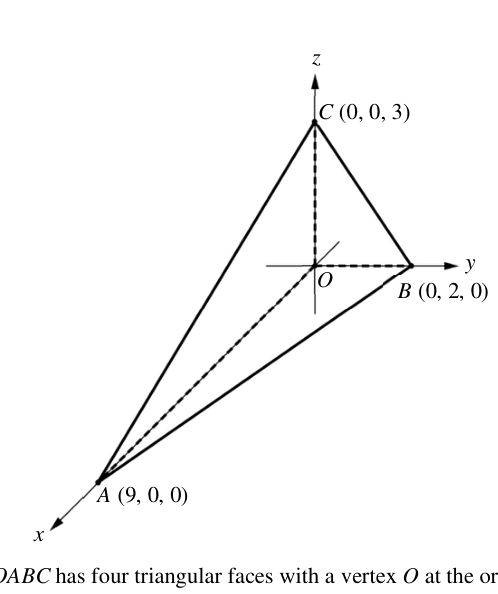
A tetrahedron OABCOABC has four triangular faces with a vertex OO at the origin. The coordinates of AA, BB and CC are (9,0,0)(9, 0, 0), (0,2,0)(0, 2, 0) and (0,0,3)(0, 0, 3) respectively (see diagram).

  1. (a)

    Find a cartesian equation of face ABCABC.

  2. (b)

    Find the acute angle between face ABCABC and the zz-axis.

  3. (c)

    Find the coordinates of the foot of perpendicular from OO to face ABCABC.

  4. (d)

    The line ss passes through OO and the midpoint of ACAC. Show that a vector equation of the of reflection of ss in face ABCABC, is r=(92032)+μ(a−216−23)\mathbf{r} = \begin{pmatrix} \frac{9}{2} \\ 0 \\ \frac{3}{2} \end{pmatrix} + \mu \begin{pmatrix} a \\ -216 \\ -23 \end{pmatrix} where aa is a constant to be determined.

Work through it with AI →

It won't just hand you the answer — it asks where you're stuck.How the checker works

Worked solution

8(a)

1. Find two non-parallel direction vectors lying on the plane.

AB⃗=OB⃗−OA⃗=(020)−(900)=(−920)\vec{AB} = \vec{OB} - \vec{OA} = \begin{pmatrix} 0 \\ 2 \\ 0 \end{pmatrix} - \begin{pmatrix} 9 \\ 0 \\ 0 \end{pmatrix} = \begin{pmatrix} -9 \\ 2 \\ 0 \end{pmatrix}

AC⃗=OC⃗−OA⃗=(003)−(900)=(−903)\vec{AC} = \vec{OC} - \vec{OA} = \begin{pmatrix} 0 \\ 0 \\ 3 \end{pmatrix} - \begin{pmatrix} 9 \\ 0 \\ 0 \end{pmatrix} = \begin{pmatrix} -9 \\ 0 \\ 3 \end{pmatrix}

2. Calculate the cross product to find a normal vector to the plane.

n=AB⃗×AC⃗=(−920)×(−903)=((2)(3)−(0)(0)(0)(−9)−(−9)(3)(−9)(0)−(2)(−9))=(62718)\mathbf{n} = \vec{AB} \times \vec{AC} = \begin{pmatrix} -9 \\ 2 \\ 0 \end{pmatrix} \times \begin{pmatrix} -9 \\ 0 \\ 3 \end{pmatrix} = \begin{pmatrix} (2)(3) - (0)(0) \\ (0)(-9) - (-9)(3) \\ (-9)(0) - (2)(-9) \end{pmatrix} = \begin{pmatrix} 6 \\ 27 \\ 18 \end{pmatrix}

We can take a simpler normal vector by dividing by 33:
n1=(296)\mathbf{n}_1 = \begin{pmatrix} 2 \\ 9 \\ 6 \end{pmatrix}

3. Form the cartesian equation of the plane using the normal vector and a point on the plane.

Using point A(9,0,0)A(9, 0, 0) and the normal vector n1\mathbf{n}_1:
r⋅n1=OA⃗⋅n1\mathbf{r} \cdot \mathbf{n}_1 = \vec{OA} \cdot \mathbf{n}_1
(xyz)⋅(296)=(900)⋅(296)\begin{pmatrix} x \\ y \\ z \end{pmatrix} \cdot \begin{pmatrix} 2 \\ 9 \\ 6 \end{pmatrix} = \begin{pmatrix} 9 \\ 0 \\ 0 \end{pmatrix} \cdot \begin{pmatrix} 2 \\ 9 \\ 6 \end{pmatrix}
2x+9y+6z=182x + 9y + 6z = 18

Answer

2x+9y+6z=182x + 9y + 6z = 18

8(b)

1. Find the normal vector to face $ABC$ by deriving its Cartesian equation from its axial intercepts (as required from part a).

The plane intercepts the coordinate axes at x=9x=9, y=2y=2, and z=3z=3.
The Cartesian equation using the intercept form is:
x9+y2+z3=1\frac{x}{9} + \frac{y}{2} + \frac{z}{3} = 1
Multiplying by 1818 gives:
2x+9y+6z=182x + 9y + 6z = 18
Thus, the normal vector to the plane is n=(296)\mathbf{n} = \begin{pmatrix} 2 \\ 9 \\ 6 \end{pmatrix}.

2. Calculate the acute angle between the $z$-axis and face $ABC$.

The direction vector of the zz-axis is k=(001)\mathbf{k} = \begin{pmatrix} 0 \\ 0 \\ 1 \end{pmatrix}.
Let the acute angle between the zz-axis and the plane be θ\theta. Using the relation between the plane's normal and the line's direction vector:
sin⁡θ=∣n⋅k∣∣n∣ ∣k∣\sin \theta = \frac{|\mathbf{n} \cdot \mathbf{k}|}{|\mathbf{n}|\,|\mathbf{k}|}
sin⁡θ=∣(296)⋅(001)∣22+92+6202+02+12\sin \theta = \frac{\left| \begin{pmatrix} 2 \\ 9 \\ 6 \end{pmatrix} \cdot \begin{pmatrix} 0 \\ 0 \\ 1 \end{pmatrix} \right|}{\sqrt{2^2 + 9^2 + 6^2} \sqrt{0^2 + 0^2 + 1^2}}
sin⁡θ=6121(1)=611\sin \theta = \frac{6}{\sqrt{121} (1)} = \frac{6}{11}
θ=sin⁡−1(611)≈33.1∘ (to 1 d.p.)\theta = \sin^{-1}\left(\frac{6}{11}\right) \approx 33.1^\circ \text{ (to 1 d.p.)}

Answer

33.1∘33.1^\circ

8(c)

1. Formulate the equation of the perpendicular line from $O$ to the plane $ABC$.

From part (a), using the intercepts, the cartesian equation of the plane ABCABC is x9+y2+z3=1  ⟹  2x+9y+6z=18\frac{x}{9} + \frac{y}{2} + \frac{z}{3} = 1 \implies 2x + 9y + 6z = 18.
The normal vector to the plane is n=(296)\mathbf{n} = \begin{pmatrix} 2 \\ 9 \\ 6 \end{pmatrix}.
The line passing through the origin OO perpendicular to the plane has equation r=λ(296)\mathbf{r} = \lambda \begin{pmatrix} 2 \\ 9 \\ 6 \end{pmatrix}.

2. Substitute the line equation into the plane equation to find the foot of the perpendicular.

Let the foot of the perpendicular be FF. Then OF⃗=λ(296)\vec{OF} = \lambda \begin{pmatrix} 2 \\ 9 \\ 6 \end{pmatrix}.
Substituting this into the plane's equation to find the intersection point:
2(2λ)+9(9λ)+6(6λ)=182(2\lambda) + 9(9\lambda) + 6(6\lambda) = 18
λ(4+81+36)=18\lambda(4 + 81 + 36) = 18
121λ=18  ⟹  λ=18121121\lambda = 18 \implies \lambda = \frac{18}{121}
Hence, OF⃗=18121(296)=(36121162121108121)\vec{OF} = \frac{18}{121} \begin{pmatrix} 2 \\ 9 \\ 6 \end{pmatrix} = \begin{pmatrix} \frac{36}{121} \\ \frac{162}{121} \\ \frac{108}{121} \end{pmatrix}.

Answer

(36121,162121,108121)\left( \frac{36}{121}, \frac{162}{121}, \frac{108}{121} \right)

8(d)

1. Find the position vector of $O'$, the reflection of $O$ in face $ABC$.

From part (c), the coordinates of FF, the foot of the perpendicular from OO to face ABCABC, are (36121,162121,108121)\left(\frac{36}{121}, \frac{162}{121}, \frac{108}{121}\right).
Since FF is the midpoint of OO and its reflection O′O', we have:
OO′⃗=2OF⃗=2(36/121162/121108/121)=(72/121324/121216/121)\vec{OO'} = 2\vec{OF} = 2 \begin{pmatrix} 36/121 \\ 162/121 \\ 108/121 \end{pmatrix} = \begin{pmatrix} 72/121 \\ 324/121 \\ 216/121 \end{pmatrix}

2. Find the midpoint $M$ of $AC$ and recognize its role in the reflection.

The line ss passes through OO and the midpoint of ACAC. Let this midpoint be MM.
OM⃗=12(OA⃗+OC⃗)=12[(900)+(003)]=(9/203/2)\vec{OM} = \frac{1}{2}(\vec{OA} + \vec{OC}) = \frac{1}{2} \left[ \begin{pmatrix} 9 \\ 0 \\ 0 \end{pmatrix} + \begin{pmatrix} 0 \\ 0 \\ 3 \end{pmatrix} \right] = \begin{pmatrix} 9/2 \\ 0 \\ 3/2 \end{pmatrix}
Since MM lies on the line segment ACAC, it is on the plane ABCABC. Therefore, MM is its own reflection in the plane. The reflected line must therefore pass through O′O' and MM.

3. Determine the direction vector of the reflected line and find the value of $a$.

The direction vector of the reflected line is:
O′M⃗=OM⃗−OO′⃗=(9/203/2)−(72/121324/121216/121)=(945/242−648/242−69/242)\vec{O'M} = \vec{OM} - \vec{OO'} = \begin{pmatrix} 9/2 \\ 0 \\ 3/2 \end{pmatrix} - \begin{pmatrix} 72/121 \\ 324/121 \\ 216/121 \end{pmatrix} = \begin{pmatrix} 945/242 \\ -648/242 \\ -69/242 \end{pmatrix}
Factoring out the scalar 3242\frac{3}{242} to match the integer components given in the question:
O′M⃗=3242(315−216−23)\vec{O'M} = \frac{3}{242} \begin{pmatrix} 315 \\ -216 \\ -23 \end{pmatrix}
Using OM⃗\vec{OM} as the position vector and (315−216−23)\begin{pmatrix} 315 \\ -216 \\ -23 \end{pmatrix} as the direction vector, the equation of the reflected line is:
r=(9/203/2)+μ(315−216−23)\mathbf{r} = \begin{pmatrix} 9/2 \\ 0 \\ 3/2 \end{pmatrix} + \mu \begin{pmatrix} 315 \\ -216 \\ -23 \end{pmatrix}
Comparing this with the given equation r=(9/203/2)+μ(a−216−23)\mathbf{r} = \begin{pmatrix} 9/2 \\ 0 \\ 3/2 \end{pmatrix} + \mu \begin{pmatrix} a \\ -216 \\ -23 \end{pmatrix}, we obtain a=315a = 315.

Answer

a=315a = 315

AI analysis — may contain mistakes.

Worked this one out on paper? Snap your steps and Gigle's AI math checker will circle the step where it went wrong.

More questions on this topic

  1. 1The lines l1l_1 and l2l_2 have equations r=(4110)+λ(1−1−6),λ∈R\mathbf{r} = \begin{pmatrix} 4 \\ 1 \\ 10 \end{pmatrix} + \lambda \begin{pmatrix} 1 \\ -1 \\ -6 \end{pmatrix}, \lambda \in \mathbb{R}…
  2. 2A drilling company plans to install a straight pipeline ABAB through a mountain. Points (x,y,z)(x, y, z) are defined relative…
  3. 3A plane Π1\Pi_1 has equation x+y+z=3x + y + z = 3. A line passes through the points PP and QQ with position vectors i+j+2k\mathbf{i} + \mathbf{j} + 2\mathbf{k}…
  4. 4The planes Π1\Pi_1 and Π2\Pi_2 have vector equations r=λ1(i+j−k)+μ1(2i−j+k)andr=λ2(i+2j+k)+μ2(3i+j−k)\mathbf{r} = \lambda_1(\mathbf{i} + \mathbf{j} - \mathbf{k}) + \mu_1(2\mathbf{i} - \mathbf{j} + \mathbf{k}) \quad \text{and} \quad \mathbf{r} = \lambda_2(\mathbf{i} + 2\mathbf{j} + \mathbf{k}) + \mu_2(3\mathbf{i} + \mathbf{j} - \mathbf{k})…
  5. 5A home interior designer is looking to design a pull-down wardrobe lift. To test his concept, the designer built a small…